
7 Costly Window Replacement Myths Pensacola Homeowners Should Ignore in 2026
- ECWA

- Mar 7
- 14 min read
Updated: Mar 18
What if the "money-saving" advice you’ve heard about your windows is actually the biggest threat to your Pensacola home? It's a frustrating position to be in. You’re watching your FPL bill climb higher every summer, you're hearing conflicting advice from different contractors, and every tropical storm forecast brings a fresh wave of anxiety about your home's first line of defense. With so much noise, it’s easy to delay a decision or, even worse, make the wrong one based on outdated information.
That kind of persistent stress can take a toll on anyone's well-being. If you're looking for ways to manage anxiety that goes beyond home repairs, you can find out more about professional support options.
We believe protecting your Emerald Coast home shouldn't be a guessing game. That’s why we’re exposing the seven most costly window replacement myths that can lead to catastrophic failure during a hurricane and cost you thousands in energy waste. In the next few minutes, we will provide clear, Florida-proven facts on impact resistance, energy ratings, and the latest 2026 building codes, empowering you to secure your home with confidence.
Key Takeaways
Discover why generic window advice often fails on the Emerald Coast and how to select windows truly engineered for Pensacola's hurricane-prone climate.
Debunk common window replacement myths to understand why impact glass provides more reliable, 24/7 protection for your home's structural integrity than shutters alone.
Learn to look past marketing buzzwords and identify the specific material qualities that ensure a window's long-term durability against Florida's intense sun and salt air.
Calculate the true return on investment for your project by leveraging significant energy savings and financial assistance from the "My Safe Florida Home" grant program.
Table of Contents The "National Advice" Trap: Why Pensacola Window Myths Are Different Myth #1: "Hurricane Shutters Offer the Same Protection as Impact Windows" Myth #2: "All Vinyl Windows Are Created Equal" Myth #3: "Window Replacement is a DIY Weekend Project" The Truth About ROI: Making Window Replacement Affordable in 2026
The "National Advice" Trap: Why Pensacola Window Myths Are Different
You can find window replacement advice anywhere on the internet. The problem? Most of it is written for homeowners in Ohio or Colorado, where a bitter winter is the biggest threat. That advice is not just unhelpful here; it's dangerous. One of the most persistent window replacement myths is that a good window is a good window, regardless of location. This is simply untrue for anyone living on the Emerald Coast.
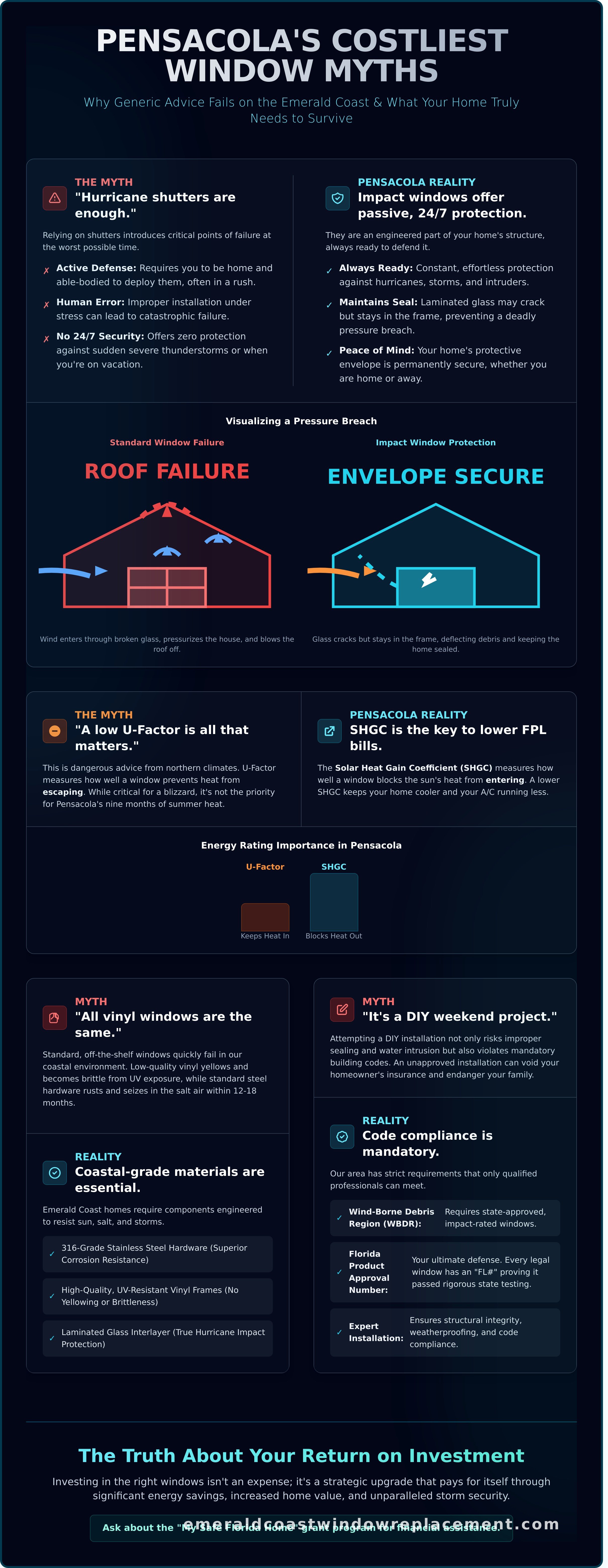
What qualifies as "energy efficient" in a northern climate, where the goal is to keep heat in, is the opposite of what your Pensacola home needs. A window's U-Factor measures its ability to prevent heat loss, which is critical for surviving a blizzard but far less important for our mild winters. Here, the key metric is the Solar Heat Gain Coefficient (SHGC), which measures how well a window blocks the sun's heat from entering your home. A low SHGC keeps your home cooler and your FPL bill down during our nine months of summer. National retailers often push generic advice that ignores this fundamental difference, leaving local homeowners with windows that fight against their air conditioner.
The High Stakes of Coastal Living
Living in paradise comes with a unique set of challenges that generic windows are not built to handle. The salty, humid air in Pensacola Beach and Gulf Breeze is relentlessly corrosive. Standard steel screws and hardware can show rust within 12-18 months, leading to operational failure. Our coastal-grade windows use 316-grade stainless steel hardware for its superior corrosion resistance. Likewise, the intense, year-round UV exposure can cause low-quality vinyl frames to yellow and become brittle in as little as five years. Finally, a standard "double-pane" window offers zero protection from storm debris. True hurricane-rated windows feature a laminated glass interlayer, similar to a car's windshield, designed to withstand impacts and keep the storm outside your home. While many homeowners rely on deployable Hurricane Shutters, impact windows provide effortless, 24/7 protection that is built directly into your home's structure.
Regulatory Reality Check
Many "optional" features discussed in national articles are mandatory here. The Florida Building Code designates our area as a Wind-Borne Debris Region (WBDR), particularly for homes within one mile of the coast or in other high-risk zones. This means that if you're replacing windows, they must be impact-rated to meet code. The enforcement can even vary by location; a project in coastal Navarre will face stricter scrutiny than one in northern Pace or Milton. This is why a local expert's guidance is invaluable. The ultimate defense against misleading sales tactics is the Florida Product Approval number. Every window legally sold for installation in Florida has an approval number (e.g., FL#12345) verifying it has passed the state's rigorous testing protocols. If a salesperson can't provide this number, their product is not approved for your home. It’s that simple. These local codes and environmental realities are why so many common window replacement myths fall apart on the Emerald Coast.
Myth #1: "Hurricane Shutters Offer the Same Protection as Impact Windows"
For many Pensacola homeowners, hurricane shutters seem like a practical line of defense. They are a familiar sight across the Emerald Coast. Yet, relying on them as a complete solution is one of the most dangerous window replacement myths we encounter. The critical difference lies in one concept: active versus passive protection. Shutters are an active defense; they require you to be home, able-bodied, and with enough advance warning to deploy them correctly. This introduces human error into your family's safety equation.
Impact windows provide passive, 24/7 protection. They are always ready. You don't have to rush home from a vacation or struggle with heavy panels as a storm bears down. This constant state of readiness eliminates the single biggest point of failure in most home storm plans: the last-minute scramble. Your home's protective envelope is permanently sealed and secure, offering true peace of mind whether you're facing a hurricane, a severe thunderstorm, or just a typical Tuesday.
The Physics of a Pressure Breach
A single broken window is all it takes for a storm to invade your home. Once breached, wind speeds of over 100 mph create a catastrophic pressure change inside. This is because impact windows use laminated glass, which may crack but stays intact within its frame, while standard tempered glass shatters completely. Internal pressurization occurs when high-velocity wind enters a home through a breach, creating an upward force on the roof that can lead to total structural failure.
Cost vs. Convenience
The argument for shutters often centers on cost, but this overlooks the total value equation. Emergency plywood board-ups are a dangerous, last-resort fix, not a strategy. True impact windows, however, deliver immediate financial returns. Many Florida insurance carriers offer premium credits of up to 45% for homes with complete impact window protection. Furthermore, as this comprehensive Department of Energy guide explains, modern windows significantly cut energy costs. In the Pensacola real estate market, a home listed as "impact-rated" commands a higher price and spends less time on the market than one that is merely "shutter-ready."
Beyond hurricane season, the benefits of impact windows transform your daily life. Here’s how:
Uncompromising Security: The same technology that stops flying debris also deters intruders. The tough polymer interlayer in impact glass makes it incredibly difficult for a burglar to break through, providing a powerful deterrent against forced entry year-round.
A Quieter Home: The laminated glass and robust framing materials used in impact windows are exceptional at dampening sound. Homeowners often report a 30-35% reduction in outside noise, turning a busy street into a quiet sanctuary.
Pest Prevention: A properly sealed window not only keeps out drafts and burglars but also common household pests. For comprehensive protection against infestations that find other ways in, many homeowners rely on specialists like Mosquito Assassin Pest Control LLC.
Believing that shutters offer equivalent protection is a critical misunderstanding of storm dynamics and home safety. Impact windows are not just a storm product; they are a complete upgrade to your home's security, efficiency, and comfort. Understanding the real-world performance of modern windows is the first step. Let's evaluate your home's hurricane readiness with a no-obligation consultation.
Myth #2: "All Vinyl Windows Are Created Equal"
This is one of the most persistent and costly window replacement myths circulating among Pensacola homeowners. The idea that a vinyl window is just a vinyl window couldn't be further from the truth. The bargain-bin window from a big-box store and a precision-engineered frame from a dedicated manufacturer are worlds apart, especially here on the Emerald Coast where sun, salt, and humidity are relentless.
Many companies tout "100% virgin vinyl" as a mark of quality. While it simply means the PVC compound doesn't contain recycled materials, it says nothing about the window's ability to survive a Florida summer. The real indicator of durability is the chemical formula. High-performance vinyl contains crucial additives like Titanium Dioxide (TiO2), which acts as a powerful UV stabilizer. Without a sufficient amount of TiO2, a vinyl frame will yellow, chalk, and become brittle under constant sun exposure. Quality frames are formulated to withstand the test of time, not just the first year.
What about the old story that vinyl frames warp or shrink in the heat? This is only true for inferior products. Modern, well-engineered vinyl is specifically designed for thermal stability. It will not bow, sag, or shrink, even when facing the direct afternoon sun that can push surface temperatures well above 120°F. When compared to aluminum, which readily conducts heat and corrodes aggressively in our salt-spray environment, a properly formulated vinyl window offers superior energy efficiency and coastal durability. It simply stands up to the demands of our region better.
The Anatomy of a High-Performance Frame
The difference is in the details you can't see. A superior vinyl frame features multi-chambered construction, creating internal air pockets that act as an insulator to block heat transfer. The corners are fusion-welded, not mechanically screwed together, forming a single, impenetrable unit that prevents air and water leaks. These frames are built to meet or exceed standards like ASTM D4726-02, which specifically tests for color retention and weathering resistance, ensuring your windows look new for years.
Thermal Performance Myths
Navigating energy ratings can be confusing, but for Pensacola, one number matters most. While U-Factor measures insulation (crucial for cold climates), the Solar Heat Gain Coefficient (SHGC) is king here. It measures how much solar heat a window blocks. You want a low SHGC, ideally 0.25 or less, to keep your home cool and your AC bills down. This is achieved with Low-E coatings specifically formulated for southern climates; more layers aren't better if they're designed to keep heat in. And yes, the argon gas used for insulation can leak, but quality windows with modern dual-seal technology have a leak rate of less than 1% per year, meaning they retain over 80% of their insulating gas even after 20 years.
Myth #3: "Window Replacement is a DIY Weekend Project"
The allure of a weekend DIY project is strong, especially with countless online tutorials making complex tasks look simple. However, believing that replacing windows in a Pensacola home is a simple "out with the old, in with the new" job is one of the most dangerous window replacement myths. Our coastal environment, unique construction methods, and stringent building codes create a high-stakes scenario where a small mistake can lead to catastrophic failure.
Most homes in our area are built with concrete block (CBS) construction, which requires a specialized installation into what’s known as a "bucket opening." This isn't a simple wood frame. It's a concrete and masonry void that demands precise preparation, waterproofing, and anchoring. An improper installation here doesn't just mean a drafty window; it means compromising the structural integrity of the opening itself. The Florida Building Code, updated as recently as 2023, has specific requirements for how a window must be secured to withstand hurricane-force winds, and these techniques are far beyond the scope of a typical DIY guide.
Even more critical is the waterproofing, or "flashing," process. In Pensacola's humid, subtropical climate, where we average over 65 inches of rain annually, any gap or flaw in the waterproof membrane becomes a direct channel for moisture. Water gets trapped behind your interior walls, and with our humidity levels often exceeding 75%, it’s a perfect breeding ground for aggressive mold growth. This isn't a minor issue; it's a silent disaster that can require tens of thousands of dollars in remediation. Furthermore, nearly every reputable window manufacturer, from PGT to Andersen, will void their comprehensive product warranties if the unit is not installed by a licensed and certified professional. Your DIY project to save money could cost you the entire investment.
This concern over moisture and mold isn't limited to what's behind the walls. Keeping your home's exterior surfaces clean is just as important for preventing long-term damage from algae and mildew. For homeowners across the state, hiring a professional service like Warrens Power Washing is a key step in maintaining their property's integrity and curb appeal.
Finally, there's the "Permit Myth." Let's be clear: you absolutely need a permit to replace windows in both Escambia and Santa Rosa Counties. This isn't optional paperwork. It’s a legal requirement that ensures the installation meets life-safety codes designed to protect your family during a hurricane. Failing to pull a permit can result in fines, problems selling your home, and denial of insurance claims after a storm.
The Precision of the Seal
In our region, "close enough" is never good enough. A window measured just 1/4 inch too small will create gaps that cause loud whistling during Gulf storms and allow air and water intrusion. Heavy, impact-resistant windows require precise structural shimming to distribute their weight correctly within the opening, preventing sagging and operational failure. Remember, caulk is a weather sealant, not a structural component; it cannot compensate for poor measurements or an improper fit.
This principle holds true for other high-impact home renovations where precision is key. For example, homeowners in other parts of the country rely on specialized contractors for services like Cabinet Refinishing Boulder to achieve a flawless, durable result that a general painter often can't replicate.
Vetting Local Professionals
There's a vast difference between a general handyman and a licensed Florida glazing contractor. A licensed professional carries the proper insurance, is an expert in the Florida Building Code, and can provide engineered "wind load" calculations that prove your new windows meet the specific pressure requirements for your home's location. This is a critical document you should always ask to see. This level of expertise is exactly why Emerald Coast Window Authority only connects homeowners with fully vetted, licensed, and insured local specialists.
Protecting your home from the elements is too important to leave to chance. This isn't just another home improvement task; it’s a critical upgrade for your family’s safety and peace of mind. Connect with a certified Pensacola installer to ensure your project is done right, the first time.
The Truth About ROI: Making Window Replacement Affordable in 2026
One of the most persistent window replacement myths revolves around cost. Many Pensacola homeowners believe that upgrading their windows is an unaffordable luxury, a project to be pushed years down the road. The reality is that modern financial incentives have completely changed the math. When you look beyond the initial price tag, a window replacement project in 2026 is one of the smartest investments you can make in your home's safety, value, and efficiency.
The upfront cost is no longer the whole story. Thanks to powerful state and federal programs, the net investment is often significantly lower than homeowners expect. These aren't small rebates; they are substantial programs designed to make homes more resilient and efficient. Consider the financial tools now available:
My Safe Florida Home Grant: This state-level program provides eligible homeowners with up to $10,000 to harden their homes against hurricanes. Replacing old, vulnerable windows with modern, impact-resistant models is a primary qualifying improvement.
Federal Tax Credits: The Energy Efficient Home Improvement Credit (25C) allows you to claim a tax credit for 30% of the cost of new, energy-efficient windows, up to $600 annually. This is a direct, dollar-for-dollar reduction of your tax liability.
Beyond these direct savings, you'll discover an "invisible profit" every month. Old, single-pane windows are a major source of heat gain, forcing your air conditioner to work overtime. New, energy-efficient windows with low U-factors are precision-engineered to block solar heat, which can slash your FPL or Gulf Power cooling bills by 15-25% during our long, hot summers. This ongoing return transforms your windows from an expense into a powerful, money-saving asset.
Local Financial Incentives
The savings don't stop at grants and tax credits. Installing impact-rated windows qualifies your home for a wind mitigation inspection. A favorable report from this inspection can trigger a homeowners insurance premium discount of 20-30%. Many Pensacola homeowners find that these insurance savings, combined with their monthly energy savings, effectively pay for the windows over time. Reputable local installers also offer honest financing options, but be wary of the "zero-down" myth; always read the contract to understand interest rates and terms.
Your Next Steps to a Protected Home
The best way to understand your true cost and potential savings is to get a neutral, third-party estimate without any high-pressure sales tactics. Using a trusted referral service allows you to compare quotes from top-rated local contractors, ensuring you get Florida-proven quality at a fair price. Protect your home and your budget by getting the facts. Request your free Pensacola window estimate today.
Secure Your Emerald Coast Home with Clarity and Confidence
In 2026, protecting your Pensacola property means cutting through the noise. We've seen how relying on shutters alone leaves your home's envelope vulnerable and how the wrong vinyl window can warp and fail in our salty, humid air. Falling for these common window replacement myths doesn't just cost you money; it compromises your family's safety when a storm is brewing offshore.
Making the right investment starts with trusted, local guidance. As a locally owned advisory service for Escambia and Santa Rosa Counties, we provide exclusive access to licensed, hurricane-zone certified contractors who install high-performance, Florida-proven window systems. We eliminate the guesswork so you can make a confident choice. Ready to secure your home with precision-engineered windows built for the coast?
Invest in lasting protection and the peace of mind your family deserves for years to come.
Frequently Asked Questions About Window Replacement
Do I really need impact windows if I live in Milton or Pace, FL?
Yes, you absolutely need impact windows for your home's protection. Hurricane Sally in 2020 demonstrated that destructive winds and debris travel miles inland, causing extensive damage in communities like Milton and Pace. A storm's power doesn't stop at the coastline. Installing impact-rated windows is a critical safety investment for any homeowner in the Florida Panhandle who wants true peace of mind when a storm is in the forecast.
What is the "My Safe Florida Home" program, and can I still apply in 2026?
The "My Safe Florida Home" program provides state grants for home hardening, but its future funding is determined annually by the Florida Legislature. While the program received new funding in the 2024 legislative session, its availability in 2026 is not guaranteed. We advise homeowners to act when a funding cycle is open, as the program's status can change from year to year based on legislative decisions and available funds.
How long does the average window replacement take in the Pensacola area?
A standard, full-home window replacement for a house with 10 to 15 windows typically takes our professional installation crew just 2 to 3 days. We pride ourselves on a seamless and efficient process designed to minimize disruption to your life. Our team provides a clear, upfront timeline before we begin, ensuring you know exactly what to expect and when your home will be fully secured.
Can I replace just the glass, or do I need to replace the entire window frame?
In almost all cases, you need to replace the entire window unit. Modern windows are an integrated system where the frame, sash, and glass work together for energy efficiency and impact resistance. Replacing only the glass in an older frame compromises the structural integrity, voids warranties, and fails to meet Florida's stringent building codes. A full replacement is the only way to guarantee performance and protection.
Is it true that vinyl windows will melt or warp in the Florida sun?
No, that is one of the most common and outdated window replacement myths. Our high-performance vinyl windows are precision-engineered with advanced UV inhibitors specifically for the intense Florida climate. They are tested to withstand surface temperatures exceeding 140°F without warping, fading, or cracking. These Florida-proven frames are built for coastal durability, ensuring they stand up to decades of sun, heat, and salt air.
How much can I actually save on my insurance by installing hurricane-rated windows?
You can achieve significant savings on your homeowner's insurance premium. After installing Florida Building Code (FBC) approved impact windows, homeowners in our area report premium reductions of up to 45%. The final amount depends on your insurance carrier and requires a certified wind mitigation inspection to verify the upgrades. This investment protects not only your home but also your budget for years to come.
What is the difference between a hurricane-rated window and an impact-resistant window?
The terms are often used interchangeably, but "impact-resistant" is the more precise description. An impact-resistant window features a laminated glass interlayer that holds the glass together even if shattered by debris. "Hurricane-rated" signifies that the entire window assembly, including the frame and hardware, has passed the rigorous tests for wind pressure and debris impact required by the Florida Building Code (FBC). We ensure every window we install meets these exacting standards.
Will new windows actually stop the noise from Highway 98 or NAS Pensacola?
Yes, new impact windows provide a dramatic reduction in outside noise. The laminated glass and multi-chambered frames are incredibly effective at dampening sound vibrations, capable of reducing perceived noise levels by up to 50%. For homeowners living near Highway 98 or under the flight paths of NAS Pensacola, the newfound peace and quiet inside is one of the most immediate and appreciated benefits of their new windows.


Comments