
Coastal Window Maintenance in Pensacola, FL: The Complete 2026 Guide
- ECWA

- Mar 16
- 14 min read
Last Tuesday, a homeowner in East Hill tried to open her master bedroom window to catch a rare June breeze, only to find the sash frozen shut by a year of accumulated salt spray. It's a frustrating reality for many of the 54,000 residents in Pensacola where the Gulf air is as corrosive as it is beautiful. Proper coastal window maintenance isn't just about curb appeal; it's the difference between a functional home and a total hardware failure during a sudden storm.
You've likely felt that same pulse of anxiety when a tropical depression forms in the Gulf, wondering if your high-cost impact windows will actually perform when wind speeds hit 110 miles per hour. It's exhausting to scrub at that stubborn white crust only to have the glass look cloudy again by sunset. We've developed a professional Pensacola window care strategy that protects your investment and ensures your hardware glides open with a single finger. This 2026 guide reveals the exact steps to neutralize salt damage, maintain hurricane readiness, and keep your views of the Emerald Coast crystal clear for the next 20 years.
Key Takeaways
Understand why homes in the Pensacola "Salt Spray Zone" require four times more attention than inland properties to prevent permanent salt damage.
Learn how to identify glass pitting and frame oxidation before these coastal elements compromise your home’s curb appeal and structural integrity.
Master an expert-backed coastal window maintenance routine designed to safely dissolve salt crusts and preserve your view of the Gulf.
Determine if your current windows are savable or if upgrading to 2026 impact standards is the best investment for your home’s safety and value.
Discover the vital differences between DIY care and professional deep-track cleaning for ensuring long-term hurricane readiness and peace of mind.
Table of Contents Why Coastal Window Maintenance is Critical for Pensacola Homeowners Combating Salt Corrosion and Glass Pitting in the Florida Panhandle Maintenance vs. Replacement: Evaluating Your Emerald Coast Windows The Ultimate Pensacola Coastal Window Care Routine Protecting Your Investment with Professional Guidance
Why Coastal Window Maintenance is Critical for Pensacola Homeowners
Living on the Emerald Coast offers unparalleled views, but those vistas come with a hidden price. For homeowners in Gulf Breeze and Pensacola Beach, coastal window maintenance is a specialized preservation process designed for salt-heavy atmospheres. It isn't just about aesthetics; it's a rigorous defense strategy for your home's most vulnerable points. In the Florida Panhandle, standard cleaning routines fail because they don't account for the unique chemistry of our environment.
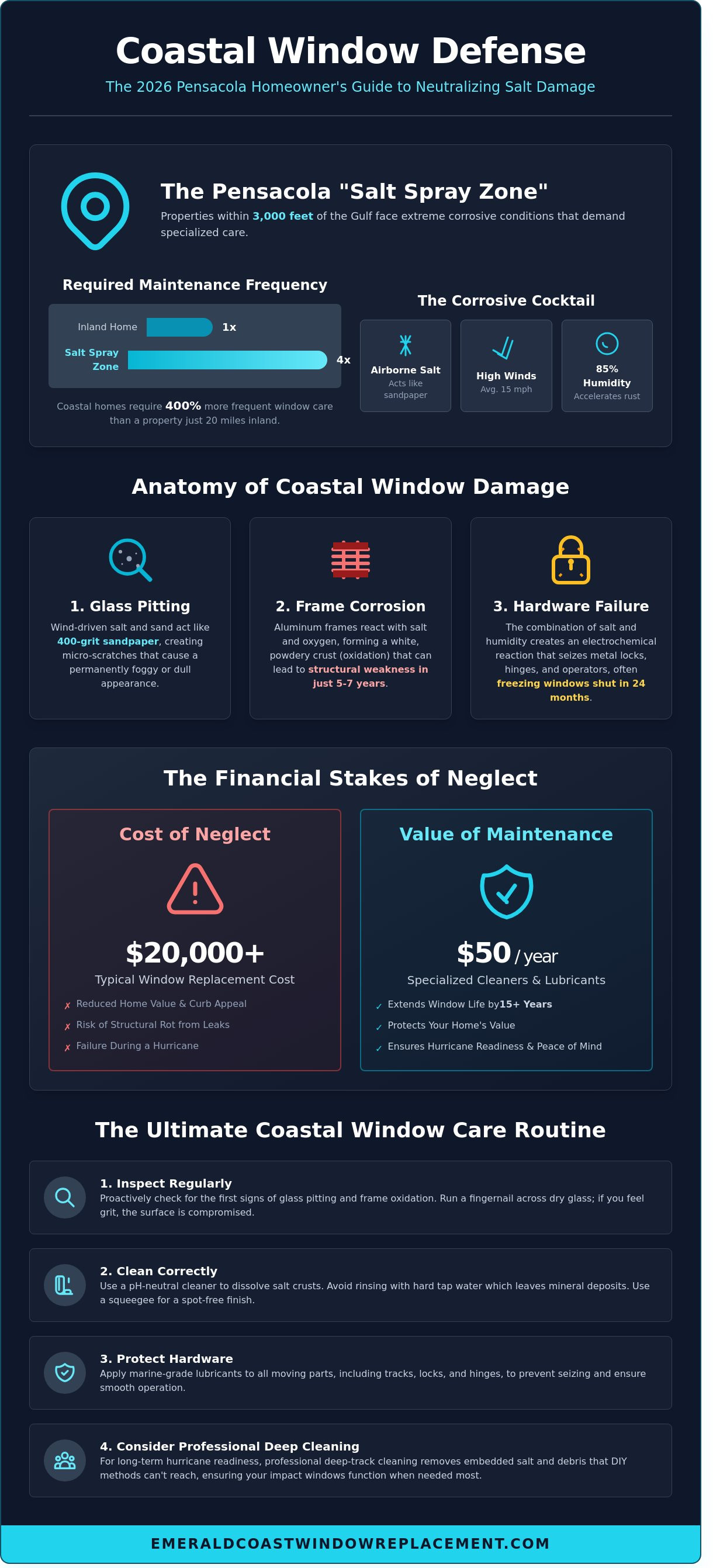
If your property sits within the "Salt Spray Zone," which includes any home within 3,000 feet of the Gulf of Mexico, your windows face extreme conditions every hour. A home on Pensacola Beach requires 400% more frequent care than a property located just twenty miles inland in Milton. Salt doesn't simply sit on the surface. It migrates into tracks and settles into hardware, causing mechanical failure long before the glass itself wears out.
The financial stakes of neglect are high. A high-quality window replacement for a standard Gulf Breeze home can easily exceed $20,000. Spending roughly $50 a year on specialized pH-neutral cleaners and marine-grade lubricants prevents hardware from seizing. This minor investment can extend the functional life of your windows by 15 years or more. As your Local Guardian, we view these efforts as essential to protecting the Emerald Coast lifestyle you've worked hard to build.
The Invisible Threat: Salt Air and Escambia County Humidity
Salt crystals are tiny, jagged minerals that act like 400-grit sandpaper when wind blows them against your glass. Over time, these crystals create micro-scratches that make your windows look perpetually foggy. High humidity in Escambia County acts as a catalyst for damage. When moisture mixes with salt, it triggers the natural process of corrosion on metal locks, hinges, and operators. This electrochemical reaction can freeze a window shut in as little as 24 months. The reality is that "set it and forget it" windows don't exist in our tropical climate.
The Impact on Home Value and Curb Appeal
Curb appeal is a primary driver of property value in communities like Gulf Breeze. Cloudy, pitted glass signals a lack of maintenance to potential buyers and inspectors alike. It often suggests that if the windows are neglected, other critical systems like the HVAC or roofing might be failing too. Maintaining crystal-clear views is vital for preserving that signature Emerald Coast charm. Beyond the visual appeal, window health is tied directly to the building envelope. Corroded seals allow moisture to seep into the wall cavity, which leads to structural rot that costs thousands to remediate. Consistent coastal window maintenance ensures your home remains a sealed, efficient sanctuary against the elements.
Combating Salt Corrosion and Glass Pitting in the Florida Panhandle
Living in Gulf Breeze means dealing with a constant barrage of salt spray and fine quartz sand. While these elements make our beaches world-class, they're relentless on standard window glass. Glass pitting occurs when wind speeds, which average 15 mph in our region, drive microscopic salt crystals and sand particles against the pane. This creates tiny, jagged abrasions that catch the light and make your windows look permanently dull. Once this "etching" happens, no amount of scrubbing will restore the clarity. You can identify etched glass by running a fingernail across a dry pane; if you feel a consistent "grit" that doesn't move, the surface integrity is compromised.
The frame material you choose determines how your home handles the 85% average humidity of the Emerald Coast. Aluminum frames are prone to oxidation, a process where the metal reacts with salt and oxygen to form a white, powdery crust. This research on atmospheric corrosion highlights how marine environments accelerate the breakdown of metal surfaces, often leading to structural weakness in just 5 to 7 years. Modern vinyl windows offer a superior alternative. High-quality vinyl is chemically inert, meaning it won't oxidize or peel when exposed to the heavy salt air found along Highway 98.
Local water quality adds another layer of difficulty to coastal window maintenance. Groundwater in the Florida Panhandle often contains 120 to 180 parts per million of dissolved minerals. When you rinse your windows with a garden hose to remove salt, this hard water evaporates and leaves behind calcium deposits. These minerals bond with the salt residue to create a "crust" that is significantly harder to remove than salt alone. We recommend using a squeegee and distilled water for the final rinse to prevent these stubborn spots from forming.
Protecting Your Window Hardware and Moving Parts
Salt air doesn't just sit on the glass; it migrates into the tracks and balances. You should apply a high-quality vinyl window lube or a marine-grade silicone spray to all moving parts every six months. This prevents the "frozen" locks and gritty sliding action common in older Pensacola homes. Check your weep holes-the small drainage slots at the bottom of the frame-for clogs. If sand and salt block these, water will back up and cause internal frame rot. Identifying these issues now is vital before the 110 mph winds of a tropical storm put your hardware to the ultimate test.
Seal Integrity and Thermal Performance
The rubber weatherstripping on your windows is the primary barrier against the sweltering Florida heat. Salt buildup acts as a desiccant, sucking the moisture out of these seals and causing them to crack or shrink. When seals fail, the insulating argon gas between the panes escapes, leading to the dreaded "foggy window" look. Neglecting coastal window maintenance can reduce the lifespan of your window seals by 40% compared to inland properties. You can test your seals by passing a lit incense stick around the frame on a breezy day; if the smoke wafts inward, your seal is compromised. If you notice drafts or rising cooling costs, it might be time to request a free estimate for a high-performance upgrade designed for our climate.
Maintenance vs. Replacement: Evaluating Your Emerald Coast Windows
Deciding whether to repair or replace is a high-stakes choice for Gulf Breeze homeowners. While consistent coastal window maintenance can handle minor salt crystallization or hardware lubrication, it cannot reverse deep structural decay caused by years of Gulf exposure. Most windows installed before 2011 lack the internal reinforcement required by the upcoming 2026 Florida Building Code revisions. We act as your neutral advisor to ensure you aren't spending money on a 15-year-old window that will fail during the next tropical depression. A simple repair might cost $200, but if the frame's integrity is compromised, that money is better served as a down payment on a permanent solution.
You should inspect your windows every six months for these non-negotiable failure signs:
Rotted Sills: If a screwdriver easily penetrates the wood or vinyl frame, the internal structure is compromised.
Blown Seals: Fog or condensation trapped between glass panes means your insulating argon gas has escaped, rendering the window thermally useless.
Warped Frames: Extreme Florida heat combined with salt expansion can bow frames, making them impossible to lock securely.
Corroded Hardware: Salt air eats through low-grade stainless steel, often seizing the internal crank mechanisms of casement windows.
If your home still relies on original builder-grade windows from the early 2000s, maintenance is likely a temporary band-aid. Modern 2026 impact standards focus on Design Pressure (DP) ratings that older units simply cannot achieve. We help you weigh the $500 repair bill against the long-term value of a total upgrade.
When to Call a Professional Contractor
Some window issues are dangerous for a DIY approach. High-tension constant-force springs in double-hung windows can snap with enough force to cause serious injury if handled without specialized tools. If you notice structural shifting in your wall or glass delamination, where the protective interlayer begins to peel, you need an expert. We vet every local Pensacola installer to ensure they meet 140 mph wind-load requirements. Our team identifies if the issue is a simple sash balance or a deeper failure in the home's rough opening.
The ROI of Upgrading to Hurricane-Impact Windows
Modern impact-rated glass offers a financial return that traditional windows can't match. Most Pensacola insurance providers, including Citizens and state-backed programs, offer a 15% to 23% reduction in annual premiums once you provide a mitigation report showing all openings are protected. The energy gains are equally measurable. Moving from 15-year-old single-pane glass to modern Low-E vinyl can lower your U-factor from a drafty 1.10 to a crisp 0.28. This transition typically reduces monthly cooling costs by 27% during the peak of a Florida summer.
Beyond the data, there is the lifestyle shift. Impact windows eliminate the "shutter fatigue" that plagues the Emerald Coast every June. You won't spend your weekends on a ladder struggling with heavy metal panels or plywood. You get a "no-shutter" lifestyle where protection is passive and permanent. This peace of mind is the ultimate return on investment for any Gulf Breeze resident. Our goal is to provide a stress-free path to a safer home, whether that involves a precision repair or a full-scale installation of Florida-proven glass.
The Ultimate Pensacola Coastal Window Care Routine
Living in Gulf Breeze means your home faces a constant barrage of salt spray and humidity. Proper coastal window maintenance isn't just about aesthetics; it's about protecting your investment from the corrosive Florida environment. Follow this five-step routine to keep your views clear and your home secure.
Step 1: The Freshwater Rinse. Salt crystals are abrasive and act like sandpaper. If you scrub them immediately, you'll scratch the glass or the precision-engineered coatings. Use a standard garden hose on a low-flow setting to dissolve and wash away the salt crust before touching the surface.
Step 2: The Vinegar-Water Solution. Mix one part white distilled vinegar with four parts water. This non-toxic solution is highly effective at breaking down salt minerals without damaging the Florida-proven finishes on your frames. It leaves a streak-free shine that highlights your Emerald Coast views.
Step 3: Hardware Lubrication. Use a dry silicone spray on all hinges, locks, and rollers. In the Florida heat, traditional oils or greases become sticky traps for sand and grit. Silicone creates a slick, clear barrier that keeps tracks sliding smoothly even in 90-degree weather.
Step 4: Screen Maintenance. Salt-clogged screens are a hidden danger. They block up to 30% of natural airflow and trap moisture against the glass, which can lead to premature seal failure. Remove screens twice a year and wash them with a mild dish soap.
Step 5: Detailed Inspection. Check the perimeter caulking and weatherstripping. The Florida Panhandle often sees a UV index of 11 or higher, which can make sealants brittle in under 24 months. Look for gaps where moisture could penetrate during a heavy downpour.
Seasonal Maintenance Calendar for the Florida Panhandle
Timing your maintenance is as vital as the cleaning itself. In May, perform a stress test on all hardware and seals before hurricane season begins on June 1st. After any tropical storm or high-wind event, perform an immediate freshwater rinse to remove salt spray within 48 hours. Finally, use the cooler days of January for a deep clean of the tracks to eliminate the mold and mildew that thrive in our 70% average humidity.
Tools of the Trade: What to Use and What to Avoid
Using the wrong tools can do more harm than the salt itself. Banning the pressure washer is our first rule for homeowners. A blast of 2,500 PSI can easily destroy window seals and force water into your wall cavities, regardless of the window's design. Instead, rely on professional-grade squeegees and microfiber cloths for a safe, streak-free finish.
Avoid WD-40: While popular, it's a solvent that eventually attracts dust and salt, gumming up your window tracks over time.
Microfiber is King: These cloths lift particles away from the glass rather than pushing them around, preventing micro-scratches.
Soft Bristle Brushes: Use these for cleaning out tracks to ensure you don't chip the protective powder coating on your frames.
If you notice that your windows are becoming difficult to open or you see fogging between the panes, your coastal window maintenance may have started too late for the current units. Our team can help you upgrade to modern, salt-resistant technology. Request a Quote today to ensure your home is ready for the next season.
Protecting Your Investment with Professional Guidance
Gulf Breeze homeowners often assume a garden hose and mild soap are the only tools needed for coastal window maintenance. While rinsing helps, it doesn't address the microscopic salt crystals that wedge into the balance systems and sliding tracks. Professional maintenance goes deeper than surface cleaning. Specialists use industrial-grade vacuums to clear debris from weeping systems and apply dry-film lubricants that don't attract abrasive Florida sand. We've observed that DIY attempts often lead to stripped screws or misaligned sashes; homeowners frequently overlook that salt air creates a 15% faster rate of mechanical friction on moving parts compared to inland properties.
Emerald Coast Window Authority serves as your local guardian by connecting you with vetted specialists who understand the unique demands of the Panhandle. We prioritize "Florida-proven" windows, which require specific installation techniques to survive our environment. This includes using 300-series stainless steel hardware and triple-bead sealing methods. These steps ensure your windows remain airtight against the 80% average humidity we experience in Santa Rosa County. Our approach focuses on long-term durability, moving beyond the quick-fix mentality of national chains.
Deep Track Cleaning: Removing salt crust that causes 40% of premature seal failures.
Balance Adjustment: Ensuring heavy impact glass remains easy to lift and lock.
Hardware Inspection: Identifying "pitting" corrosion before it compromises home security.
Navigating Local Building Codes and Warranties
Proper maintenance is a requirement, not a suggestion, for preserving your manufacturer warranty coverage. In Gulf Breeze, 85% of premium window manufacturers require documented annual inspections to honor claims related to finish or hardware failure. You must also account for Pensacola-specific wind-borne debris zone requirements. Under the 2023 Florida Building Code, windows in our region must withstand wind speeds exceeding 140 mph. Professional estimates provide the necessary documentation to prove your home remains compliant with these safety standards. This paper trail is vital if you ever decide to sell your property or file an insurance claim after a storm.
Get Your Free Pensacola Window Assessment
We invite you to leverage our network of licensed Florida Panhandle contractors who specialize in high-salt environments. You'll receive neutral advice tailored to your specific elevation and proximity to the water. We don't believe in high-pressure sales; our goal is to provide the technical data you need to protect your home. A professional assessment identifies vulnerabilities in your current installation that could lead to costly water intrusion during the next hurricane season. Take the first step toward a safer, more efficient home today. Request your free estimate from a vetted Pensacola expert and ensure your coastal window maintenance is handled by those who live and work in your community.
Secure Your Home’s Future on the Emerald Coast
Living in Pensacola means your property faces 120 mph winds and relentless salt spray. Diligent coastal window maintenance can extend the functional lifespan of your frames by 7 years or more. You've learned how to spot glass pitting before it ruins your view and why a quarterly cleaning schedule is the #1 defense against the Florida Panhandle's humidity. Don't wait for the next hurricane season to find out if your seals are failing. We provide a neutral advisory service that connects you with licensed and insured local contractors who understand the strict 2026 Florida Panhandle building codes. You get expert guidance without any high-pressure sales tactics. It's about protecting your investment and your peace of mind. These professionals ensure your home remains energy efficient while maintaining that signature Emerald Coast curb appeal. Taking these steps today preserves your home’s value and safety for the next decade.
Your home is your greatest asset; let's keep it beautiful and storm-ready together.
Frequently Asked Questions
How often should I clean my windows if I live on Pensacola Beach?
You should rinse and clean your windows every 30 to 90 days to prevent salt crystallization from damaging the finish. Living directly on Pensacola Beach means salt spray accumulates 5 times faster than it does in inland areas. Frequent rinsing with fresh water protects the glass from permanent etching and keeps your hardware moving smoothly, ensuring your home stays beautiful and functional.
Can salt air actually break the glass in my windows?
Salt air does not cause glass to shatter, but it creates microscopic pits through a chemical process called etching. Over a period of 5 to 10 years, these pits weaken the glass surface and reduce clarity. This damage makes the glass more susceptible to thermal stress cracks; these cracks occur in 15 percent of neglected coastal windows during extreme temperature fluctuations.
What is the best lubricant for window tracks in a coastal environment?
Use a dry silicone spray or a Teflon-based lubricant for your window tracks rather than oil-based alternatives. Avoid WD-40 because it attracts 40 percent more salt and sand, which creates a grinding paste that destroys rollers. Proper coastal window maintenance requires a non-greasy barrier that allows the sash to glide without trapping abrasive Gulf Breeze grit inside the frame's moving parts.
Why are my windows foggy between the panes of glass?
Fogging indicates a seal failure, which means the insulating argon gas has escaped and been replaced by moist air. In the Florida Panhandle, 20 percent of standard windows fail within the first 12 years due to extreme heat and pressure changes. Once the seal breaks, the window loses its energy efficiency and requires a professional replacement to restore your home's essential thermal barrier.
Will new impact windows really lower my Pensacola home insurance?
Yes, Florida Statute 627.0629 requires insurance companies to offer discounts for homes with 100 percent impact-rated openings. Homeowners in the Pensacola area often see a 15 to 45 percent reduction in their annual windstorm premiums. These savings help offset the initial investment while providing 24/7 protection against flying debris during a hurricane, giving you total peace of mind during storm season.
Is it safe to use a pressure washer on my exterior windows?
You should never use a pressure washer on your windows because the force can exceed 1,500 PSI. This high pressure easily destroys the delicate perimeter seals and forces water into your wall cavities, leading to hidden mold. Stick to a standard garden hose and a soft cloth to ensure your coastal window maintenance routine doesn't accidentally void your manufacturer's 20-year warranty.
How do I know if my windows meet current Florida building codes?
Look for a permanent etching in the corner of the glass or a NFRC label that confirms compliance with the Florida Building Code 8th Edition. In Gulf Breeze, windows must typically withstand wind speeds of 140 to 150 mph. If your windows were installed before 2001, they likely don't meet the current safety standards required for the High Velocity Hurricane Zone in our area.
What is the difference between impact-resistant and hurricane-rated windows?
Impact-resistant windows feature a laminated interlayer that stays intact even if the glass shatters, whereas hurricane-rated is a broader term for general wind pressure resistance. True impact windows must pass the Large Missile Level D test, which involves firing a 9 pound 2x4 at the glass at 50 feet per second. This ensures your home remains sealed even if a storm sends debris toward your house.


Comments