
Understanding ENERGY STAR Ratings for Windows in Pensacola, FL (2026 Guide)
- ECWA

- Mar 18
- 13 min read
Could your windows be the primary reason your air conditioner works overtime during a typical 95-degree July afternoon in Pensacola? While many homeowners focus solely on storm protection, failing to prioritize the right energy star rating for windows can lead to a home that feels like an oven and utility bills that never seem to drop. We understand that living on the Emerald Coast brings a unique set of challenges, from salt-air corrosion to the relentless Florida sun that can fade your favorite living room rug in a single season.
This 2026 guide is designed to help you decode technical labels and choose precision-engineered glass that actually performs in our humid climate. You'll discover how to select windows that lower your monthly cooling costs by an average of 12% while increasing your home's resale value in the competitive Florida Panhandle market. We will walk you through the essential metrics like U-factor and solar heat gain coefficients; this ensures your next investment provides both peace of mind and a cooler, more comfortable living space for years to come.
Key Takeaways
Learn why Pensacola’s "Southern Climate Zone" designation requires specific window standards to effectively combat Florida’s intense humidity and heat.
Master the technical details of the energy star rating for windows by focusing on the Solar Heat Gain Coefficient (SHGC), the critical metric for reducing your cooling costs.
Discover how modern impact-resistant hurricane glass can actually improve your home's thermal performance while providing essential coastal protection.
Find out how to analyze your home’s sun exposure to select the right glass coatings that preserve your interior comfort and curb appeal.
Understand the vital role professional installation plays in ensuring your high-performance windows deliver the long-term energy savings and peace of mind you expect.
Table of Contents What is the ENERGY STAR Rating for Windows in Pensacola? Decoding the Label: U-Factor vs. SHGC for Florida Homes The Myth: Can Hurricane Windows Be ENERGY STAR Rated? How to Choose the Best Rated Windows for Your Pensacola Home Connecting with Vetted Pensacola Window Experts
What is the ENERGY STAR Rating for Windows in Pensacola?
Choosing new windows for your Gulf Breeze home involves more than just picking a frame color or a hardware style. You're making a long-term investment in your property's resilience and monthly operating costs. If you've been researching upgrades, you've likely seen the blue sticker on glass samples at a local showroom. To understand the basics of this program, many homeowners ask What is ENERGY STAR? and why it's the gold standard for the Florida Panhandle. This government-backed symbol ensures that a product meets strict energy-efficiency specifications set by the U.S. Environmental Protection Agency (EPA).
The energy star rating for windows isn't a one-size-fits-all label. It relies on rigorous testing performed by the National Fenestration Rating Council (NFRC). This independent organization provides the data that allows the EPA to certify products. They measure how much heat enters your home through the glass and how well the window prevents air from leaking around the seals. In our coastal environment, these numbers determine whether your living room feels like a sanctuary or a sauna during the peak of August. As of October 2023, the Version 7.0 standards raised the bar for what qualifies as efficient, and these requirements will align with the stricter 2026 Florida energy codes to ensure maximum protection.
The Southern Climate Zone Advantage
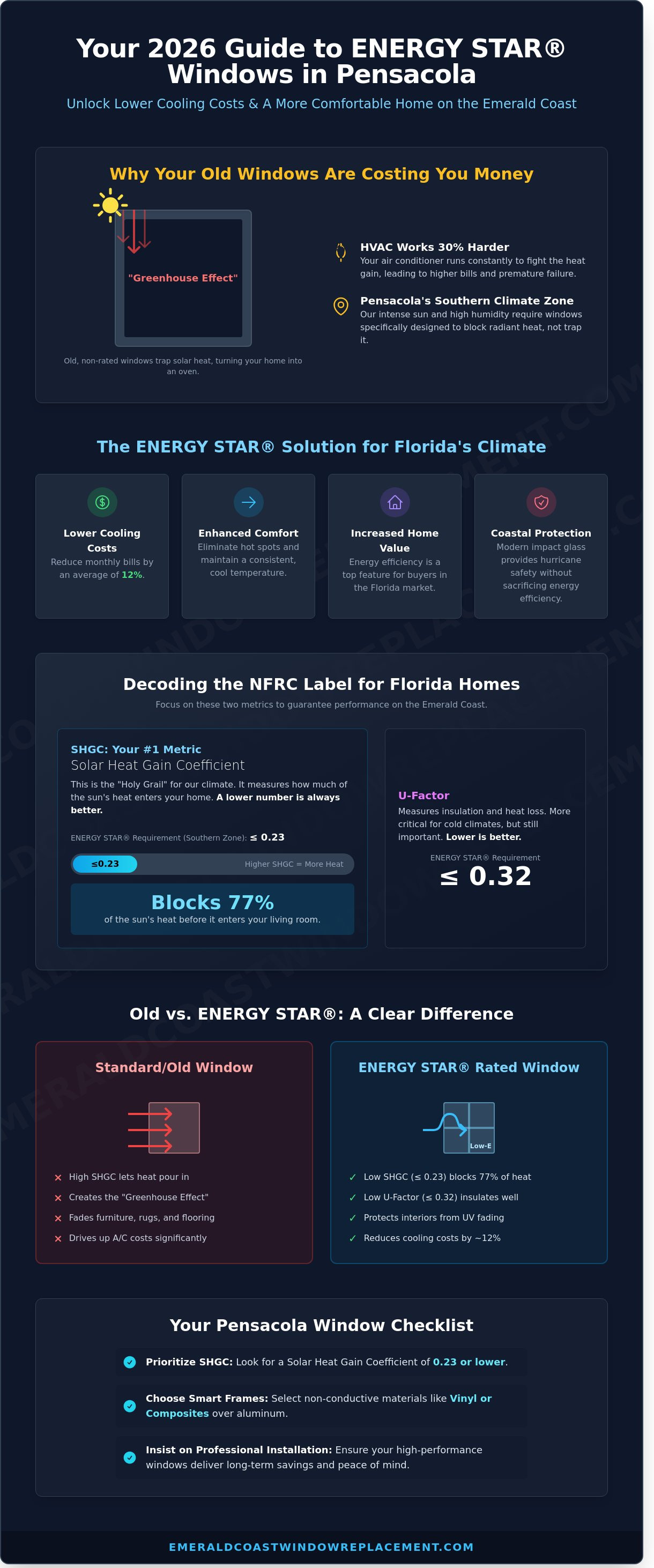
Pensacola sits firmly within the Southern Climate Zone. Unlike northern states that focus on keeping heat inside during harsh winters, our priority is blocking radiant heat from entering. The high humidity levels of the Emerald Coast also demand materials that won't warp or rot under constant moisture exposure. Precision-engineered vinyl and composite frames are often the best choice here because they don't conduct heat like traditional aluminum. For 2026, the Southern Climate Zone criteria require windows to meet a Solar Heat Gain Coefficient (SHGC) of 0.23 or lower and a U-factor of 0.32 or lower to earn the rating.
Why Traditional Windows Fail in the Panhandle
Many older Escambia County homes still feature single-pane glass or clear double-pane units without modern low-E coatings. These windows create a "Greenhouse Effect" where short-wave solar radiation enters your home and transforms into long-wave heat that gets trapped inside. This isn't just a comfort issue; it's a financial one. Data shows that non-rated windows force your HVAC system to work 30% harder to maintain a steady temperature when the heat index climbs above 95 degrees. This constant strain leads to premature mechanical failure and higher utility bills every month. Ignoring the energy star rating for windows in a coastal environment means you're essentially paying for air conditioning that leaks through the glass. Our Florida-proven solutions stop this cycle, providing a stress-free way to protect your home and your wallet.
Decoding the Label: U-Factor vs. SHGC for Florida Homes
Understanding an
energy star rating for windows
requires looking past the blue and white sticker to the technical data underneath. Every window sold in Milton or Gulf Breeze features a National Fenestration Rating Council (NFRC) label. This label provides the standardized data you need to compare different brands accurately. For homeowners along the Emerald Coast,
is the first step toward a more comfortable, hurricane-ready home.
The label breaks down performance into four key areas: U-Factor, Solar Heat Gain Coefficient (SHGC), Visible Transmittance (VT), and Air Leakage (AL). While all four matter, their importance shifts depending on your geography. In the Florida Panhandle, we prioritize blocking the sun’s heat over trapping internal warmth. If you choose the wrong metrics, you might end up paying for insulation you don't need while letting in the heat that drives your cooling costs through the roof.
Solar Heat Gain Coefficient (SHGC) Explained
The Solar Heat Gain Coefficient is the "Holy Grail" metric for Pensacola residents. This number, ranging from 0 to 1, measures how much solar radiation enters your home through the glass. In our climate, a lower number is always better. ENERGY STAR 7.0 specifications, updated in 2023, require windows in the Southern Zone to have an SHGC of 0.23 or lower.
When you install windows with a 0.23 SHGC, you're effectively blocking 77% of the sun's heat before it ever enters your living room. This is critical for south-facing windows that bake under the Florida sun for eight hours a day. Reducing this heat intake can lower your monthly cooling bills by 12% to 15% during peak summer months. It also protects your interior finishes, preventing the UV rays from fading your hardwood floors or coastal-themed furniture.
U-Factor: The Insulation Metric
U-Factor measures how well a window prevents heat from escaping your home. While this is the primary concern for homeowners in Maine or Minnesota, it still plays a role in Gulf Breeze. In Florida, the U-Factor tells you how well your windows keep the expensive, air-conditioned air inside where it belongs. For our region, look for a U-Factor between 0.32 and 0.40.
Your choice of frame material significantly impacts this number. Aluminum frames are incredibly strong for hurricane resistance, but they conduct heat easily. To meet a high energy star rating for windows, many local homeowners choose vinyl frames or thermally broken aluminum. Vinyl frames offer superior U-Factor performance because the material doesn't transfer heat. This ensures that even when it's 95 degrees in Milton, your window frames remain cool to the touch.
Light and Air: VT and Air Leakage
Visible Transmittance (VT) measures how much natural light enters the home. On the Emerald Coast, we want those stunning views and bright interiors. A VT rating of 0.50 or higher ensures your home feels open and airy without the "tinted" look of older energy-efficient glass. Finally, Air Leakage (AL) measures how much air moves through the window's seals. You should demand an AL rating of 0.3 or lower. This prevents that salty humidity from seeping into your home, maintaining your indoor air quality and protecting your drywall from moisture damage.
If you aren't sure which ratings are best for your specific floor plan, you can request a quote from our team to see Florida-proven options. Selecting the right balance of these four metrics ensures your home stays a sanctuary against the Gulf Coast heat.
The Myth: Can Hurricane Windows Be ENERGY STAR Rated?
Many homeowners in Gulf Breeze believe they must choose between extreme storm protection and high-level thermal efficiency. This is a common misconception that often leads to unnecessary stress during the window replacement process. You don't have to sacrifice a low power bill to ensure your family remains safe during a Category 4 hurricane. In fact, high-performance impact windows are some of the most efficient products on the market today. While the primary goal of impact glass is to resist penetration from flying debris, the same technology that makes the glass strong also makes it an incredible insulator.
The energy star rating for windows in the Southern Zone requires a Solar Heat Gain Coefficient (SHGC) of 0.23 or lower and a U-factor of 0.40 or lower. Precision-engineered impact windows frequently exceed these standards. By combining multiple panes of glass with a durable interlayer, these windows create a formidable barrier against the Florida heat. Our team at Emerald Coast Window Authority focuses on providing dual-rated solutions that address the specific 140 mph to 150 mph wind-borne debris requirements of Escambia County while keeping indoor temperatures stable.
Choosing a window with a high-tier energy star rating for windows provides several immediate benefits for coastal properties:
Reduced HVAC Strain: Impact-rated units prevent the "greenhouse effect" common in sun-drenched Florida rooms.
Consistent Comfort: Laminated glass eliminates cold or hot spots near large window openings.
Sound Dampening: The same interlayer that stops a 2x4 board also blocks up to 40% of outside noise.
Structural Integrity: These windows are designed to stay in the frame even if the glass cracks, maintaining the home's pressure seal.
How Impact Glass Blocks UV Rays
The secret to the efficiency of hurricane windows lies in the interlayer, typically made of Polyvinyl Butyral (PVB) or SentryGlas Plus (SGP). This transparent layer is sandwiched between two sheets of glass. It acts as a powerful filter, blocking 99% of harmful ultraviolet (UV) radiation from entering your home. This protection is vital for Gulf Breeze residents who enjoy large, scenic views but want to prevent their hardwood floors and designer furniture from fading. When we pair this interlayer with a high-performance Low-E coating, the window reflects infrared light while allowing visible light to pass through clearly.
Meeting Pensacola Building Codes
Local building departments in Pensacola and surrounding Santa Rosa County have strict requirements for new installations. As of the Florida Building Code 8th Edition, which became effective on December 31, 2023, homes in wind-borne debris regions must utilize impact-resistant glazing or approved shutter systems. We recommend the impact glass route because it simplifies the permitting process and provides year-round energy savings. A window that carries both a Florida Product Approval number and an ENERGY STAR certification gives you the ultimate peace of mind. It proves the unit has been tested against 150 mph winds and verified for its ability to lower your monthly cooling costs by an average of 12% compared to non-certified models.
How to Choose the Best Rated Windows for Your Pensacola Home
Selecting the right energy star rating for windows in the Florida Panhandle requires more than just picking a recognizable brand. It's about matching specific glass technology to our unique coastal climate. Follow these four steps to ensure your investment stands up to the Gulf Coast heat.
Step 1: Identify your home’s orientation. Walk around your property at 3:00 PM. Windows on the west and south sides of your house receive the most intense solar radiation. These specific openings require the lowest Solar Heat Gain Coefficient (SHGC) to prevent your air conditioner from overworking.
Step 2: Demand the Southern Zone label. The ENERGY STAR program divides the country into four regions. Florida sits entirely in the Southern Zone. Windows rated for northern climates will actually trap heat inside your home, which is the opposite of what a Pensacola homeowner needs.
Step 3: Confirm 2026 Federal Tax Credit eligibility. Under Section 25C of the Inflation Reduction Act, homeowners can claim significant credits for qualifying upgrades. Ensure the specific model you choose meets the version 7.0 ENERGY STAR requirements to qualify for these incentives through December 31, 2026.
Step 4: Verify the NFRC temporary label. Before your installers peel off the stickers, check the National Fenestration Rating Council (NFRC) label. This is your only physical proof that the energy star rating for windows you paid for is actually what was delivered to your job site.
Maximizing Your ROI with Tax Credits
The Inflation Reduction Act has transformed the financial landscape for home improvements. For the 2026 tax year, Pensacola residents can claim a tax credit of 30% of the cost of ENERGY STAR certified windows, with an annual limit of $600. To secure this credit, you must keep the Manufacturer’s Certification Statement and the NFRC labels. These documents prove to your tax professional that the units meet the strict efficiency standards required by the IRS.
Selecting Frame Materials for the Emerald Coast
Frame choice impacts both the longevity and the thermal performance of your installation. In areas like Navarre and Pace, vinyl frames are the most popular choice because they offer high insulation values at a competitive price point. They don't rot or corrode, making them ideal for our humid environment.
For homeowners with expansive waterfront views, thermally broken aluminum provides the structural strength needed for large picture windows. While standard aluminum conducts heat, a thermally broken frame uses a reinforced polymer strip to block thermal transfer. If you live directly on the Gulf, composite frames offer a high-end alternative. These materials mimic the look of wood but provide superior resistance to salt-air exposure and won't expand or contract during our volatile temperature swings.
Ready to upgrade your home's protection and efficiency?
from our local experts today.
Connecting with Vetted Pensacola Window Experts
Choosing the right energy star rating for windows is a significant first step, but the label on the glass is only as good as the technician who fits it into your wall. In Gulf Breeze, a window that isn't perfectly plumb and square becomes a liability during a tropical storm. Even a 1/16-inch gap can allow pressurized air to enter your home, which compromises the unit's thermal seal and leads to 25% higher cooling costs during our July heatwaves. Professional installation isn't just about aesthetics; it is the final step in securing the energy efficiency you paid for.
Our team at Emerald Coast Window Authority acts as your local guardian. We've spent years identifying which contractors actually deliver on their promises and which ones cut corners. We focus on installers who treat window replacement as a precision-engineered project rather than a quick fix. This ensures your home remains a sanctuary against both rising utility bills and the unpredictable Gulf weather. By matching you with vetted experts, we remove the guesswork from your home improvement journey.
The Value of Local Expertise
National "big box" retailers often rely on a rotating door of sub-contractors who might not be familiar with the 2023 Florida Building Code updates. These local codes are strict for a reason. In the Panhandle, your windows must withstand salt-air corrosion and specific wind loads that installers in inland states never encounter. A generic installation often ignores the necessity of stainless steel hardware or coastal-grade flashing, leading to seal failure within 3 to 5 years. Our referral service connects you with specialists who understand these nuances, ensuring your warranty remains valid and your home stays protected from the relentless salt spray.
Request Your Free Local Estimate
The path to a more efficient home shouldn't be a source of stress. We've simplified the process so you can compare quotes from licensed, insured, and highly-rated Pensacola contractors without the typical sales pressure. During a professional 45-minute consultation, an expert will evaluate your home's specific needs, such as solar heat gain on south-facing walls or impact-resistance requirements for waterfront properties. You'll receive a clear, transparent estimate that reflects the true value of your investment.
Warranty Verification: Ask about labor warranties that cover 100% of the work for at least 10 years to complement manufacturer parts coverage.
Sealant Quality: Verify the installer uses high-grade, non-corrosive sealants specifically designed for high-humidity environments.
Performance Standards: Ensure the proposed windows meet the current energy star rating for windows for the Southern Climate Zone to qualify for potential tax credits.
Your home deserves the best protection available on the Emerald Coast. Take the first step toward peace of mind and lower monthly bills by reaching out to experts who know our community. Get your free, no-obligation window estimate in Pensacola today!
Protect Your Pensacola Home for 2026 and Beyond
Upgrading your home for 2026 requires a clear understanding of the latest Southern Zone efficiency requirements. The current energy star rating for windows demands a Solar Heat Gain Coefficient of 0.23 or lower to effectively block the intense Florida sun. This standard ensures your cooling system doesn't work overtime during our humid July afternoons. You can achieve these significant savings without sacrificing safety. Today's impact-resistant glass options meet both the 2023 Florida Building Code and federal energy benchmarks for coastal regions.
Emerald Coast Window Replacement bridges the gap between technical standards and local reliability. We provide direct access to licensed Florida Panhandle contractors who are experts in 2026 hurricane impact and energy efficiency protocols. Residents in Pensacola and Gulf Breeze can access free, no-pressure estimates to start their home improvement journey with confidence. Your home deserves the peace of mind that comes from professional craftsmanship and coastal durability. We're ready to help you protect your investment while enhancing your curb appeal.
Frequently Asked Questions
Do ENERGY STAR windows really make a difference in Florida?
Yes, ENERGY STAR windows reduce solar heat gain by 77% compared to standard clear glass windows. In the intense heat of Gulf Breeze, these windows act as a thermal barrier that keeps your home cooler. Choosing a high energy star rating for windows in the Southern Zone ensures your glass has the specific Low-E coatings needed to deflect 95% of ultraviolet rays. This protection preserves your flooring and furniture from sun damage while lowering your cooling demand.
What is the best SHGC rating for windows in Pensacola?
The best Solar Heat Gain Coefficient (SHGC) for Pensacola homes is 0.23 or lower. This rating measures how much heat from the sun enters your home; lower numbers mean better cooling efficiency. We recommend precision-engineered windows with an SHGC of 0.21 for maximum coastal durability. These ratings are vital for the Florida Panhandle climate because they prevent your living space from turning into a greenhouse during our 90-degree summer days.
Can I get a tax credit for installing ENERGY STAR windows in 2026?
You can claim a federal tax credit of up to $600 annually for ENERGY STAR certified window upgrades through the year 2032. The Energy Efficient Home Improvement Credit covers 30% of your total product costs under the Inflation Reduction Act. To qualify for this incentive in 2026, your windows must meet the Version 7.0 energy standards. This credit provides an immediate financial return on your investment in home safety and energy efficiency.
Are all hurricane impact windows ENERGY STAR certified?
No, impact resistance and energy efficiency are separate performance metrics that require different certifications. While impact windows are built to withstand 140 mph winds per ASTM E1996 standards, they only receive an ENERGY STAR label if they also meet strict thermal requirements. We prioritize a high energy star rating for windows alongside impact certification. This ensures your Emerald Coast home is both structurally secure during a hurricane and thermally efficient year-round.
How much can I save on my Pensacola electric bill with new windows?
Pensacola homeowners typically see an average savings of 12% on their annual electricity bills after replacing single-pane windows. According to EPA data, this upgrade can save a typical Florida household between $101 and $538 every year. These savings are most noticeable during the peak summer months when your air conditioner doesn't have to work overtime. Investing in high-quality windows provides long-term financial relief and enhances the overall value of your coastal property.
What happens if I install windows that aren’t ENERGY STAR rated in Pensacola?
Installing non-rated windows often leads to a 30% increase in solar heat gain compared to certified models. You'll likely experience uncomfortable "hot spots" where the temperature near your glass is 5 to 10 degrees higher than the rest of the house. Without the proper ratings, your windows won't have the advanced coatings required to withstand the Florida Panhandle's salt-air environment. This often results in higher utility bills and a shorter lifespan for your HVAC system.
How do I read the NFRC label on my new windows?
Focus on the top two numbers of the NFRC label: the U-factor and the Solar Heat Gain Coefficient. For a home in Gulf Breeze, you should look for a U-factor of 0.40 or less and an SHGC of 0.23 or less. The U-factor tells you how well the window insulates against heat transfer, while the SHGC measures sun-heat blockage. These technical specs provide the transparency you need to ensure your new windows offer genuine coastal charm and protection.


Comments