
DIY Window Installation in Pensacola: A 2026 Guide to Risks, Codes, and Coastal Reality
- ECWA

- Mar 9
- 14 min read
Updated: Mar 20
The single biggest mistake a Pensacola homeowner can make isn't choosing the wrong window; it's installing it themselves. Here on the Emerald Coast, a window is more than a view. It's your home's first line of defense against 150 mph winds and driving rain, and a small installation error can have catastrophic consequences.
We understand the appeal. With home insurance premiums in Florida soaring an average of 42% in 2023 alone, the idea of a diy window installation to save thousands on labor costs is incredibly tempting. You're handy, you've watched the videos, and you're ready to improve your home's value and energy efficiency on your own terms.
But before you pick up that pry bar, this 2026 guide provides the coastal reality check you won't get from a generic tutorial. We'll give you the peace of mind you deserve by demystifying the specific Florida Building Codes for Escambia County, explaining the non-negotiable impact ratings your windows must have, and showing you how a simple mistake can jeopardize your insurance eligibility. This article will equip you with the knowledge to decide if this project truly saves money or just invites risk.
Key Takeaways
Understand the specific Design Pressure (DP) ratings required by the Florida Building Code for homes in Escambia and Santa Rosa counties.
Discover the most common measurement mistake that can derail a project and the essential tools needed for a successful coastal installation.
Learn how an improper diy window installation can void manufacturer warranties and negatively impact your home insurance wind mitigation credits.
Evaluate the true cost of a DIY project by weighing your time and risk against the peace of mind that comes with a professional, hurricane-ready installation.
Table of Contents Understanding DIY Window Installation vs. Professional Replacement in Pensacola The DIY Step-by-Step: How to Install a Replacement Window Navigating Florida Building Codes: Why DIY is Different in the Panhandle The Hidden Costs of DIY: Insurance, Warranties, and Structural Risks The Local Guardian Path: When to Call a Pensacola Professional
Understanding DIY Window Installation vs. Professional Replacement in Pensacola
The allure of a weekend project is strong, and for many homeowners, a DIY window installation seems like a straightforward way to save money and upgrade their home. In most parts of the country, this might be a manageable task. But here on the Emerald Coast, the math is different. The constant threat of hurricane season and the corrosive salt air transform a simple home improvement project into a critical component of your home's structural defense system. This isn't just about aesthetics; it's about safety, compliance, and long-term peace of mind.
Before you even consider this project, it’s vital to distinguish between a standard vinyl window and the high-performance, impact-rated units required to protect a home in Gulf Breeze. A standard window is designed to keep out rain and improve energy efficiency. An impact window is an engineered system designed to withstand 150+ MPH winds and direct impacts from flying debris. The installation for one is fundamentally different from the other, and a mistake with an impact window can render it useless when you need it most.
Pocket vs. Full-Frame: Which is DIY-Friendly?
A pocket installation, where you simply insert a new window into the existing frame, is the most common DIY approach. It's faster and less invasive. However, this method is only viable if your existing window frame is perfectly square, solid, and free of any rot. For many older homes in Milton and Pace, decades of humidity mean the original wood frames are often compromised. Look for visual signs like peeling paint on the sill, soft spots that give when pressed with a screwdriver, or water stains on the surrounding drywall. These are red flags that a pocket install will fail.
The Impact of Coastal Salt Air on DIY Material Choice
Living in Pensacola Beach or Gulf Breeze means a constant battle with salt. The hardware that comes standard with many off-the-shelf windows is often galvanized steel, which can begin to show rust and corrosion in as little as 18 months. A professional coastal installation exclusively uses materials like 316-grade stainless steel fasteners and corrosion-resistant coatings. Furthermore, the flashing and sealants must be specifically rated for coastal UV and salt exposure to prevent premature failure and water intrusion.
The real question comes down to evaluating your own skill set against the unforgiving standards of the Florida Building Code. A successful diy window installation in our area requires more than just leveling the unit. It involves a deep knowledge of how to properly flash the rough opening to create a waterproof barrier, how to anchor an impact window to meet specific wind-load requirements, and how to seal it against wind-driven rain. A crucial first step is a thorough inspection of your existing window frame, sill, and jamb. A deep dive into understanding window components reveals just how many potential failure points exist. An improperly installed window not only voids the manufacturer's warranty but can lead to catastrophic failure during a storm, risking both your property and your family's safety.
The DIY Step-by-Step: How to Install a Replacement Window
Understanding the technical steps of a window replacement reveals why professional precision is not a luxury; it's a necessity for coastal durability. While a weekend project might seem appealing, a single misstep in a diy window installation can compromise your home's defense against hurricane-force winds and torrential rain. Before you even pick up a tool, consider that a flawed installation can void your manufacturer's warranty and may even conflict with your existing builder warranty information, leaving you financially responsible for future failures. This guide outlines the professional-grade process, highlighting the critical points where small errors lead to significant problems.
The entire project hinges on a flawless foundation. It begins with careful removal of the old window sash and stops, followed by a thorough inspection of the rough opening. In Florida's humid climate, it's common to find hidden wood rot or termite damage once the old frame is out. Any compromised wood must be replaced to provide a solid, secure anchor for the new unit. The opening must then be cleaned of all old caulk, debris, and nails, creating a perfectly smooth surface for the new seals to adhere to.
Measuring for a Perfect Fit in High-Wind Zones
The most common failure point for any DIY window project is the initial measurement. We use the 'Rule of Three,' measuring the width at the top, middle, and bottom, and the height at the left, middle, and right. The smallest of these numbers is your order size, minus a 1/4-inch tolerance. In historic Pensacola or Gulf Breeze cottages with settled foundations, openings are rarely perfectly square. A 1/4-inch miscalculation seems small, but it creates a gap large enough for catastrophic wind-driven water intrusion during a tropical storm.
A successful installation requires a specific set of tools engineered for the challenges of Emerald Coast homes. Your standard toolbox likely won't be enough. Here’s what our professionals use:
Oscillating Multi-Tool: Essential for making clean, precise cuts in exterior siding or interior trim without causing damage.
4-Foot Level: A short level isn't sufficient. A long level is the only way to ensure the window is perfectly plumb and level across its entire span, preventing operational issues down the road.
Impact Driver with Masonry Bits: Many Gulf Breeze homes are concrete block construction. An impact driver provides the necessary torque to set fasteners securely into concrete, creating an anchor that can withstand 150+ MPH winds.
With the opening prepped and the new window on hand, the unit is carefully placed, or "set," into the opening. Composite shims are inserted around the frame to hold it in place. This is where the level becomes critical. The window must be adjusted until it is perfectly plumb (vertically straight) and level (horizontally straight). An out-of-plumb window will not open, close, or lock properly, and its seals will fail under pressure. Once leveled, the window is fastened into the frame using high-grade, corrosion-resistant screws.
Sealing and Flashing for Tropical Rain Events
This is where your home’s weather protection is truly made or broken. We apply self-adhering flashing tape around the window flange using a 'shingle' method, starting at the bottom and overlapping each subsequent piece. This ensures any water that gets behind your siding is directed down and out. Inside the gap, a correctly sized backer rod and a minimal-expansion foam designed for windows and doors are applied. Using the wrong high-expansion foam can actually warp and bow the vinyl frame in the Florida heat, destroying the window's integrity. If this process seems complex, it's because getting it perfect requires years of experience. Our precision installation process guarantees a watertight seal every time.
Navigating Florida Building Codes: Why DIY is Different in the Panhandle
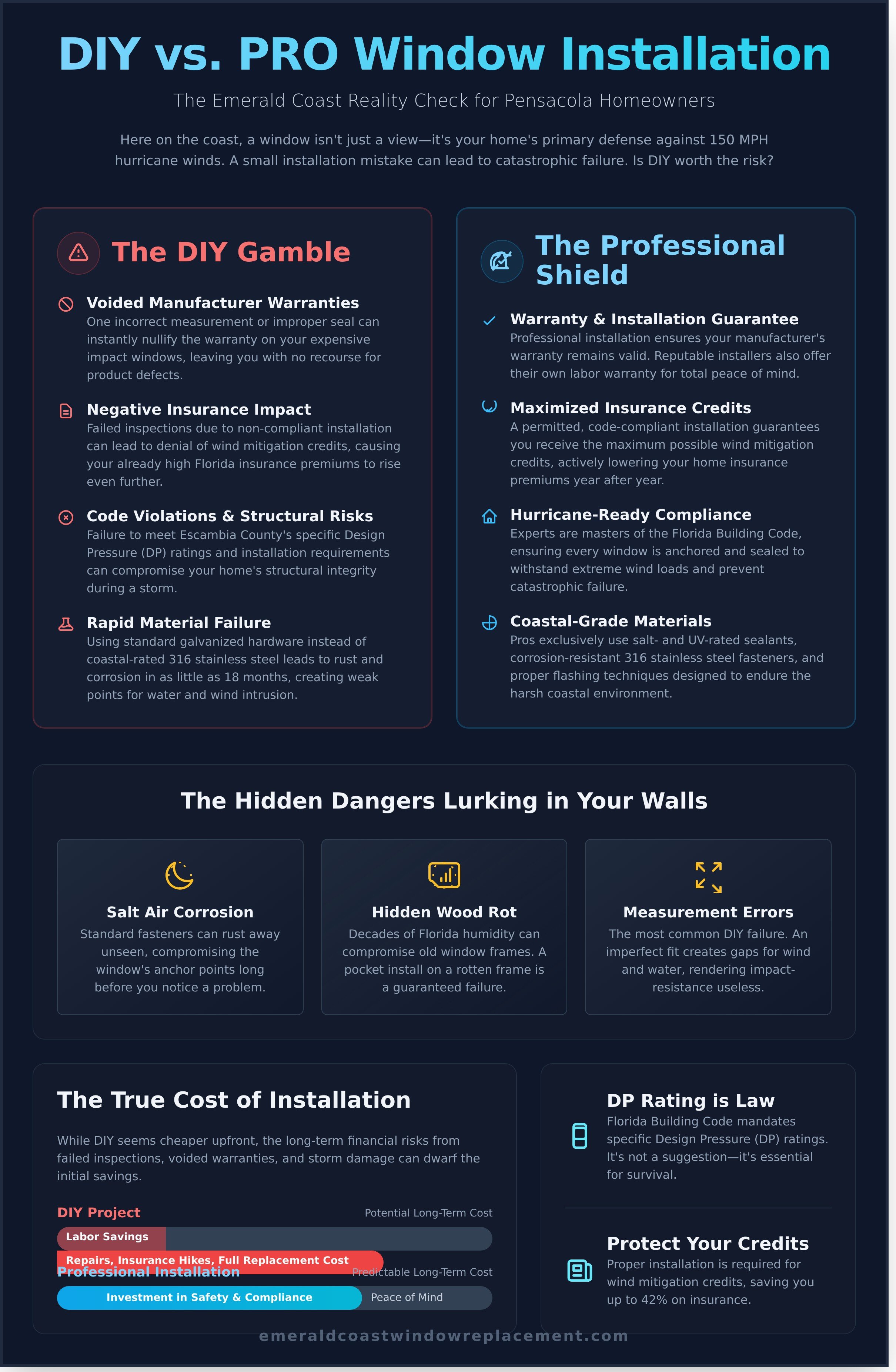
Replacing a window seems straightforward. You take one out, you put a new one in. But here on the Emerald Coast, that simple task is governed by a complex and non-negotiable set of rules designed for one purpose: to protect your home and family from a hurricane. The Florida Building Code (FBC) is one of the most stringent in the nation, and attempting a diy window installation without mastering its local nuances is a significant financial and safety risk. The current 8th Edition (2023) of the FBC already sets a high bar, and with updates occurring every three years, the 2026 requirements are expected to be even more demanding.
Permitting Requirements in Pensacola and Gulf Breeze
Any project that involves replacing windows in Escambia or Santa Rosa counties legally requires a building permit. This isn't just bureaucratic red tape; it’s a critical checkpoint to ensure the new windows meet life-safety standards. Proceeding without one can lead to "stop-work" orders, significant fines, and major complications when you try to sell your home or file an insurance claim. While Santa Rosa County allows for an "owner-builder" permit, this path makes you, the homeowner, the legally responsible contractor. You assume 100% of the liability for meeting every single code requirement, a burden that can have severe consequences if not met perfectly.
DP Ratings and Wind Zones Explained
Our corner of the Panhandle, from Pensacola to Gulf Breeze, sits squarely within the 140mph and 150mph wind-speed zones as defined by the FBC. This designation dictates the required Design Pressure (DP) rating for your windows. A DP rating isn't just about wind; it’s a performance grade that measures a window's ability to resist wind load, water penetration, and structural pressure. A higher DP rating, like a DP50 or greater, means a stronger, more resilient window. While you can find performance data on a window's NFRC label, the crucial DP rating is typically on a separate AAMA Gold Label. This is where many DIY projects fail. The "off-the-shelf" windows available at national big-box retailers are often built to a lower, more generic standard and may carry a DP rating of 30 or less, making them completely non-compliant and unsafe for a coastal Florida home.
Your home's first line of defense against a storm is its building envelope. The FBC requires that all openings, including windows and doors, in our wind-borne debris region be protected. You have two primary compliance options:
Impact-Resistant Glass: Windows engineered with a laminated glass core designed to withstand impacts from flying debris without failing.
A Non-Impact Window with an Approved Shutter System: Standard windows protected by a permanently installed or removable storm shutter system that has been tested and approved for our wind zone.
Choosing the right product and ensuring it's installed to the manufacturer's precise specifications and FBC standards is not a casual weekend project. It’s a technical process where the smallest error can compromise the safety of your entire home. For true peace of mind and guaranteed compliance, a professional installation is the only responsible choice.
The Hidden Costs of DIY: Insurance, Warranties, and Structural Risks
The initial appeal of saving on labor costs is powerful, but it's a short-term gain that often leads to significant long-term financial pain. In Florida, a window isn't just a pane of glass; it's a critical component of your home's structural defense system. A botched diy window installation creates hidden liabilities that can cost you thousands in lost insurance credits, voided warranties, and diminished home value. These are the expenses that don't show up on a receipt from the hardware store.
Your home is your most valuable asset on the Emerald Coast. Protecting it requires precision and certified expertise, not guesswork.
Insurance Credits and Wind Mitigation Inspections
In Florida, your homeowner's insurance premium is directly tied to your home's ability to withstand hurricane-force winds. After installing new impact windows, a certified inspector visits to complete the official Wind Mitigation Inspection Form (OIR-B1-1802). To grant you the maximum discount for "Opening Protection," the inspector must verify that your windows not only meet Florida Building Code but were installed professionally. Without permits and a licensed contractor's signature, your windows won't qualify. Consider this: a typical wind mitigation credit can save a Gulf Breeze homeowner $700 to $1,200 per year. Over 10 years, that's up to a $12,000 loss in discounts, a figure that almost certainly eclipses any money saved on DIY labor.
Worse yet, in the wake of recent storms, insurers are cracking down. If they discover your impact protection isn't professionally certified, they may consider it non-compliant and have grounds to deny a storm damage claim or even drop your coverage entirely.
The Warranty Gap: DIY vs. Certified Pro
That 25-year manufacturer warranty looks impressive, but it's built on a critical condition found in the fine print. Nearly every major window manufacturer includes a clause stating the warranty is only valid if the product is installed by a licensed and certified professional according to their exact specifications. The moment you install it yourself, that comprehensive coverage vanishes.
Manufacturers make a clear distinction between product defects and installation errors. If your new window fogs up from a failed seal or leaks during a heavy rain, who is to blame?
With a DIY Installation: The manufacturer will attribute the failure to improper installation, leaving you with zero support. You are responsible for 100% of the cost to repair or replace it.
With a Professional Installation: Our team stands behind our work. We diagnose the problem and work directly with the manufacturer to process the claim, ensuring your investment is protected.
A professional’s labor warranty backs the manufacturer’s product warranty. Without it, your 25-year protection effectively becomes a 0-year warranty the day you finish your project. Don't let a weekend project jeopardize a decades-long investment. Ensure your home is protected and your warranties are intact. Request a free, no-obligation quote for certified window installation today.
The Local Guardian Path: When to Call a Pensacola Professional
After weighing the substantial risks, it’s clear that protecting your Gulf Breeze home is too important for guesswork. The initial appeal of a lower-cost diy window installation quickly fades when you calculate the true investment. Consider the cost of specialized tools, the dozens of hours spent on a single window, and the immense financial liability of a single mistake, like a cracked frame or a failed inspection that requires a complete do-over. A professional quote, by contrast, is a fixed number that includes expertise, insurance, and peace of mind.
Choosing a contractor, however, presents its own challenge. You need more than just a handyman; you need a specialist who understands the unique demands of the Emerald Coast. Local professionals are intimately familiar with Santa Rosa County building codes, the corrosive effects of salt air on hardware, and the specific wind-load requirements for homes along the Sound. They don't just install windows; they fortify your home against our specific coastal threats. We simplify that search, connecting you directly with the area's most trusted and licensed experts.
The Value of a Licensed Florida Contractor
A Florida contractor’s license is more than a piece of paper; it’s your assurance of protection and quality. Licensed professionals are required to carry both liability insurance and workers' compensation. This shields your personal assets completely. Should an accident occur on your property, you won't be held financially responsible. They also bring mastery of "Florida-proven" installation techniques, using corrosion-resistant fasteners and advanced sealing methods designed to defeat our region's wind-driven rain and humidity. This level of expertise ensures your windows perform flawlessly for decades, not just a single storm season.
Requesting Your Stress-Free Local Estimate
We've removed the anxiety from finding a qualified installer. Our referral service connects you exclusively with verified Panhandle specialists who have a documented history of excellence in our community. When you meet with a professional for a consultation, you are in control. It's the perfect time to ask critical questions to ensure they are the right fit for protecting your home. A prepared homeowner is a confident one.
Permitting: "Will you handle the entire permitting process with the county on my behalf?"
Product Ratings: "What Design Pressure (DP) rating do you recommend for my home's specific exposure, and why?"
Timelines: "What are the current manufacturing lead times for impact windows, and what is your estimated installation schedule?"
Warranties: "Can you explain the manufacturer's warranty on the windows and your own warranty on the installation labor?"
Taking the first step toward a secure, storm-ready home doesn't have to be stressful. An expert evaluation provides a clear path forward, outlining your options without any obligation. It’s the simplest way to trade the uncertainty of a diy window installation for the guaranteed protection of a professional job. Secure your home and your peace of mind. Get your free, no-pressure window estimate in Pensacola today!
Secure Your Coastal Investment for 2026 and Beyond
While a weekend project can be tempting, a diy window installation in Pensacola isn't like one in other parts of the country. You're facing the stringent 2023 Florida Building Code, 8th Edition, which dictates specific wind-load requirements that can reach 140 mph in our region. A single mistake can void a manufacturer's warranty and impact your homeowner's insurance policy, turning potential savings into a significant financial liability.
Your home is your most important shield against the storm. It deserves more than a gamble. Instead of navigating complex permits and risking structural integrity, consider a path of certainty. Our stress-free, neutral advisory service connects you with expertly vetted local contractors who understand the demands of our coastal environment.
Let us handle the details. Our partners focus exclusively on Florida-proven hurricane durability, ensuring your installation is seamless, secure, and built to last. Secure your home with a professional hurricane-impact window estimate and gain true peace of mind.
Investing in your home's safety is the smartest decision a homeowner on the Emerald Coast can make.
Frequently Asked Questions About Window Installation
Do I need a permit to replace windows in Pensacola, FL?
Yes, a building permit is required for window replacement in Pensacola and throughout Escambia County. The Florida Building Code classifies window replacement as a structural alteration, meaning the work must be permitted and inspected. This process ensures your new windows meet the stringent wind-load and impact-resistance codes established after Hurricane Ivan in 2004. Failing to secure a permit can result in fines and complications when you sell your home.
Can I install hurricane-impact windows myself?
While technically possible, it’s a significant risk we strongly advise against. Hurricane windows must be installed with absolute precision according to manufacturer specifications and Florida building codes to perform during a storm. Improper anchoring, flashing, or sealing can cause catastrophic failure under pressure. A professional installation is your best guarantee that the window will protect your home as engineered and that your warranty will be honored by the manufacturer.
Will DIY window installation void my home insurance wind credits?
Yes, an improper DIY window installation will almost certainly void your wind mitigation credits. Insurance providers require a Uniform Mitigation Verification Inspection Form (OIR-B1-1802) completed by a certified inspector to grant discounts, which can be up to 45% of your premium. A DIY project without a permit and professional documentation won't pass this inspection. You lose out on significant savings and may even face policy issues for unpermitted work.
How much can I save by installing my own windows in Florida?
You might save between 25-40% on labor costs upfront, but the financial risks are immense. A single mistake, like an improper seal leading to water intrusion, can cause over $2,000 in hidden wall and floor damage. If your installation fails a building inspection, you'll have to pay a professional to remove and reinstall the windows correctly. These potential costs quickly erase any initial savings from a do-it-yourself project.
When such damage occurs, it requires specialized intervention. To understand the professional processes involved in water damage restoration from an expert's perspective, you can learn more about The Solution, a company that specializes in repairing these types of building failures.
What is the difference between a pocket install and a full-frame install?
A pocket installation, or insert replacement, involves placing a new window unit inside the existing window frame. It’s faster and less invasive but only works if your original frame is perfectly square and free of any rot or damage. A full-frame installation is a complete replacement where we remove the old window, trim, and frame down to the rough opening. This allows us to inspect for hidden damage and ensure a perfect, weatherproof seal.
What DP rating is required for windows in Gulf Breeze and Navarre?
Homes in Gulf Breeze and Navarre are located in a high-velocity hurricane zone, requiring a minimum Design Pressure (DP) rating of DP50. Depending on your home's specific location, elevation, and exposure, the code may require an even higher rating, such as DP55 or DP60. A professional assessment is critical to determine the exact DP rating needed to properly protect your home and comply with Santa Rosa County building codes.
How do I know if my existing window frames are rot-free?
You can check for rot by pressing a screwdriver or awl firmly against the wood, especially on the sill and lower corners where water collects. If the wood feels soft, spongy, or flakes away easily, rot is present. Also, look for cracked paint, discoloration, or visible mildew. Even minor softness indicates a problem that a simple pocket installation can't fix; the entire frame will need to be replaced to prevent future structural damage.
Is it better to use vinyl or aluminum windows for coastal Florida homes?
High-quality vinyl windows are typically the superior choice for coastal homes on the Emerald Coast. Modern vinyl frames are incredibly durable, won't corrode from salt spray, and offer excellent energy efficiency to lower your cooling costs. While aluminum is strong, it conducts heat and can corrode over time unless it has a premium AAMA 2605 factory finish. For long-term performance and peace of mind, we recommend Florida-proven vinyl impact windows.


Comments