Energy Efficient Windows Cost Florida: The 2026 Panhandle Homeowner’s Guide
- ECWA

- Jul 12
- 12 min read
Did you know that heat transfer through inefficient glass can account for nearly 40% of your home's cooling load during a Panhandle summer? It's a frustrating reality for many of us living along the Gulf Coast, especially when you're trying to balance the energy efficient windows cost Florida homeowners face against the rising price of electricity. You've likely noticed your air conditioner running non-stop while intense UV rays slowly bleach your furniture and flooring. It feels like a losing battle against the heat, but it doesn't have to be.
We understand that the technical side of home hardening feels overwhelming when you're staring at confusing jargon like SHGC and U-Factor. This guide simplifies the process by showing you exactly how to evaluate performance ratings and calculate your long-term ROI. You'll learn how to meet the 2026 Florida building codes and leverage state programs like My Safe Florida Home to make your upgrade more affordable. We'll preview the latest Energy Star requirements and provide a clear path to finding vetted local specialists who prioritize your home's resilience and comfort.
Table of Contents
What Defines Energy-Efficient Windows in the Florida Climate?
In the Florida Panhandle, an energy-efficient window is more than just a piece of glass; it's a high-performance thermal shield. While homeowners in the north focus on keeping heat inside during the winter, our priority is the exact opposite. True efficiency here means engineering a window to minimize heat transfer from the outside in, while maintaining the structural integrity required to withstand coastal wind pressures. As we move through 2026, the energy efficient windows cost Florida residents invest in is increasingly tied to meeting stricter building codes that demand better thermal performance to combat our rising humidity and temperatures.
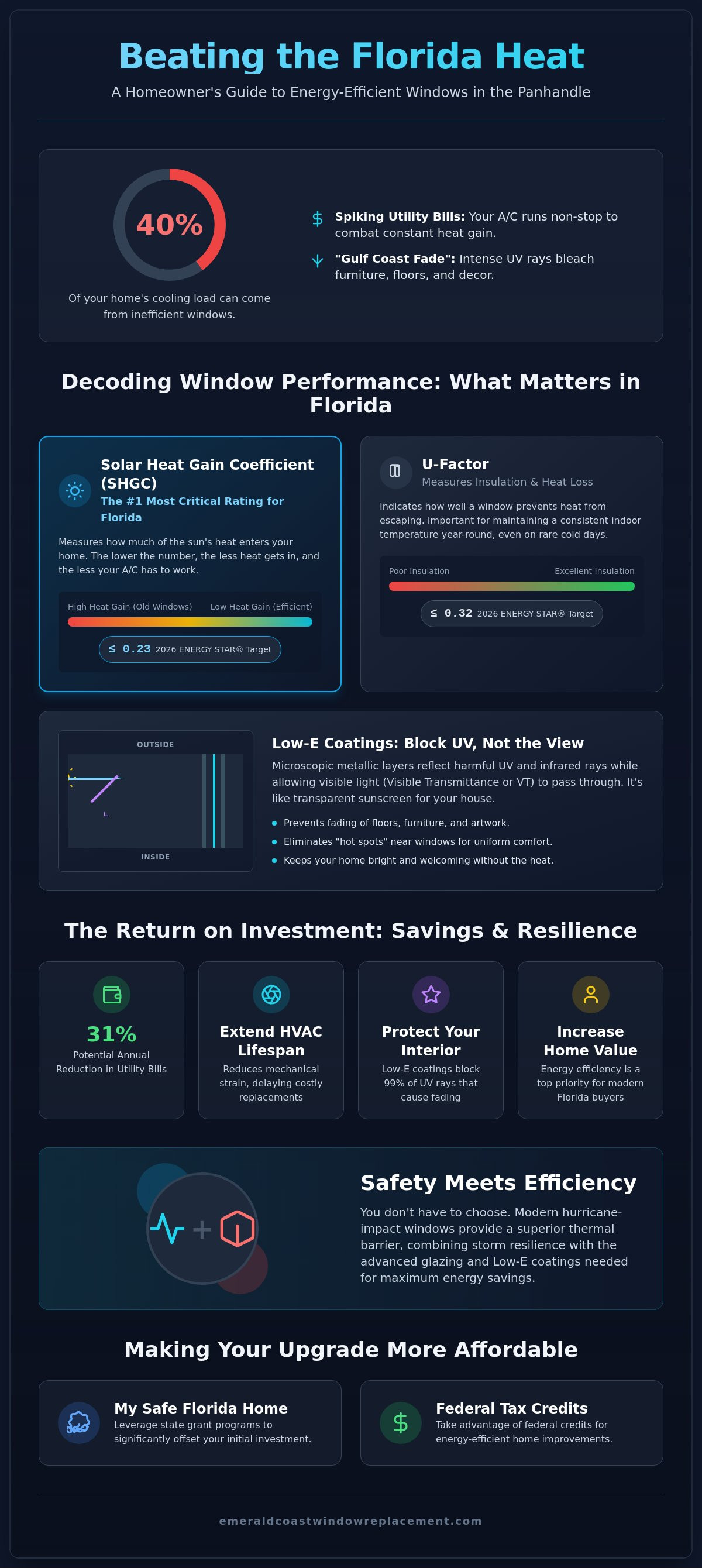
The core of this technology lies in Insulated glazing. These units use two or more panes of glass separated by a vacuum or gas-filled space. This creates a physical break that stops heat from "bridging" into your home. However, the most critical metric for a Florida homeowner isn't the U-Factor, which measures insulation, but the Solar Heat Gain Coefficient (SHGC). In our climate, a low SHGC is your best defense. It measures how much of the sun’s radiant heat actually enters your home. To meet 2026 ENERGY STAR Southern Zone requirements, windows must achieve an SHGC of 0.23 or less. This ensures that the majority of the sun's infrared energy is reflected away before it ever reaches your living room.
The Financial Reality of Pensacola Utility Bills
Old, single-pane glass acts like a heat magnet, allowing the intense afternoon sun to bake your interior spaces. When your windows fail to block this heat, your air conditioner has to work significantly harder to maintain a comfortable temperature. This constant cycling doesn't just spike your monthly bill; it drastically shortens the lifespan of your HVAC system. By upgrading to high-performance vinyl or impact-resistant frames, you reduce this mechanical strain. Homeowners often find that the long-term ROI is realized not just in lower utility costs, but in the deferred expense of a $15,000 AC replacement. Furthermore, these upgrades typically recoup a large portion of their value during a home resale, as energy efficiency is a top priority for modern Florida buyers.
Coastal UV Protection: Beyond Just Temperature
Living in Gulf Breeze or Pensacola means dealing with some of the highest UV indexes in the country. Without proper protection, this intense light causes the "Gulf Coast fade," where hardwood floors, expensive rugs, and coastal decor lose their vibrance within just a few years. High-performance Low-E coatings act like a transparent sunscreen for your home. These microscopic layers reflect UV rays while allowing natural light to pass through. This technology also eliminates "hot spots" near windows, ensuring a uniform indoor climate. You can finally sit by the window in July without feeling like you're standing under a heat lamp.
Decoding Performance Ratings: SHGC, U-Factor, and Low-E Glass
Every window comes with a story, and that story is told on the National Fenestration Rating Council (NFRC) sticker. While national manufacturers often emphasize insulation for cold climates, Panhandle homeowners need to prioritize different metrics. The energy efficient windows cost Florida residents pay is an investment in specific performance ratings that combat our unique humidity and solar intensity. For 2026, the ENERGY STAR Southern Climate Zone certification requires a Solar Heat Gain Coefficient (SHGC) of 0.23 or less and a U-Factor of 0.32 or less. These aren't just arbitrary numbers; they are the benchmarks for keeping your home comfortable without overworking your air conditioner.
The SHGC is your most critical defense. It measures how much of the sun's radiant heat enters your home through the glass. In a region where the UV index frequently hits double digits, a lower SHGC is essential. Meanwhile, the U-Factor measures how well the window prevents heat from escaping. While we don't face long winters, a low U-Factor is still vital during those rare North Florida freezes and helps maintain a consistent indoor temperature year-round. You should also look for high Visible Transmittance (VT) ratings. This allows you to enjoy the natural Emerald Coast sunshine without the associated heat gain, ensuring your home remains bright and inviting.
The Science of Low-E (Low-Emissivity) Coatings
High-performance energy-efficient windows utilize spectrally selective Low-E coatings to manage thermal energy. These microscopic metallic layers are engineered to reflect infrared heat while letting visible light pass through. In our coastal environment, soft-coat Low-E is the preferred choice. Because the coating is applied in a vacuum and sealed inside the glass unit, it is protected from the corrosive salt air that can degrade exposed materials. This technology reflects up to 70% more heat than standard double-pane glass, creating a significant barrier against the afternoon sun.
Frame Materials and Thermal Conductivity
The frame is just as important as the glass when it comes to blocking heat. Modern vinyl windows have largely replaced older aluminum designs because they offer superior thermal resistance. Aluminum is a conductor; it absorbs the Florida heat and radiates it directly into your living space. In contrast, vinyl is an insulator. High-quality vinyl frames feature multi-chambered designs that trap air, creating a thermal break that stops heat transfer in its tracks. This structural detail ensures that your window frames stay cool to the touch, even on a 95-degree July day.
If you are trying to determine which rating combinations will provide the best return for your specific home layout, you can consult with an expert at Emerald Coast Window Authority for a neutral, data-driven assessment.
The Impact Connection: Can Hurricane Windows Be Energy Efficient?
Many Panhandle homeowners believe they have to choose between storm safety and thermal performance. This is a common misconception that often leads to missed opportunities for savings. When calculating the energy efficient windows cost Florida residents expect to pay, it's vital to realize that modern impact glass serves as a dual-threat solution. You don't have to sacrifice a cool living room for a secure one. In fact, the same engineering that protects your home from a Category 4 hurricane also provides some of the best insulation available in the coastal market.
The secret lies in the construction of the glass itself. While standard windows rely on two separate panes, hurricane windows feature a robust laminated interlayer bonded between layers of glass. This creates a dense, multi-layered barrier. For residents in Escambia County, meeting strict wind-load codes is a legal necessity, but the secondary benefit is a dramatic reduction in solar heat gain. This heavy-duty glass also provides an incredible lifestyle upgrade: sound dampening. The thickness of the impact glass effectively mutes the roar of Gulf Coast storms, traffic, and neighborhood noise, turning your home into a quiet sanctuary.
Laminated Glass as an Insulator
The PVB or SGP interlayer used in impact glass acts as a superior thermal break. Unlike standard glass, which can allow heat to radiate through fairly easily, this polymer layer disrupts thermal transfer. This density also helps reduce air infiltration. Because impact-rated units are built with reinforced frames and heavy-duty seals to withstand pressure, they are naturally more airtight than economy options. This means your cooled air stays inside, and the humid Florida air stays out. Many homeowners find that these units actually outperform standard double-pane windows in our specific Southern climate.
Meeting 2026 Florida Building Codes
Staying compliant with the latest 2026 Florida Building Codes is essential for insurance eligibility and home value. In Santa Rosa County and surrounding areas, your windows must meet specific wind-borne debris standards while also hitting Energy Star thermal targets. To ensure your project is up to code, always verify the NFRC labels on your impact-rated products. These labels confirm the window has been tested for both structural resilience and energy performance. By choosing a high-performance impact window, you are hardening your home against the environment while simultaneously driving down your monthly utility overhead.
Calculating the Cost: Investment, Savings, and Tax Credits
Investing in your home's exterior is a strategic move that requires looking past the initial sticker price. When evaluating the energy efficient windows cost Florida homeowners encounter, it's important to consider the total financial ecosystem. This includes immediate tax incentives, monthly utility reductions, and long-term insurance savings. In our coastal market, high-performance windows are one of the few upgrades that pay you back in multiple ways simultaneously. Beyond the monthly math, "Energy-Efficient" has become a premier selling point for Panhandle real estate, often helping homes in Escambia and Santa Rosa counties stand out in a competitive market.
The total window replacement cost in Gulf Breeze is influenced by several local variables. Frame material selection, the specific number of panes, and the inclusion of impact-resistant interlayers all play a role. However, state-level support through the My Safe Florida Home program can provide matching grants up to $10,000 for eligible homeowners, significantly lowering the out-of-pocket burden. For federal incentives, the Energy Efficient Home Improvement Credit (Section 25C) historically offered a 30% tax credit. Because information regarding the 2026 status of this credit varies, we strongly recommend consulting a tax professional or the official IRS website to confirm current limits before finalizing your project.
Real-World Energy Savings in Milton and Pace
Homeowners in Milton and Pace often see a dramatic shift in their monthly overhead after a full upgrade. By switching from old, leaky frames to high-performance units, you can save up to 31% annually on heating and cooling bills. For a typical 2,000 sq. ft. home, this translates to $50 to $150 in monthly savings during the peak of summer. There is also the "HVAC Longevity" factor to consider. When your windows block 70% of solar heat gain, your air conditioner cycles less frequently. This reduces mechanical wear and can delay a costly system replacement by several years, adding thousands of dollars in hidden value to your ROI timeline.
The Value of Professional Installation
Even the most advanced glass and windows will fail to deliver promised savings if they aren't sealed correctly. In our humid climate, professional flashing is the only way to prevent air leaks and moisture intrusion. A poor seal allows conditioned air to escape and invites wood rot into your wall cavities. When vetting contractors, ask for proof of local licensing and NFRC certification. Ensuring your windows are installed to precise manufacturer specifications is the only way to protect your warranty and guarantee the thermal performance you paid for.
Ready to see how these savings apply to your specific property? Connect with a vetted local specialist through Emerald Coast Window Authority for a zero-pressure performance assessment.
The Stress-Free Way to Find Vetted Panhandle Contractors
Traditional window shopping often feels like a high-stakes negotiation. You're met with high-pressure tactics and confusing quotes that make it difficult to compare apples to apples. This stress is the last thing you need when trying to protect your home. Determining the actual energy efficient windows cost Florida homeowners should expect doesn't have to be a guessing game. We've seen too many neighbors in Pensacola and Gulf Breeze settle for subpar products because they were overwhelmed by technical jargon. This is where a neutral perspective changes everything. By working with a window option specialist, you gain an advocate who understands the nuances of coastal engineering without the bias of a direct sales rep.
Our goal is to ensure the energy efficient windows cost Florida residents invest is spent on products that actually perform. Whether you live in Milton or Navarre, your home faces specific environmental demands that require more than just a standard replacement. We help you navigate these choices with clarity and confidence. By focusing on the unique climate challenges of the Gulf Coast, we ensure your investment provides lasting value and protection.
The "Neighborly" Advisory Process
We take the guesswork out of home hardening by strictly vetting our network of specialists. Every contractor we recommend must prove their professional standing and coastal experience. Our vetting process includes:
Verification of current Florida state licensing and insurance.
A proven track record of successful coastal installations in Escambia and Santa Rosa counties.
Commitment to using NFRC-certified products that meet 2026 Energy Star standards.
Adherence to high-quality craftsmanship and transparent, zero-pressure communication.
A direct sales rep is often incentivized to push a specific brand or stock inventory. In contrast, a neutral advisor prioritizes your home's structural resilience and your long-term budget. This consultative approach ensures you get the right SHGC ratings and impact certifications for your specific zip code. We look for teams that understand how salt air affects hardware and how Panhandle humidity impacts seal integrity over time.
Get Your Professional Window Estimate Today
Starting your upgrade shouldn't be a chore. Our platform simplifies the inquiry process so you can focus on the results rather than the paperwork. When you reach out, we gather the essential details of your project to match you with the most qualified specialists in Escambia and Santa Rosa counties. You can expect accurate project information and a commitment to quality that matches our regional pride. You don't have to navigate this high-stakes environment alone. It's time to stop worrying about rising utility bills and start enjoying a more comfortable, secure coastal residence.
Protect Your Home’s Future and Comfort
Protecting your Panhandle home requires a strategic approach that balances daily comfort with long-term structural resilience. By focusing on low SHGC ratings and utilizing the 2026 My Safe Florida Home grants, you can significantly lower your cooling bills while hardening your exterior against the elements. We've seen how high-performance impact windows act as a dual-threat, blocking intense solar heat and muting coastal noise simultaneously. Navigating the energy efficient windows cost Florida homeowners encounter is much easier when you view it as a strategic investment in your property’s safety and overall market value.
Our neutral advisory service exists to remove the stress and high-pressure tactics from this important process. We connect you with a vetted network of licensed local specialists who understand the specific environmental demands of our coastal region. You deserve an honest, zero-pressure assessment from experts who are deeply invested in the well-being of the Pensacola community. Find Vetted Energy-Efficient Window Contractors in Pensacola to take the first step toward a more resilient and efficient home. It’s a rewarding journey that brings lasting peace of mind and comfort to your family.
Frequently Asked Questions
Do energy-efficient windows really lower my Pensacola electric bill?
Yes, high-performance windows are one of the most effective ways to lower your Pensacola utility costs. By blocking up to 70% of solar heat gain, these units allow your air conditioner to run less frequently. Homeowners often see annual savings of up to 31% on their cooling bills. When you consider the energy efficient windows cost Florida residents pay, the long-term utility reduction acts as a significant monthly dividend.
What is the most important energy rating for Florida windows?
The Solar Heat Gain Coefficient (SHGC) is the most critical rating for our climate. While northern states prioritize U-Factor for insulation, we need to block the sun's radiant energy. A lower SHGC number means less heat enters your home. For the 2026 ENERGY STAR Southern Zone certification, look for an SHGC of 0.23 or less to ensure your home stays cool during intense Panhandle summers.
Are triple-pane windows worth the extra cost in the Florida Panhandle?
Triple-pane windows are generally not necessary for the Florida Panhandle. They're designed to trap heat inside during freezing winters, which isn't our primary challenge. A high-quality double-pane window with spectrally selective Low-E coatings provides the ideal balance of performance and value. You'll get the protection you need against the Gulf Coast heat without the excessive weight and expense of a third pane of glass.
How much can I save with the federal tax credit for energy-efficient windows in 2026?
The federal tax credit status for 2026 is currently subject to specific IRS guidelines. Historically, the Energy Efficient Home Improvement Credit allowed homeowners to claim 30% of the cost, up to $600 annually. However, because some reports indicate this credit may have changed or expired, it's vital to consult a tax professional or visit the official IRS website. This ensures you have the most current information regarding limits for the 2026 tax year.
Can I get hurricane-impact windows that are also Energy Star certified?
Absolutely. Many high-performance impact windows are also Energy Star certified. The laminated interlayer required for hurricane protection acts as an excellent thermal barrier. You don't have to choose between storm safety and energy efficiency. These dual-threat windows meet strict wind-load codes in Escambia and Santa Rosa counties while keeping your home's interior climate consistent and much more affordable to maintain.
How do I know if my current windows are energy inefficient?
You can check for inefficiency by touching the glass on a sunny afternoon. If it feels hot to the touch, it's radiating heat into your home. Other signs include visible condensation between the panes, audible air leaks, or noticeable fading on your furniture and flooring. If your air conditioner never seems to stop running despite a high thermostat setting, your windows are likely the primary culprit.
What is the best window frame material for the Florida heat and salt air?
High-quality vinyl is the superior choice for our coastal environment. Unlike aluminum, vinyl is a natural insulator that doesn't conduct heat into your living spaces. It's also exceptionally resistant to the corrosive salt air found in Pensacola and Gulf Breeze. Modern vinyl frames are designed with multi-chambered profiles that trap air, creating a thermal break that helps stabilize the energy efficient windows cost Florida homeowners invest in.
Will new energy-efficient windows reduce the noise in my home?
Yes, new windows will significantly dampen exterior noise. The same features that block heat, such as double-pane construction and argon gas fills, also act as sound barriers. If you upgrade to hurricane-impact glass, the thick laminated interlayer provides even greater sound insulation. You'll notice a much quieter home environment, with traffic and lawn equipment noise becoming a distant hum rather than a constant, loud distraction.


Comments