Signs of Window Failure in Coastal Homes: The 2026 Homeowner’s Guide
- ECWA

- 2 days ago
- 13 min read
Is that chalky residue on your frames just a cosmetic annoyance, or is it a warning that your home's first line of defense is about to give way? Many homeowners in the Florida Panhandle realize too late that the salt air and intense humidity have quietly compromised their protection. Understanding the specific signs of window failure in coastal homes is essential for maintaining both your safety and your property value as we approach the 2026 storm season.
It's understandable to feel a sense of anxiety when your energy bills start to climb or your windows become difficult to open during the most humid months. You want a home that feels like a sanctuary, not a source of constant maintenance stress. We're here to help you navigate these challenges with the clarity and confidence of a local expert who understands the unique demands of our region.
This guide provides a comprehensive checklist to help you spot subtle and structural issues before they become emergencies. You'll learn how our coastal climate accelerates hardware corrosion and seal failure. We also outline a clear plan for upgrading to high-performance hurricane-impact windows, ensuring your home meets the stricter requirements of the upcoming 9th Edition Florida Building Code updates.
Table of Contents
The Coastal Climate: Why Windows Fail Faster in the Florida Panhandle
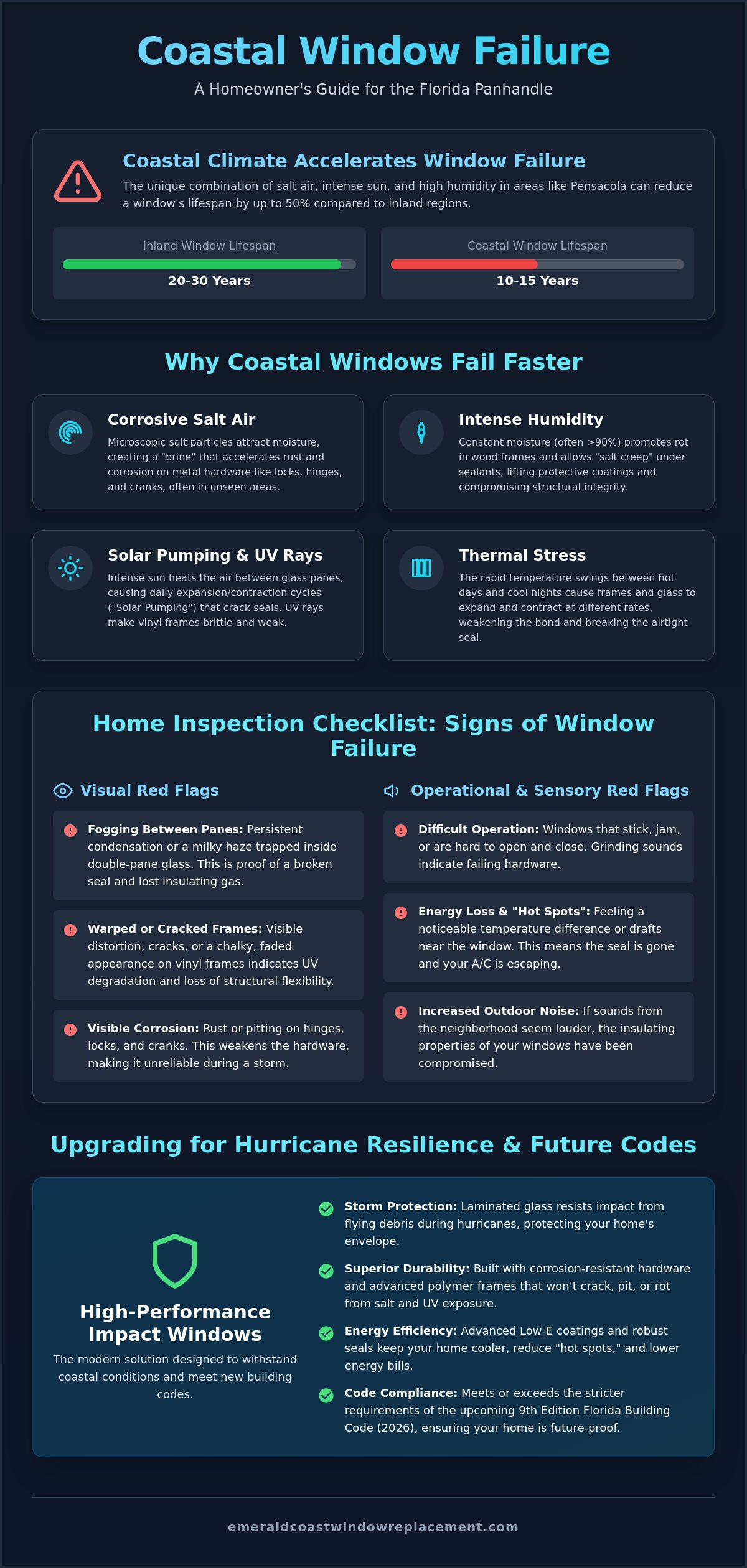
In the Florida Panhandle, your windows do much more than provide a view; they act as a vital structural shield. We define coastal window failure as the point where the entire window system loses its ability to defend your home against air infiltration, water intrusion, and fluctuating wind pressures. While windows in inland states might last for decades, the unique environmental stressors in Pensacola and Gulf Breeze can reduce that lifespan by 30% to 50%. Understanding the specific signs of window failure in coastal homes is the first step toward securing your property before the next major storm hits.
One of the most destructive forces we see is the "Solar Pumping" effect. The intense Florida sun heats the air space between glass panes, causing the air to expand and put significant outward pressure on the seals. As temperatures drop at night, the air contracts. This daily cycle eventually causes the seals to become brittle and crack. This process leads to Insulated glazing failure, where the protective insulating gas escapes and moist air enters the unit. By 2026, as climate shifts bring more volatile weather, older window units that lack modern durability standards simply cannot keep up with these physical demands.
The Role of Salt Air and Humidity
Salt air is a relentless neighbor. Microscopic salt particles are carried by the breeze and settle into every crevice of your window frames. These particles are hygroscopic, meaning they naturally attract and hold moisture. This creates a corrosive "brine" that accelerates the oxidation of metal hardware, even the hidden hinges and locks you can't easily see. It's a quiet process that often goes unnoticed until the window fails to lock during a storm.
When humidity levels routinely sit above 90%, non-vinyl materials like wood or certain metals face constant threats. We often see "salt creep," where salt deposits work their way under sealants and coatings. This lifts the protective layers and allows moisture to reach the core of the window frame. This causes rot or structural pitting that compromises the unit's integrity. Identifying these early signs of window failure in coastal homes can prevent a small maintenance issue from becoming a total structural vulnerability.
UV Exposure and Thermal Expansion
The UV index in our region is among the highest in the country. Over time, these rays break down the chemical stabilizers in older vinyl windows, making the frames brittle and prone to cracking. This degradation isn't just about color fading; it's a loss of structural flexibility that every window needs to survive high winds.
Thermal stress in Escambia County is the physical strain placed on window components as they rapidly expand in the afternoon heat and contract during the cooler coastal nights. This constant movement weakens the bond between the glass and the frame. Eventually, the window can no longer maintain a tight seal, leaving your home vulnerable to the high-pressure winds common during hurricane season. If your frames feel hot to the touch or show signs of warping, the structural bond has likely already begun to fail.
Visual Red Flags: Identifying Glass and Seal Failure Early
While the internal mechanisms of a window fail out of sight, the evidence eventually surfaces in ways you can't ignore. In our part of the Panhandle, we often see homeowners mistake these visual cues for simple aging or high humidity. However, these are often the primary signs of window failure in coastal homes, indicating that your home's thermal and structural envelope is no longer intact. Catching these red flags early can mean the difference between a planned upgrade and an emergency replacement after a Gulf breeze rainstorm.
One of the most obvious indicators is persistent condensation or a "foggy" appearance that remains trapped between your double-pane glass. This isn't just a nuisance; it's proof that the seal has ruptured, allowing the argon or krypton insulating gas to escape. Once that gas is gone, the window's energy efficiency plummets. You might also notice a "white haze" or mineral deposits inside the glass unit. This occurs when moisture enters and reacts with the glass coatings, leaving behind a permanent milky residue that no amount of cleaning can remove.
The 'Wipe Test' for Condensation
Because Pensacola's humidity is famously high, it's common to see moisture on the outside of your windows in the morning. To determine if you're facing a genuine seal failure, perform a simple "wipe test." If the moisture is on the interior or exterior surface and wipes away easily, your seals are likely still functional. If the fog remains unreachable between the panes, the seal has failed. This trapped moisture is one of the definitive signs of window failure in coastal homes, as it signifies that the desiccant inside the spacer bar is saturated and can no longer protect the unit.
Beyond just fog, look for water stains or actual pooling on your interior sills after a heavy rain. This suggests that the window's drainage system or "weep holes" are clogged, or that the frame itself has warped. Scientific research on coastal atmospheric corrosion confirms that salt spray can degrade the protective coatings on window hardware and spacers, accelerating the breakdown of these vital seals. If you notice these moisture issues, it's wise to request a professional assessment before the next storm season.
Glass Distortion and Pressure Blown Seals
In high-wind areas, windows are subjected to intense pressure changes. Over time, this can lead to glass bowing or "collapsing," where the panes actually curve inward or outward. You can spot this by looking at the reflections of the street or trees from your driveway; if the images look like a funhouse mirror, the glass is distorted. This distortion puts immense stress on the edges of the glass, often leading to a complete seal blowout.
You may also see "rainbowing" or oil-slick patterns, known as Moiré patterns, when the two panes of glass touch each other in the center. This is a clear sign of pressure failure. A window with distorted glass is a structural liability that won't provide the impact resistance you need during a hurricane. Identifying these visual red flags allows you to move from a state of vulnerability to one of protection.
While many homeowners focus on foggy glass, the way your window moves—or doesn't move—is just as critical. In a high-stakes environment like the Florida Panhandle, hardware failure isn't just a minor inconvenience. It's a major safety concern. If you have to put your shoulder into opening a sash, or if you hear a distinct grinding sound when moving your sliding windows, you are experiencing advanced signs of window failure in coastal homes. These operational red flags often indicate that the salt air has moved past the exterior and is now eating away at the mechanical heart of your window system.
Pitting, rusting, or bubbling on the finish of your handles and latches are more than cosmetic flaws. They are evidence of a chemical reaction called oxidation. When salt particles settle into the metal, they create a permanent corrosive layer. This often leads to locks that feel "mushy" or no longer align perfectly with the keeper. When a hurricane warning is issued, you need to know that every window will lock tight and stay sealed against extreme pressure. A latch that doesn't engage fully is a weak point that could lead to a catastrophic failure during a storm.
Corrosion of Hidden Mechanical Parts
In Gulf Breeze and Pensacola, stainless steel hardware is a necessity, not a luxury. Standard zinc-plated or low-grade steel components will fail rapidly in our salt-heavy atmosphere. The real danger lies in the parts you cannot see, such as balance springs, rollers, and hinges. We often see "frozen" windows where the internal mechanisms have rusted solid. This creates a significant safety risk by blocking emergency egress points. If you can't open your window easily during a fire or emergency, the window has failed its most basic function. Salt air easily penetrates the track systems and roller assemblies, turning smooth operation into a gritty, audible struggle that eventually wears down the frame itself.
Frame Integrity and Material Degradation
Your window frames provide the structural foundation for the glass. If the frame degrades, the entire system is compromised. For those with vinyl windows, look for "chalking," which is a white, powdery residue on the surface. This is a sign that the chemical stabilizers in the vinyl have broken down due to intense UV exposure and salt air. If you have wood-clad windows, check for soft spots or peeling paint near the corners. This often indicates that moisture has seeped behind the cladding, causing the wood core to rot.
Frame warping is another common issue caused by Escambia County's heat and humidity. When a frame warps, it creates air gaps that compromise your home's entire envelope. These gaps allow conditioned air to escape and humid, salt-laden air to enter, further accelerating the damage. This structural shift makes it impossible for the window to meet modern performance standards. Identifying these signs of window failure in coastal homes early allows you to address the problem before it impacts your home's safety and energy efficiency.
Beyond the Eyes: Detecting Energy Loss and Sound Infiltration
Sometimes the most telling indicators of a compromised home aren't visual or mechanical. They are sensory. You might notice that certain rooms feel significantly warmer than others, even with the air conditioning running at full capacity. These "hot spots" near your glass are often the first quiet signs of window failure in coastal homes. When the barrier between your living space and the Florida sun breaks down, your comfort and your wallet both pay the price.
Drafts are another clear warning sign. You can often feel these by passing a hand along the window perimeter on a breezy day or by watching for slight movements in your curtains. For a more definitive check, try the "Dollar Bill" test. Open your window, place a bill across the sill, and close the window tightly. If you can pull the bill out with no resistance, your weatherstripping has likely flattened or rotted away. This lack of a tight seal allows our humid, salt-heavy air to bypass your defenses entirely.
The Invisible Cost of Failed Insulated Glass Units (IGUs)
Modern high-performance windows rely on a pocket of Argon gas trapped between the panes to block heat transfer. When a seal fails, this gas dissipates and is replaced by ordinary air. This transforms your window from a shield into a heat conductor. This failure makes it impossible to meet the rigorous energy-efficient windows standards required for 2026. Data suggests that your HVAC system can work up to 30% harder to maintain a cool temperature when these coastal window seals fail. This extra strain doesn't just raise your monthly utility bills; it significantly shortens the lifespan of your expensive cooling equipment.
Sound Infiltration as a Diagnostic Tool
Your home should be a quiet sanctuary. If you've noticed a sudden increase in neighborhood noise, such as traffic on Highway 98 or the whistle of a Gulf breeze, your windows are likely the culprit. A quiet home is a primary sign of a healthy, hermetic seal. Sound waves travel through air; if air can get in, so can noise. This is where material choice becomes vital for long-term satisfaction. High-quality vinyl windows provide superior sound dampening when properly sealed, creating a much-needed acoustic barrier. If your home has become noisier over the last year, it's time to schedule a professional assessment of your window seals before the next storm season arrives.
From Vulnerability to Protection: Upgrading for Hurricane Resilience
Attempting to repair a single failed seal or replace a rusted hinge is often a temporary bandage on a much larger, systemic issue. When you notice the primary signs of window failure in coastal homes, it usually indicates that the entire unit has reached the end of its functional life in our demanding environment. In the Florida Panhandle, we don't just deal with heat; we face high-velocity pressure cycles that test every inch of a window's frame and glass. Patchwork repairs cannot restore the structural integrity required to meet the 9th Edition of the Florida Building Code, which takes effect on December 31, 2026. This update eliminates the previous "one-mile" exemption, requiring impact-rated glazing for any area with a design wind speed of 130 mph or higher.
Investing in hurricane windows is the only way to break the failure cycle permanently. These systems are engineered to withstand the relentless salt air and UV rays that destroy standard units. Beyond physical safety, the financial incentives are significant. Florida law requires residential insurers to offer premium discounts for wind-loss reduction measures. Homeowners with certified impact-rated windows can receive insurance reductions ranging from 10% to 45%. Additionally, the "My Safe Florida Home" program has a $280 million allocation for the 2025-2026 fiscal year, offering matching grants up to $10,000 for those who qualify.
Why Impact Windows are the Coastal Standard
There is a fundamental difference between simple "thick glass" and a true laminated hurricane-impact system. Impact windows consist of two panes of glass bonded together with a transparent interlayer. This design allows the window to resist the push-pull pressure cycles that cause standard windows with failed seals to blow out during a storm. Even if the exterior glass is struck by debris, the interlayer remains intact, maintaining the building's envelope and preventing catastrophic internal pressurization. This provides 24/7 passive protection without the need to install heavy shutters every time a tropical depression forms in the Gulf.
Next Steps for Florida Panhandle Homeowners
If you have spotted the signs of window failure in coastal homes, the most important step is to act before the next storm season. We recommend starting with a professional, low-stress assessment to determine the current health of your home's envelope. Understanding the window replacement cost in Gulf Breeze or Pensacola is easier when you work with local specialists who understand regional permitting and the "25 Percent Rule." This rule states that if you replace more than 25% of your home's window area within 12 months, the new units must meet the current, stricter Florida Building Code standards.
Contact Emerald Coast Window Authority today for a neutral expert estimate. We are here to help you navigate your options and ensure your home remains a safe, beautiful sanctuary for years to come.
Secure Your Coastal Sanctuary for the 2026 Season
Protecting your home on the Florida Panhandle starts with a proactive eye. Identifying the subtle signs of window failure in coastal homes, from "mushy" locks to persistent internal fogging, allows you to address vulnerabilities before they are tested by a hurricane. Modern impact-resistant systems do more than just stop debris; they eliminate the cycle of corrosion and energy loss that standard windows simply can't survive in our salt-heavy atmosphere.
Navigating the upcoming 2026 Florida Building Code updates doesn't have to be a source of stress. We provide a no-pressure advisory service to help you understand your options and ensure full compliance. Our mission is to connect you with vetted, licensed local contractors who prioritize durability and craftsmanship. Take the first step toward long-term peace of mind by choosing a partner who values your safety as much as you do.
Find a Vetted Window Specialist in Pensacola Today
Your home is your most significant investment. By choosing high-performance solutions now, you're ensuring it remains a beautiful and secure retreat for your family, regardless of what the Gulf breeze brings.
Frequently Asked Questions
Can I just replace the glass if the seal has failed?
You can technically replace just the glass unit, but we rarely recommend it for coastal properties. When the seal fails, it often points to underlying frame warping or hardware corrosion caused by salt air. Replacing only the glass leaves the structural vulnerabilities intact. For long-term resilience, a full-frame replacement ensures the entire system meets modern safety and impact standards.
How long do windows typically last in a coastal environment like Pensacola?
Windows in the Florida Panhandle generally have a lifespan of 10 to 12 years before showing significant signs of window failure in coastal homes. While the same units might last 20 years inland, our constant exposure to salt spray and intense UV rays accelerates material breakdown. Regular inspections are vital to catch these issues before the hardware or seals fail completely.
Is condensation on the outside of my windows a sign of failure?
External condensation is typically a sign that your windows are actually working correctly. It occurs when the glass surface temperature drops below the dew point, which is common during humid Pensacola mornings. This moisture sits on the outside and evaporates as the sun rises. However, if you see "fog" that you cannot wipe away because it is trapped between the glass panes, you are looking at a definitive seal failure.
Do failed windows affect my home's ability to withstand a hurricane?
Failed windows are a major structural liability during a storm. If a seal is broken or a frame is warped, the window cannot maintain the airtight barrier needed to resist high-velocity wind pressure. Once a window gives way, the sudden change in internal pressure can lead to catastrophic damage, including roof failure. Maintaining intact, high-performance windows is your home's primary defense against hurricane-force winds.
Will new windows really lower my cooling bills in the Florida heat?
Upgrading to modern energy-efficient windows can significantly reduce your monthly utility costs. When older seals fail, your HVAC system must work much harder to combat the heat and humidity leaking into your home. New units utilize advanced coatings and insulating gas to block solar heat gain. Many local homeowners report a noticeable drop in their cooling expenses immediately after installing high-performance impact solutions.
What is the 'Dollar Bill' test for checking window seals?
The "Dollar Bill" test is a simple way to check for failed weatherstripping. Close your window on a dollar bill so that half is inside and half is outside. If you can pull the bill out easily without any resistance, your seal is no longer airtight. This gap allows conditioned air to escape and salt-laden air to enter, which are common signs of window failure in coastal homes.
Are vinyl windows better than aluminum for resisting salt air corrosion?
Vinyl windows are generally superior for coastal environments because they do not rust, pit, or corrode when exposed to salt air. Aluminum frames, even when treated, eventually succumb to oxidation and "chalking" in our harsh climate. Modern vinyl is engineered with high-quality stabilizers that resist UV degradation, making it a durable and low-maintenance choice for homes in Pensacola and Gulf Breeze.
How does the 2026 Florida Building Code affect my window replacement?
The 9th Edition of the Florida Building Code, effective December 31, 2026, mandates stricter impact-resistance standards for coastal regions. The previous "one-mile" exemption for wind-borne debris regions is being eliminated. This means many homes that were previously exempt will now require impact-rated glazing for any major window replacement project. It's essential to work with specialists who understand these evolving legal requirements to ensure your home remains compliant and protected.


Comments