Energy Efficient Windows in Gulf Breeze: The 2026 Homeowner’s Guide
- ECWA

- Apr 19
- 12 min read
On July 15, 2024, temperatures in Gulf Breeze hit a staggering 94 degrees with 80% humidity, leaving many local homeowners watching their electric meters spin out of control. You've likely felt that familiar heat radiating through your glass or noticed moisture pooling on your window sills during a heavy afternoon thunderstorm. It's frustrating to pay for air conditioning that escapes through outdated seals and thin, single-pane glass. Choosing the right energy efficient windows Gulf Breeze homes require is about more than just curb appeal; it's about reclaiming your comfort and protecting your property from the relentless Florida sun.
You shouldn't have to choose between a beautiful view of the Sound and a manageable power bill. We'll show you how the newest 2026 window technologies can reduce your cooling energy usage by 12% based on current Department of Energy benchmarks. This guide explores precision-engineered glass that blocks solar gain and impact-resistant frames designed to withstand 140 mph hurricane winds. We'll walk through the specific technical ratings and coastal durability standards you need to ensure your home remains a quiet, draft-free sanctuary during every season on the Emerald Coast.
Key Takeaways
Understand why the Emerald Coast’s intense UV radiation demands more than standard glass to maintain a comfortable and protected indoor environment.
Learn how the latest 2026 technology for energy efficient windows Gulf Breeze homeowners need utilizes specialized gas fills to create an invisible thermal barrier.
Discover how to combine maximum hurricane protection with thermal efficiency, debunking the myth that safety and energy savings are mutually exclusive.
Master the specific ratings that matter for the Florida Panhandle, focusing on the Solar Heat Gain Coefficient to effectively slash your annual cooling costs.
Identify the critical advantages of choosing a local "Guardian" specialist who understands the unique salt-air and storm-prone demands of our coastal community.
Table of Contents The Unique Climate Challenges for Gulf Breeze Windows Anatomy of a High-Performance Window in 2026 The Efficiency-Impact Connection: Safety Meets Savings Decoding Ratings: SHGC and U-Factor for Florida Choosing the Right Gulf Breeze Window Specialist
The Unique Climate Challenges for Gulf Breeze Windows
Living in Gulf Breeze means enjoying the beauty of the Santa Rosa Sound, but it also means facing 224 average days of intense sunshine every year. Standard windows often act as a weak point in your home's thermal envelope. In the Florida Panhandle, energy efficiency isn't just about insulation; it is measured by how effectively a window rejects solar heat gain and stands up to 90% humidity levels. For coastal Florida homes, energy efficiency is the window's capacity to repel solar radiation and seal against moisture while maintaining structural integrity against salt-driven corrosion. Standard glass panes without specialized coatings allow a massive amount of infrared light to enter your home. This radiation heats up your floors and furniture, turning your living room into a heat trap. When you choose
energy efficient windows Gulf Breeze
homeowners can trust, you are installing a barrier that reflects this heat before it ever crosses the threshold. Understanding the
reveals how multi-pane glass and argon gas fills act as a shield against these invisible heat waves.
Combatting the "Solar Oven" Effect
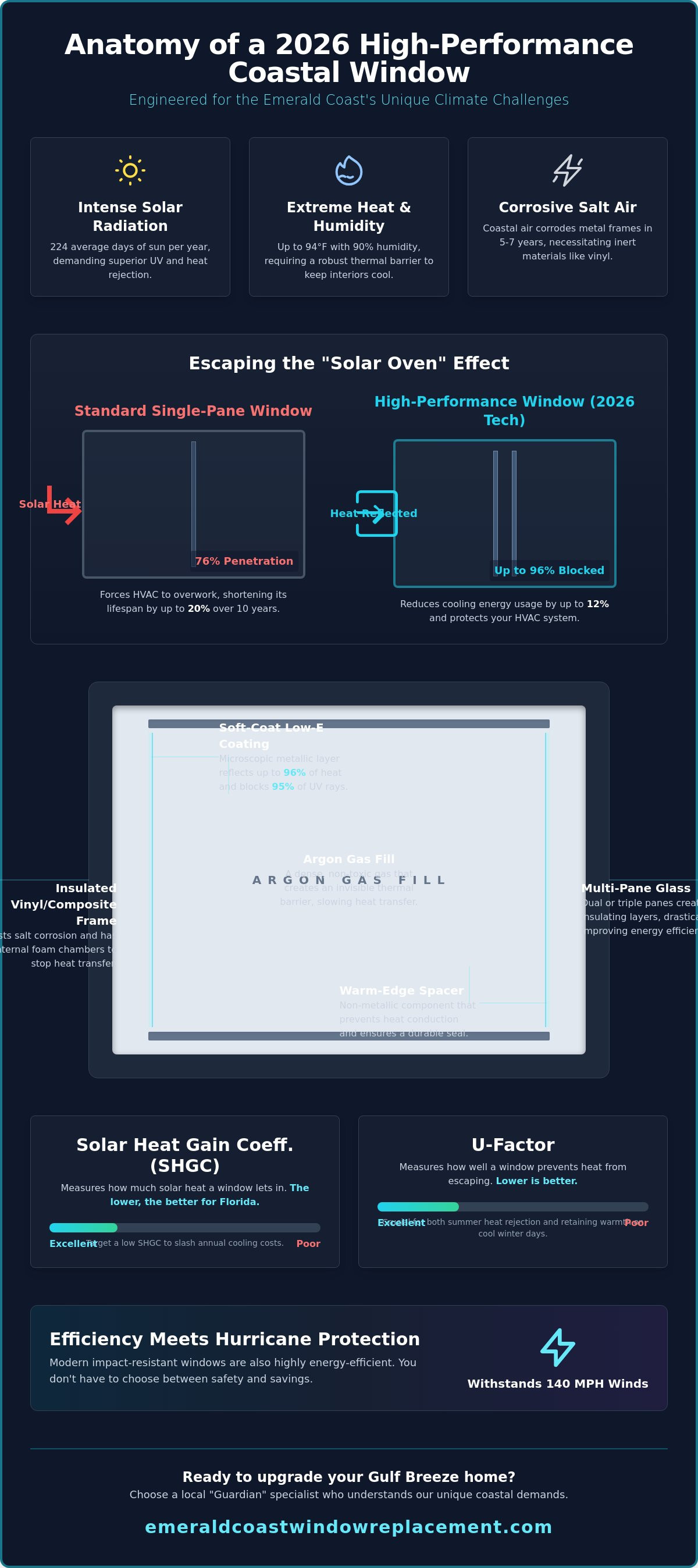
Standard single-pane glass allows up to 76% of solar energy to penetrate your living space. This creates a "solar oven" effect that forces your air conditioner to cycle constantly to maintain a comfortable temperature. Over a 10 year period, this added strain can shorten an HVAC system's lifespan by 20% or more. Investing in
reduces this thermal load significantly. By blocking the sun's rays, you protect your cooling equipment and your monthly budget.
Salt Air and Frame Durability
Proximity to the Santa Rosa Sound introduces high concentrations of salt into the air, which is a nightmare for traditional building materials. Traditional aluminum frames often struggle in this environment; they oxidize and pit within 5 to 7 years. Vinyl and advanced composite materials provide a superior alternative because they are chemically inert to salt spray.
Vinyl Frames: These don't corrode, peel, or require painting, making them ideal for the Emerald Coast.
Composite Materials: These offer the strength of wood without the risk of rot or salt damage.
Internal Insulation: Modern frames feature internal chambers often filled with polyurethane foam to stop heat transfer.
These modern frames improve the overall U-factor of
energy efficient windows Gulf Breeze
Anatomy of a High-Performance Window in 2026
By 2026, residential building standards in the Florida Panhandle have moved beyond basic glass. Modern
energy efficient windows Gulf Breeze
homeowners choose are now precision-engineered systems designed to combat 90-degree humidity and corrosive salt air. The evolution of multi-pane technology focuses on creating a thermal break that old single-pane units simply cannot provide. Specialized gas fills act as an invisible thermal barrier within these units. Argon gas is a dense, non-toxic insulator injected between glass panes to significantly slow down the transfer of heat from the outdoors to your living room. To keep this gas trapped, 2026 standards rely on warm-edge spacers. These non-metallic components replace old aluminum tracks that used to conduct heat and cause seal failure. High-quality spacers maintain the seal's integrity even during the intense temperature swings of a Florida summer. Understanding how these parts work together starts with
, which helps you identify how well a window blocks solar radiation before it enters your home.
Understanding Low-E Glass Coatings
Low-E coatings are microscopic metallic layers applied to the glass surface. They reflect long-wave infrared energy, or heat, while allowing visible light to pass through. For our specific climate, soft-coat Low-E is the preferred choice over hard-coat options. Soft-coat technology involves applying silver or tin to the glass in a vacuum chamber, reflecting up to 96% of external heat. Beyond temperature control, these coatings act as a shield for your interior. They block roughly 95% of the UV rays that cause your coastal furniture and hardwood flooring to fade over time.
Triple-Pane vs. Double-Pane in Gulf Breeze
While triple-pane glass is a staple in northern climates, its ROI in a cooling-dominated environment like the Emerald Coast is more nuanced. Double-pane windows remain the standard for most local homes because they offer a high level of efficiency without excessive weight. However, triple-pane units provide a 20% improvement in insulation that can be beneficial for west-facing rooms. The most noticeable advantage of triple-pane glass in our area is sound dampening. If your property is located near the constant noise of Highway 98, three layers of glass can reduce exterior sound by up to 50% compared to older windows. You must consider that triple-pane units are significantly heavier. They require reinforced frames and a sturdy home structure to handle the additional load. If you're weighing these options for your next project,
The Efficiency-Impact Connection: Safety Meets Savings
Many Gulf Breeze homeowners believe they must sacrifice thermal performance to achieve storm protection. This is a common misconception that often leads to missed opportunities for long-term savings. In reality, the structural requirements for storm safety directly complement the goals of thermal efficiency. High-performance energy efficient windows Gulf Breeze residents install today are engineered to handle both extreme wind pressure and the relentless Florida sun.
The heavy-duty frames required for impact ratings provide a more robust thermal break than standard builder-grade windows. These frames are reinforced with materials like aluminum or high-grade vinyl that prevent warping and maintain a tight seal for decades. When a window is built to withstand a Category 4 hurricane, it's also built to stop air infiltration. This airtight construction eliminates the drafts that typically force your HVAC system to work overtime during the humid summer months.
If you're looking for a deeper dive into the protective side of these products, our guide on hurricane windows explains the rigorous testing these units undergo. The same technology that keeps your family safe also keeps your home cool.
Impact Glass as a Thermal Insulator
Impact-rated glass is essentially a "glass sandwich." It consists of two panes of glass bonded together by a clear, flexible interlayer, usually made of Polyvinyl Butyral (PVB). This interlayer is a powerhouse for efficiency. It acts as a sound dampener and a thermal barrier, significantly improving the window's R-value. Homeowners can gain clarity on these metrics by understanding energy performance ratings provided by the Department of Energy, which details how U-factors and Solar Heat Gain Coefficients (SHGC) impact monthly utility costs.
UV Protection: The PVB layer blocks up to 99% of ultraviolet rays, preventing your floors and furniture from fading.
Heat Transfer: The density of laminated glass slows the transfer of heat into your home, maintaining a consistent internal temperature.
Hot Spot Elimination: Modern impact glass reduces the "hot spots" often felt near large picture windows during the 3 PM sun peak.
2026 Florida Building Codes and Efficiency
The 2026 standards for Santa Rosa County follow the updated Florida Building Code, which mandates specific wind-load and energy requirements for all new installations. Meeting these codes isn't just about legal compliance; it's a financial strategy. Most energy efficient windows Gulf Breeze homeowners select today automatically meet the criteria for federal tax credits and local utility rebates.
Beyond immediate rebates, the long-term insurance savings are substantial. Many Florida insurers offer "wind mitigation" credits that can reduce annual premiums by 15% to 45% once impact-rated windows are installed throughout the home. We provide a Free Estimate to help you determine which code-compliant options offer the fastest return on your investment while ensuring your coastal home remains a sanctuary.
Decoding Ratings: SHGC and U-Factor for Florida
Understanding the National Fenestration Rating Council (NFRC) label is your best defense against high utility bills. Think of this sticker as a performance guarantee for your home. While many homeowners focus primarily on the frame material, the technical specifications of the glass determine your long-term comfort. You need to know exactly what those numbers mean before you sign a contract.
In the Florida Panhandle, the Solar Heat Gain Coefficient (SHGC) is the most critical number on that label. It measures how much solar radiation passes through the glass and turns into heat inside your house. A high SHGC turns your living room into a greenhouse. The U-Factor measures non-solar heat flow. While it is vital in snowy climates to keep furnace heat inside, it plays a secondary role here. You still want a low U-Factor to prevent your expensive air conditioning from escaping through the glass, but the SHGC is what stops the sun from fighting your AC in the first place.
For a home in the Pensacola area, you should target an SHGC of 0.25 or lower to maximize thermal protection and maintain a stable indoor temperature.
Targeting the Right SHGC Numbers
Lower numbers mean better heat rejection. In Gulf Breeze, the goal is to block the infrared spectrum while allowing visible light to enter. Modern energy efficient windows Gulf Breeze residents choose often feature triple-silver Low-E coatings. These precision-engineered layers provide a crisp view of the water without the sweltering heat. Balancing this light transmission ensures your home stays bright without increasing your window replacement cost Gulf Breeze through higher monthly cooling demands. Look for a Visible Transmittance (VT) rating above 0.40 to keep that coastal charm while maintaining a low SHGC.
ENERGY STAR 2026 Coastal Criteria
The 2026 standards for the ENERGY STAR Southern Climate Zone are the most rigorous yet. To earn this certification, windows must meet specific thresholds designed specifically for high-humidity, high-heat environments like ours. Don't take a salesperson's word for it; verify the ratings on the official NFRC certified directory. Even the highest-rated glass will underperform if the installation is sloppy. Professional installation ensures the window frame is perfectly level and the flashing is integrated correctly. This precision maintains the rated performance against our 140-mph coastal wind requirements. We ensure every unit meets these local demands for total peace of mind.
Ready to see the data for your specific home?
to compare the latest high-performance ratings for your property today.
Choosing the Right Gulf Breeze Window Specialist
Selecting an installer for your energy efficient windows Gulf Breeze project is the final step in securing your property’s future. Many homeowners feel tempted by the low entry prices of national big box retailers. However, these chains often rely on a rotating door of subcontractors who might lack specific experience with the Florida Panhandle’s unique building codes. A local specialist acts as a guardian for your property. We understand a window in Gulf Breeze must withstand 140 mph wind zones and constant salt air exposure that would corrode standard hardware within 36 months.
Vetting Your Window Contractor
Precision is non-negotiable for coastal installations. Before signing any contract, ask specifically about their experience with high-velocity hurricane zones. You should verify that the contractor holds an active license and specialized insurance for Santa Rosa County projects, as general coverage often falls short for coastal structural work. There is also a critical difference between a surface-level quote and a detailed estimate. A professional estimate provides a line-item breakdown including:
Exact U-factor and SHGC ratings for each glass unit.
Specific flashing and sealing protocols for moisture protection.
Permit acquisition and debris disposal fees.
Detailed warranty terms for both the product and the labor.
The Emerald Coast Window Authority Advantage
Our team provides a neutral advisory service designed to eliminate the high-pressure sales tactics common in the industry. We connect you with vetted professionals who specialize in high-performance vinyl windows. These frames are engineered to resist warping in the 90-degree humidity of a Florida summer while maintaining a tight thermal seal. By focusing on quality over volume, we ensure you receive the most durable energy efficient windows Gulf Breeze can provide for the 2026 season. This approach ensures your investment provides measurable returns on your cooling bills starting the first month after installation.
Our goal is to make your home safer and more comfortable without the stress of a typical construction project. We've built our reputation on transparency and local reliability. If you're ready to upgrade your home’s protection and efficiency, we're here to help you take the next step with confidence.
Secure Your Gulf Breeze Home for 2026 and Beyond
Living on the Emerald Coast means preparing for both high heat and hurricane season. By 2026, the Florida Building Code requires windows to withstand specific wind pressures, often exceeding 140 mph in coastal zones. Choosing energy efficient windows Gulf Breeze homeowners can trust means looking beyond aesthetics. You need a low Solar Heat Gain Coefficient (SHGC) to block the intense Florida sun and a durable U-factor to keep your cooling costs manageable. These upgrades aren't just about comfort; they're a strategic investment in your property's resilience and long term value.
Navigating these technical requirements doesn't have to be overwhelming. You deserve a partner who understands the specific salt air and storm demands of our region. Emerald Coast Window Replacement connects you with vetted specialists who provide expert local guidance on Panhandle building codes and access to top rated hurricane impact brands. Our stress free, no pressure contractor referral service ensures you get the right fit for your home without the typical sales tactics.
Your home is your greatest asset, and we're here to help you protect it for years to come.
Frequently Asked Questions
Do energy-efficient windows really lower electric bills in Gulf Breeze?
Yes, they provide a measurable reduction in monthly cooling costs. According to the Department of Energy, Energy Star certified windows save homeowners an average of 12% on utility bills nationwide. In our local climate, where humidity and heat are extreme, replacing old single-pane glass with energy efficient windows Gulf Breeze residents trust can reduce peak summer cooling loads by up to 30%. This creates a more stable indoor temperature and reduces the constant cycling of your HVAC system.
What is the best type of window frame for the Florida Panhandle?
High-quality vinyl and thermally broken aluminum are the top performers for the Emerald Coast. Vinyl is particularly effective because it doesn't conduct heat and resists the corrosive effects of salt air. Unlike wood frames that rot in our 90% humidity or standard metal frames that transfer heat into your home, premium vinyl maintains its structural integrity for decades. We recommend multi-chambered frames that provide extra pockets of insulation for maximum thermal resistance.
Can I get hurricane protection and energy efficiency in the same window?
You can definitely achieve both goals with a single installation. Modern impact-resistant windows utilize a laminated glass sandwich, featuring two panes of glass bonded to a clear polymer interlayer. This construction provides 24/7 protection against 140 mph winds while the insulated glass unit and argon gas fills offer superior energy efficiency. It's a comprehensive solution that secures your home's envelope while blocking the intense Florida sun.
How much do energy-efficient windows cost in Gulf Breeze?
The total investment depends on the number of openings, frame materials, and specific glass performance levels you choose. While we don't provide flat pricing without an inspection, the 2025 Cost vs. Value Report indicates that homeowners typically see a 67% return on investment in home resale value for vinyl window replacements. We provide a free estimate for every project to ensure you have an accurate, transparent quote tailored to your home's specific dimensions and safety needs.
Is Low-E glass worth the extra cost for Florida homeowners?
Low-E glass is an essential investment for any home on the Emerald Coast because it reflects up to 70% of solar heat. This microscopic coating allows natural light to enter while reflecting the infrared energy that causes your rooms to overheat. By preventing the greenhouse effect in your living spaces, Low-E glass protects your flooring from UV fading and typically pays for itself through energy savings within 5 to 7 years of installation.
How long do high-performance vinyl windows last in a salt-air environment?
Premium vinyl windows are engineered to last between 20 and 30 years, even in high-salinity coastal areas. Unlike aluminum which can pit or wood which eventually peels and rots, vinyl is a non-corrosive material that stays beautiful despite the salt spray. Our Florida-proven windows include specialized hardware and reinforced vinyl compounds designed to withstand the UV radiation and moisture levels found specifically in the Gulf Breeze area.
What SHGC rating should I look for in Pensacola or Gulf Breeze?
Homeowners should look for a Solar Heat Gain Coefficient (SHGC) of 0.25 or lower for the best results. The SHGC measures how much solar radiation enters through the glass; in our southern climate, a lower number means less heat gain. Installing energy efficient windows Gulf Breeze homeowners rely on with a 0.25 rating ensures your home stays cool even when outdoor temperatures climb past 95 degrees during the humid summer months.
Are there tax credits for installing energy-efficient windows in 2026?
The Energy Efficient Home Improvement Credit allows you to claim 30% of the cost of eligible window upgrades on your federal taxes. This credit is currently capped at $600 per year for windows through the end of 2032 under the Inflation Reduction Act. To qualify for this incentive in 2026, your new windows must meet the Energy Star Most Efficient criteria. This provides a direct path to offset the cost of your home performance upgrades.


Comments