Impact vs Non-Impact Windows Cost: A 2026 Florida Homeowner’s Comparison
- ECWA

- 4 days ago
- 12 min read
The lowest estimate on your desk might actually be the most expensive choice you make for your home this year. As homeowners in the Pensacola area, we've all felt the sting of rising insurance premiums and the annual anxiety that comes with hurricane season. It's tempting to look at standard glass as a way to cut costs, but that initial savings disappears quickly when you factor in the massive hurricane impact windows insurance discount Florida carriers now offer for fully protected homes. You want a house that stands strong against the Gulf's unpredictable weather without draining your bank account every month just to keep it insured.
We're here to help you move past the confusing contractor jargon and see the real numbers behind your investment. You'll discover the actual price gap between impact and non-impact options, including how the 2026 building code updates and the "all-or-nothing" insurance rule affect your bottom line. We will break down long-term ROI through energy efficiency and premium credits, giving you the confidence to choose a solution that protects your family and your finances for years to come. This guide provides the clarity you need to make a steady, informed decision for your coastal residence.
Table of Contents
Impact vs. Non-Impact Windows: Defining the Value Gap
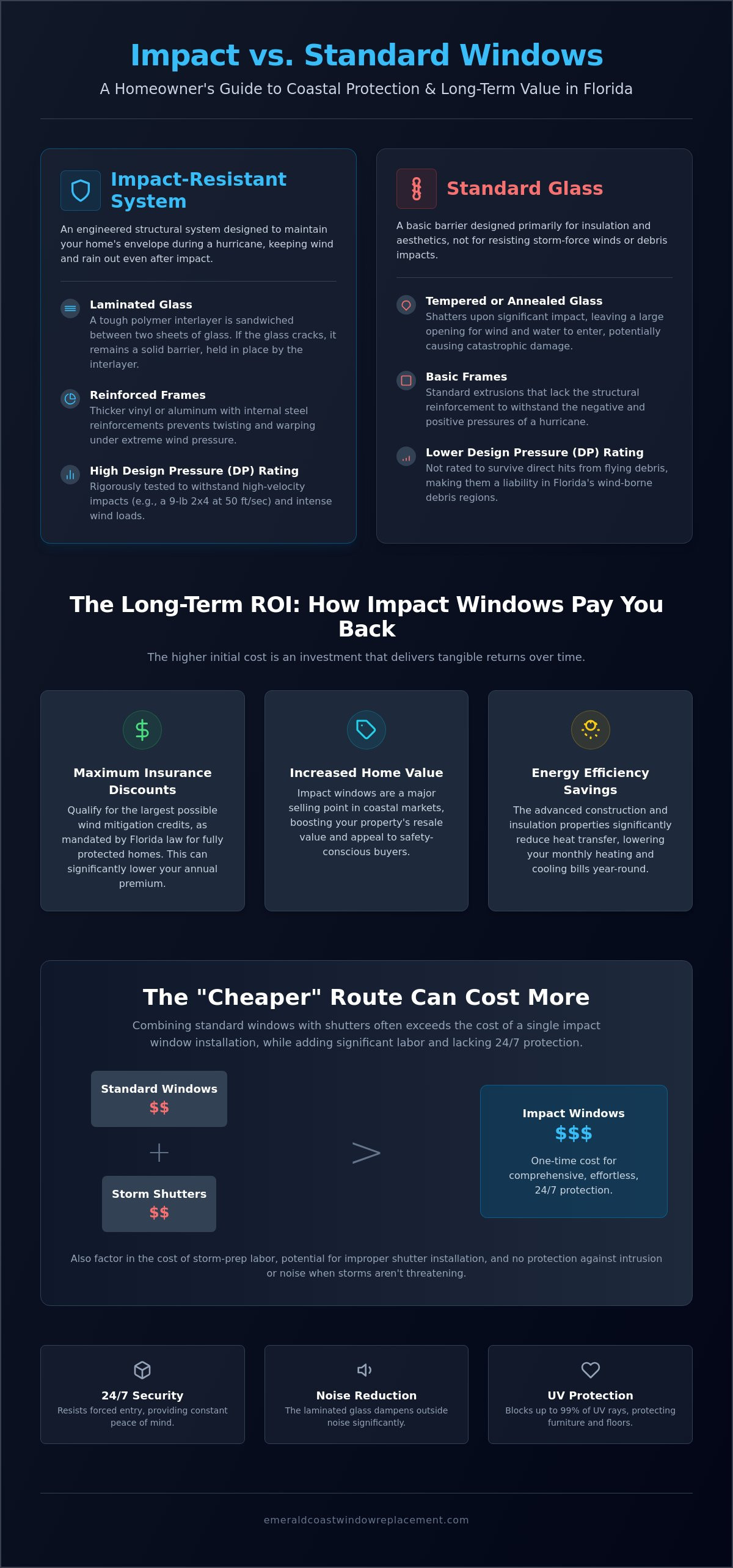
Choosing between impact and non-impact windows isn't just a matter of picking a different glass type; it's a choice between a basic barrier and a fully engineered structural system. Traditional windows are designed to keep the rain out and the AC in. Impact-resistant windows, however, are built to keep your roof on by maintaining the home's structural envelope during a storm. This fundamental shift in purpose is why the cost reflects a sophisticated engineering process rather than a simple material upgrade. While standard windows rely on tempered glass that shatters upon impact, a true impact system uses a combination of reinforced frames and specialized glass that stays intact under extreme pressure. This structural integrity is exactly what qualifies a home for the hurricane impact windows insurance discount Florida homeowners seek to offset their rising monthly costs. Without this specific rating, your insurance carrier likely won't recognize the upgrade as a valid wind mitigation feature.
Design Pressure (DP) ratings are the metric that separates these two categories. A DP rating measures how much wind load a window can handle before it fails. In coastal areas like Pensacola or Gulf Breeze, high DP ratings are a necessity. Non-impact windows often carry lower ratings because they aren't expected to survive a direct hit from flying debris; whereas, impact systems are tested to withstand repetitive cycles of high-velocity pressure and impact without failing. The "system" approach, where the glass, frame, and sealant work in unison, is what drives the initial price gap, but it's also what provides the peace of mind you need when a storm enters the Gulf.
The Anatomy of Impact-Resistant Glass
The core of an impact window is the interlayer. Unlike the single or double-pane glass in older homes, which offers little more than a thin barrier, impact glass features a tough polymer layer sandwiched between sheets of glass. This Laminated glass construction ensures that even if the outer layer cracks from a stray branch or debris, the window remains a solid shield. You also get the added benefit of 24/7 security against intruders and a noticeable drop in outside noise, turning your home into a quiet sanctuary. Because the glass is significantly thicker and heavier than standard residential glass, it requires a more robust operating mechanism to function smoothly over time.
Frame Reinforcement: More Than Just Glass
Even the strongest glass is useless if the frame folds under pressure. Impact frames are built with significantly thicker vinyl or aluminum extrusions than their standard counterparts. These frames are further strengthened with internal steel or aluminum reinforcements to ensure they don't twist or warp during a storm. Specialized heavy-duty hardware and reinforced corner welds keep the sash securely locked within the frame when the wind tries to pull it out. The increased density and complexity of these frames represent a major part of the price difference, as they provide the structural backbone required to protect your home's envelope. Effectively, the frame acts as the anchor that allows the impact glass to do its job under the most extreme conditions.
Comparing the Upfront Costs: Impact vs. Standard
There is no sugarcoating the reality that impact-rated units require a larger initial check than standard glass. For 2026 projects, homeowners are seeing a distinct price gap driven by global supply chain shifts and local demand. While a standard vinyl window might seem like a bargain, it lacks the heavy-duty components required to withstand a Category 3 storm or higher. The cost of impact windows is driven by three main factors: the raw cost of laminated glass, specialized manufacturing processes, and the rigorous testing required to meet Florida Building Code standards. Every unit must pass a missile impact test where it's struck by a nine-pound 2x4 at 50 feet per second. This level of durability isn't cheap to produce, but it's the only way to qualify for the hurricane impact windows insurance discount Florida carriers provide to reward lower-risk properties.
Labor also plays a massive role in your final quote. Impact windows are significantly heavier than standard units, often requiring extra crew members for a safe installation. Beyond the weight, the anchoring requirements in the Panhandle are incredibly strict. A window is only as strong as its connection to your home's framing. If the anchoring isn't precise, the entire unit can fail under pressure, regardless of how strong the glass is. This precision labor adds to the upfront cost but ensures the system actually performs when the wind starts to howl. To help manage these initial expenses, many residents look toward the My Safe Florida Home grant program, which can provide matching funds to offset the investment in these critical upgrades.
Material Choices and Their Price Impact
The frame material you choose will heavily influence your total. While aluminum was once the standard for coastal durability, 2026 has seen a major shift toward high-performance vinyl. Aluminum prices have climbed due to recent tariffs, making vinyl a more cost-effective option that still offers excellent structural integrity. You also need to consider glass coatings. Most modern impact units include Low-E coatings and solar tints as standard features to combat the Florida sun. If your home features custom shapes or oversized picture windows, expect the price gap to widen further, as these require specialized engineering to maintain their impact rating at larger scales.
Installation Complexity in Coastal Florida
Installing windows in Escambia and Santa Rosa Counties isn't the same as doing a job in the Midwest. Our local codes require specific fastener spacing and depth to combat wind-borne debris. If you're retrofitting an older Pensacola home, we often find that the original openings need structural reinforcement before they can support the weight and pressure of a new impact system. This is why it's vital to consult a specialist’s guide to window options before signing a contract. Working with a vetted professional ensures your installation meets the high standards required for both safety and insurance compliance. If you're feeling overwhelmed by the different quotes you've received, Emerald Coast Window Authority can help you compare your options with an expert, neutral eye.
The Long-Term ROI: Where Impact Windows Pay You Back
Viewing impact windows as a simple home improvement project misses the bigger picture. In the Panhandle, this is a long-term financial strategy. You're trading a higher upfront cost for a decade of lower operating expenses. Between the immediate reduction in your monthly utility bills and the significant drop in your annual insurance premiums, these systems often pay for themselves much faster than homeowners realize. Based on current 2026 data, the savings from insurance alone can often cover the initial investment within 7 to 12 years, all while providing 24/7 protection that shutters simply can't match.
Florida Insurance Credits and Premium Reductions
Florida law requires insurance companies to offer credits for wind mitigation, but you have to prove your home is protected. This starts with a Wind Mitigation Inspection using the updated OIR-B1-1802 form. Once a certified inspector confirms that every opening in your home is impact-rated, you unlock the hurricane impact windows insurance discount Florida insurers are mandated to provide. For many of our neighbors, this translates to a 15% to 45% reduction on the wind portion of their policy. If you're curious about how these savings balance against the initial investment, it's helpful to review a specific window replacement cost in Gulf Breeze to see the local math in action.
Energy Efficiency: Beyond Storm Protection
While the insurance savings are predictable, the energy efficiency gains are the silent workhorse of your ROI. Laminated glass is naturally much thicker than standard panes, which means it acts as a superior thermal barrier against the humid heat we face in Milton and Pensacola. High-performance units often feature argon gas fills and advanced Low-E coatings that block up to 99% of UV rays. This doesn't just protect your furniture from fading; it significantly lightens the load on your air conditioner. You can dive deeper into the technical specs of these energy-efficient windows to see how they maintain a comfortable indoor climate year-round.
Finally, consider your home's resale value. In a market where storm resilience is a top priority for buyers, having certified impact windows is a massive selling point. It tells a potential buyer that the home is safe, quiet, and cheap to insure. This "passive resilience" often allows sellers to recoup a large portion of their investment during the sale, making it one of the most stable upgrades you can choose for a Florida property.
The Hidden Costs of Non-Impact Windows
It's easy to look at the sticker price of standard glass and assume that pairing it with shutters is the budget-friendly move. However, this calculation rarely accounts for the full scope of ownership over the next decade. When you combine the price of high-quality standard windows with the purchase and installation of professional-grade accordion or roll-down shutters, the total often rivals the cost of a single impact-resistant system. Beyond the initial check, you have to consider the ongoing "Storm Day Tax"-the heavy physical and emotional toll of prepping your home as a hurricane approaches. This time spent wrestling with panels or deploying heavy shutters is a recurring cost that many homeowners overlook until the first warning is issued.
There is also the risk of total failure. If a single shutter jams or isn't deployed correctly, your home's structural envelope is compromised. Once a window breaks, internal pressure can lift the roof from the inside out. Impact windows eliminate this human-error variable entirely. They provide the 24/7 reliability required to maintain your hurricane impact windows insurance discount Florida status without you ever having to lift a finger. This "passive" reliability is often what makes the difference during a claim, as insurers expect every opening to be fully protected to honor your mitigation credits.
The Cost of Hurricane Shutters and Maintenance
High-end shutter systems aren't a "set it and forget it" solution. In our salt-air environments like Pensacola Beach, moving parts in accordion tracks or roll-down motors require regular cleaning and lubrication to prevent seizing. If they aren't maintained, they may fail exactly when you need them most. There's also the aesthetic trade-off. Bulky shutter housings can detract from your home's curb appeal, whereas modern vinyl windows provide a clean, high-end look without any visible hardware. Over time, the combined cost of standard window replacement, shutter purchase, and recurring maintenance often exceeds the streamlined investment of an impact-rated system.
Passive vs. Active Protection
The most significant difference lies in how these systems function during a crisis. Impact windows provide "passive" protection; they're always ready, whether you're at home or vacationing in Navarre. Shutters are "active" systems that rely entirely on human intervention. If a storm shifts path while you're at work or out of town, your home remains vulnerable. Even if you're home, the stress of deploying shutters in rising winds is a burden you don't have to carry with impact glass. A window only protects your home's envelope if it's actually covered before the wind starts. To ensure you're making the most financially sound choice for your specific property, consult with a local window expert to compare the total cost of ownership for both options.
Making the Right Choice for Your Panhandle Home
Deciding on the right window system comes down to your home's proximity to the Gulf and your long-term financial goals. If you live on Pensacola Beach or in the lower parts of Gulf Breeze, impact windows are a non-negotiable necessity for both safety and home value. For most homeowners in the Wind-Borne Debris Region, the hurricane impact windows insurance discount Florida carriers offer makes the choice simple, as it directly offsets the price gap over time. However, if you're located significantly further inland where secondary protection is already in place, high-performance non-impact windows might suffice. The key is to look past the initial sticker price and evaluate the total cost of ownership, including energy bills and future insurance premiums.
Choosing the wrong product can be a costly mistake that leaves your home vulnerable and your insurance credits void. It's not just about the glass; it's about ensuring every component of the installation aligns with the unique demands of our coastal climate. We've seen many neighbors struggle with confusing quotes that don't account for local permitting or structural prep. Finding a balance between safety and budget doesn't have to be a high-pressure experience if you have a steady partner to help you navigate the technical details.
Local Regulations and Building Codes
The regulatory environment in the Panhandle is shifting. The 8th Edition of the Florida Building Code is currently in effect, but the 9th Edition, scheduled for December 31, 2026, will expand the Wind-Borne Debris Region even further inland. This means more homes in Escambia and Santa Rosa Counties will soon be required to have impact-rated openings. A specialist ensures your new hurricane windows meet these evolving standards, preventing issues during the mandatory permitting process. In Pensacola, an unpermitted window replacement is a major red flag that can prevent you from claiming insurance discounts or passing a future home inspection.
How to Get an Accurate, Neutral Quote
Navigating the world of window manufacturing can feel overwhelming when every contractor claims to have the "best" proprietary product. At Emerald Coast Window Authority, we act as a neutral guide to help you cut through the noise. Our goal is to provide the professional authority of an expert contractor with the reliability of a trusted neighbor. By using a neutral advisory service, you avoid high-pressure sales tactics and gain a clear, honest comparison of the products that actually fit your home's needs. We take pride in helping our community build resilience through transparent information and expert connections. Connect with a vetted local professional for a free estimate today.
Secure Your Coastal Investment for the Years Ahead
Choosing the right windows for your Panhandle home is a decision that impacts your safety, your comfort, and your monthly budget. You now understand that the upfront cost of impact-rated systems is balanced by the elimination of the physical stress of storm prep and the recurring maintenance required by shutters. By maintaining your home's structural envelope, you aren't just buying glass; you're securing a long-term financial strategy that pays dividends through energy efficiency and the mandatory hurricane impact windows insurance discount Florida carriers provide.
We're here to help you navigate these choices without the stress of high-pressure sales tactics. Our neutral advisory service connects you with a vetted network of licensed Florida Panhandle contractors who value craftsmanship and community safety. Focus on long-term home resilience and start seeing the savings that a high-performance window system provides every day of the year.
Get a Professional Window Estimate for Your Pensacola Home and take the first step toward a safer coastal lifestyle. You can move forward with confidence, knowing your home is protected by a steady, dependable partner.
Frequently Asked Questions
How much more do impact windows cost than regular windows?
Impact windows require a higher initial investment than standard windows because they're built as a complete structural system. You're paying for specialized laminated glass and heavily reinforced frames that must pass rigorous missile-impact testing. While the upfront price is higher, this cost is often balanced by the long-term savings on your utility bills and insurance premiums.
Do impact windows really lower my homeowners insurance in Florida?
Yes, installing these systems is one of the most effective ways to secure a hurricane impact windows insurance discount Florida law mandates for protected homes. To unlock these savings, you must ensure every opening in your home is protected and provide your carrier with a certified wind mitigation inspection. Many Panhandle homeowners see their windstorm premiums drop by 20% or more after a full installation.
Can I install impact glass in my existing window frames?
No, you cannot simply swap the glass because standard frames aren't designed to handle the weight or the pressure of an impact event. A true impact-rated window is an engineered unit where the glass and the reinforced frame work together to stay anchored in your wall. Attempting to retrofit glass into old frames would fail building codes and won't provide the protection you need.
How long do impact-resistant windows last in coastal environments?
Most high-performance impact windows are built to last 20 to 30 years, even with the salt air we experience in Pensacola and Gulf Breeze. Choosing vinyl frames is often the best move for coastal durability because they don't corrode or pit like older aluminum models. Regular cleaning of the tracks and hardware will ensure the system operates smoothly for decades.
Are impact windows energy efficient enough to pay for themselves?
Yes, the thick laminated glass acts as a powerful thermal barrier that keeps the Florida heat outside where it belongs. By reducing the load on your air conditioner and qualifying you for substantial insurance credits, these windows eventually pay for themselves. Most homeowners find that the combination of lower monthly bills and increased home value makes this a very stable investment.
Do I still need shutters if I have impact-resistant windows?
No, impact windows are a stand-alone solution that completely eliminates the need for bulky shutters or plywood. They provide "passive" protection, meaning your home is always ready for a storm even if you're away on vacation. This 24/7 readiness is a major lifestyle upgrade for busy families who don't want to spend their weekend wrestling with heavy shutter panels.
Is there a tax credit for installing impact windows in 2026?
Yes, you can currently take advantage of the Energy Efficient Home Improvement Credit, which offers a federal tax credit of up to $600 annually for qualifying windows. This incentive was extended through 2032, providing a helpful way to offset your project costs. We recommend keeping your receipts and NFRC labels to make the filing process simple during tax season.
What happens if the outer pane of an impact window breaks?
The window will stay intact and continue to protect your home's interior from wind and rain. The internal polymer interlayer is designed to hold the glass fragments together, much like a car windshield. While the glass may look "spider-webbed" after a strike, the structural envelope remains sealed, preventing the dangerous internal pressure changes that lead to roof failure.


Comments