
Low-E Glass Windows in Pensacola: The Homeowner’s 2026 Guide to Energy Savings
- ECWA

- Mar 22
- 14 min read
What if your windows were actually a hidden tax on your monthly budget, quietly draining 30% more from your wallet every single summer? Many homeowners don't realize that outdated panes are the primary culprit behind those soaring utility bills. By installing low e glass windows, you can finally stop that oppressive wall of heat from entering your living room. You've likely noticed your expensive rugs or hardwood floors starting to bleach under the intense Gulf Coast sun; it's a clear sign that your home lacks the protection it needs against the Florida Panhandle's relentless UV rays.
At Emerald Coast Window Authority, we believe your home should be a sanctuary, not an oven. This guide explores how precision-engineered coatings block up to 70% of solar heat gain while ensuring your property remains fully compliant with the updated Florida 2026 energy codes. We'll show you how to lower your monthly costs and achieve the coastal durability your family deserves. You'll discover why this investment is the smartest way to maintain your comfort and protect your interior decor for years to come.
Key Takeaways
Learn how microscopic metallic layers reflect intense Florida heat to lower your monthly cooling costs without sacrificing natural sunlight.
Discover why choosing high-performance low e glass windows with a low Solar Heat Gain Coefficient is the most effective way to eliminate the "oven effect" in Gulf Breeze and Milton homes.
Understand how to integrate thermal efficiency with hurricane-impact durability for a single window unit that defends your home against both heatwaves and storm surges.
Identify the critical differences between hard and soft coat technologies to ensure your upgrade meets the gold standard for 2026 coastal energy efficiency.
Gain the confidence to navigate NFRC labels and find vetted local specialists who understand the specific demands of the Escambia and Santa Rosa climate.
Table of Contents What is Low-E Glass and Why Does Pensacola Need It? How Low-E Windows Beat the Florida Panhandle Heat The Power Couple: Combining Low-E with Hurricane-Impact Glass Choosing the Right Low-E Coating for Your Pensacola Home The Emerald Coast Advantage: Finding Vetted Local Experts
What is Low-E Glass and Why Does Pensacola Need It?
Living in the Florida Panhandle means the sun is your constant companion. In Milton and Pensacola, we enjoy an average of 224 sunny days every year. While that's great for a day at the beach, it's often a liability for your home's cooling system. Standard clear glass acts like a magnifying glass, allowing solar heat to pour into your living space and forcing your air conditioner to run 24/7. This is exactly why low e glass windows have become the standard for homeowners who want to regain control over their indoor climate.
Low-E, or low emissivity, is a specialized technology involving a microscopic, metallic layer applied to the glass. This coating is so thin that it's thinner than a strand of human hair, ensuring your view remains unobstructed. The primary goal of this technology is to manage heat transfer. This Low-E glass explained by experts highlights how the coating reflects thermal energy back to its source instead of letting it soak through the pane. In our region, where humidity and heat levels often peak in August, this reflection is the difference between a cool sanctuary and a sweltering living room.
The urgency for this upgrade is growing. Florida's energy regulations are tightening, with new 2026 energy standards for residential properties expected to demand even higher thermal efficiency. If your windows were installed before 2015, they likely lack the precision-engineered coatings required to meet these upcoming benchmarks. We see homeowners losing up to 30% of their home's cooling energy through inefficient glass. Upgrading now isn't just about comfort; it's a strategic move to protect your home's value and lower your monthly overhead.
The Science of Emissivity Simplified
Emissivity is a technical term for how much heat a surface radiates. A standard glass pane has high emissivity, meaning it absorbs heat and then radiates it into your home. Think of it like a dark asphalt driveway on a July afternoon. In contrast, a Low-E coating gives the glass low emissivity. It acts like a high-tech mirror that reflects heat energy away. Low-E glass is a transparent shield that keeps heat out in summer and in during winter.
UV vs. Infrared: What Are You Actually Blocking?
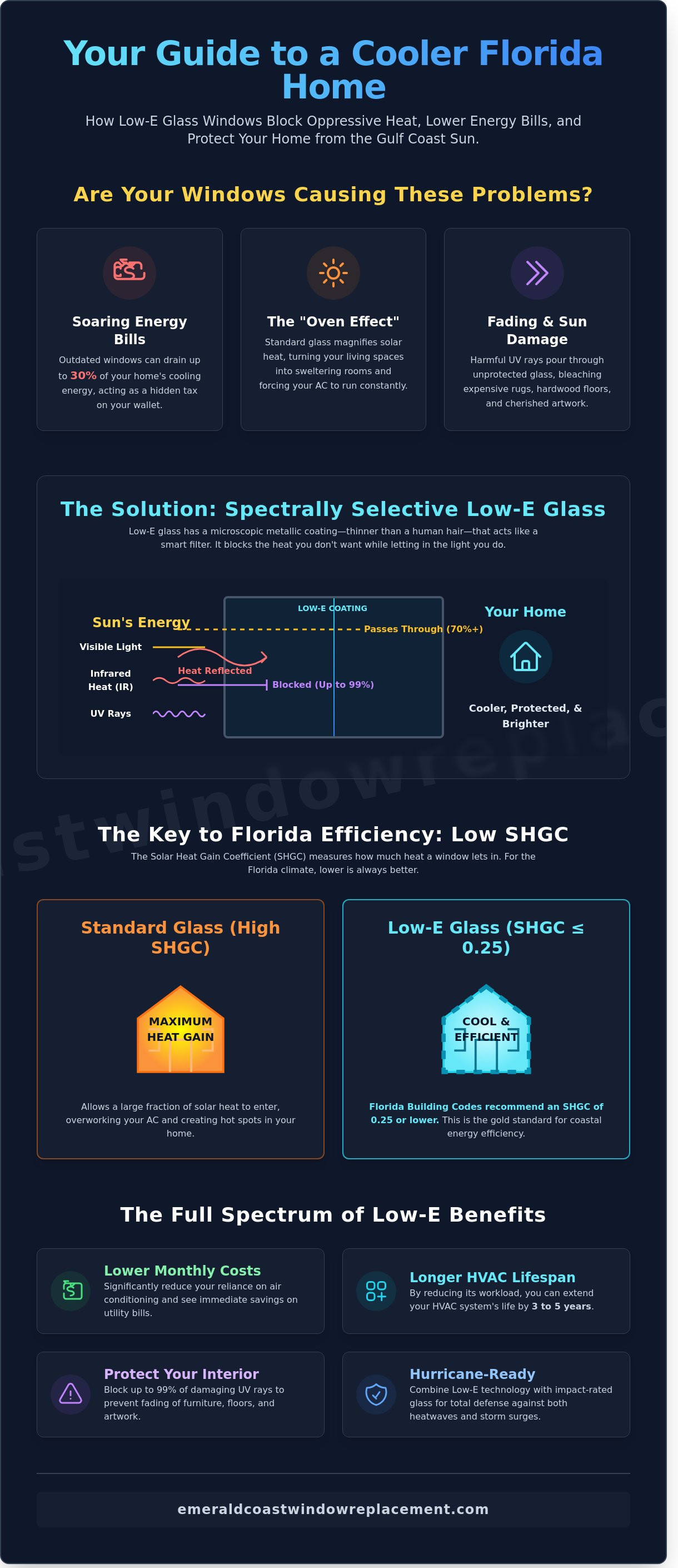
It's vital to understand that not all sunlight is the same. Solar energy hits your home in different forms, mainly Ultraviolet (UV) light and Infrared (IR) light. UV rays are the culprit behind faded curtains, bleached rugs, and damaged artwork. Infrared rays are what you feel as physical heat. High-quality low e glass windows use spectrally selective coatings to filter these specifically. They can block up to 99% of UV rays and a significant portion of IR heat while still allowing 70% or more of visible light to pass through. For coastal homes, this means you get the bright, airy Emerald Coast lifestyle without the heat damage or the high AC bills.
How Low-E Windows Beat the Florida Panhandle Heat
Milton summers aren't just warm; they're relentless. In Escambia and Santa Rosa counties, standard clear glass often acts like a magnifying glass, intensifying the sun's rays as they enter your living space. This creates a localized "oven effect" where solar energy pours into your home, forcing your air conditioner to run for 15 or 18 hours a day just to keep pace. By installing low e glass windows, you stop the heat before it ever crosses your threshold. This reduction in thermal transfer can extend your HVAC system's lifespan by 3 to 5 years because the unit doesn't have to cycle as frequently to maintain a steady temperature.
The technical secret lies in the microscopic layers of silver or other low-emissivity materials applied to the glass. These coatings are designed to reflect long-wave infrared energy, which is the heat you feel from the sun. When your home stays naturally cooler, your monthly utility bills reflect that efficiency immediately. Our local climate demands windows that do more than just provide a view; they must act as a functional barrier against the Gulf Coast humidity and heat.
Combatting Solar Heat Gain (SHGC)
When you're evaluating window performance in Milton, the Solar Heat Gain Coefficient (SHGC) is the most vital metric to track. SHGC measures the fraction of solar radiation admitted through a window. In northern states, homeowners might want a higher number to help warm their homes during snowy winters. However, Florida building codes and efficiency standards prioritize an SHGC of 0.25 or lower. High-performance choosing energy-efficient windows involves checking these ratings to ensure they meet the specific demands of the Emerald Coast.
Reflective Positioning: Low-E layers are positioned on the internal side of the outer pane to reflect exterior heat back toward the street.
Visible Light Transmittance: Modern coatings allow 70% or more of natural light to enter while still blocking the heat.
Reduced Radiant Heat: These windows lower the "mean radiant temperature" of a room, making it feel 5 to 10 degrees cooler even if the thermostat hasn't moved.
Protecting Your Interiors from Gulf Coast UV
The Florida sun doesn't just raise your power bill; it can destroy your property. Coastal decor, expensive area rugs, and hardwood floors can fade or discolor in as little as 24 months when exposed to direct Milton sunlight through standard glass. Think of low e glass windows as high-SPF sunscreen for your home. These precision-engineered coatings block up to 95% of harmful ultraviolet (UV) rays, which are the primary cause of fading in fabrics and wood finishes.
This protection preserves the vibrant colors of your furniture and the integrity of your interior paint. It's an investment in your home's aesthetic value as much as its energy efficiency. Beyond the summer heat, these windows offer a secondary benefit during the 15 to 20 nights of freezing temperatures Milton experiences each winter. The same coating that keeps heat out in July works to keep your furnace's warmth inside during January by reflecting internal heat back into the room. If you're tired of high utility costs and fading furniture, a free estimate can show you exactly how much a modern upgrade can protect your investment.
The Power Couple: Combining Low-E with Hurricane-Impact Glass
Many Milton homeowners believe they must choose between energy savings and storm protection. You don't have to make that compromise. While low e glass windows provide the thermal barrier your home needs to fight the Florida heat, impact glass provides the structural shield necessary for hurricane season. These are two distinct technologies that work in tandem. Low-E is a microscopic metallic coating applied to the glass surface, whereas "impact" refers to the heavy-duty lamination and reinforced frames that prevent shards from flying during a storm.
We integrate these technologies into a single, high-performance unit. Some clients worry that adding a chemical coating might weaken the glass or make it more prone to shattering. This is a common misconception. The coating is thinner than a human hair and doesn't affect the structural integrity of the tempered glass. In fact, understanding how Low-E coatings work helps clarify why they are the perfect partner for impact-resistant layers. They handle the radiation while the lamination handles the force.
The financial benefits of this combination extend beyond your monthly utility bill. In the Florida Panhandle, installing "Impact + Low-E" windows can lead to a 25% to 45% reduction in the windstorm portion of your homeowner’s insurance premiums. Under Florida Statute 627.0629, insurance companies must provide discounts for homes with effective wind-protective improvements. It's a rare win-win that increases your home's resale value while lowering your daily cost of living.
How the 'Sandwich' Works
An impact window functions like a transparent sandwich. It consists of two panes of glass bonded together by a clear, flexible interlayer, usually made of Polyvinyl Butyral (PVB). We place the Low-E coating on the internal surface of the glass, typically surface number two or three. This placement keeps the silver layers protected from scratches and oxygen. Beyond safety, this multi-layer construction acts as a massive acoustic buffer. It can reduce external noise from traffic or lawnmowers by as much as 40 percent, creating a sanctuary inside your home.
Coastal Durability and Salt Air Resistance
Living near Pensacola Beach or Perdido Key presents a unique challenge: salt air corrosion. We use "soft-coat" low e glass windows because the silver layer is vacuum-sealed inside the Insulated Glass Unit (IGU). This prevents the humid, salty atmosphere from ever touching the sensitive coating. This protection is vital for maintaining the window's clarity and performance over a 20-year lifespan. Proper professional installation is the only way to ensure these seals remain airtight. If a seal fails, the salt air can enter the unit, leading to "seal failure" or permanent clouding. Our precision-engineered installation process ensures your investment remains crystal clear and efficient despite the harsh coastal elements.
Energy Efficiency: Blocks up to 95% of UV rays.
Storm Security: Withstands winds exceeding 140 mph.
Sound Dampening: High STC ratings for a quieter home.
Insurance Savings: Qualifies for significant wind mitigation credits.
Choosing the Right Low-E Coating for Your Pensacola Home
Selecting the perfect window involves more than just picking a frame style. In our humid, sun-drenched climate, the specific coating on your low e glass windows determines whether your power bill drops or stays stagnant. You need to look for the National Fenestration Rating Council (NFRC) label on every unit. For Milton homeowners, the Solar Heat Gain Coefficient (SHGC) is the most critical number. Aim for an SHGC of 0.25 or lower. This rating means the window blocks 75% of the sun's heat from entering your living room. A U-Factor of 0.40 or less is also vital, as it measures how well the window prevents heat from migrating through the glass during those rare but humid winter nights.
Hard Coat vs. Soft Coat: The Winner for Florida
The manufacturing process defines how your windows perform over the next twenty years. Hard coat, or pyrolytic glass, involves applying a thin layer of tin to the glass while it is still molten. It's durable and often used in DIY projects, but it lacks the precision needed for Gulf Coast heat. Soft coat glass, known as sputter coating, is the gold standard for 2026. This process applies silver and zinc oxide layers in a vacuum chamber after the glass is formed. It offers significantly better thermal performance, reflecting nearly twice as much heat as hard-coated alternatives.
Feature Hard Coat (Pyrolytic) Soft Coat (Sputter) Insulation (U-Value) Moderate (~0.45) Superior (~0.24) Solar Heat Blocking Lower Efficiency High Efficiency (SHGC < 0.25) Appearance Slightly Tinted Nearly Invisible
Understanding Visible Transmittance (VT)
Visible Transmittance (VT) measures how much natural light enters your home. Homeowners often worry that high-performance low e glass windows will make their rooms look dark or give the glass a dated green tint. Modern "triple-silver" coatings have solved this issue. You can now achieve a VT rating of 0.70, meaning 70% of natural light pours in while 95% of damaging UV rays are blocked. This balance ensures your coastal home remains bright and airy without fading your furniture or flooring. The "green look" is a relic of 1990s technology; today's coatings are virtually indistinguishable from clear glass to the naked eye.
Working with a local expert ensures you get products designed specifically for the Emerald Coast. Use this checklist when interviewing contractors to verify they understand our unique requirements:
Do they offer windows that meet the ASCE 7-22 wind load standards for Santa Rosa County?
Can they provide the specific SHGC and U-Factor data for the units they propose?
Are the installers certified to handle soft-coat glass without damaging the delicate silver layers?
Does the warranty cover seal failure and "spontaneous breakage" caused by thermal stress?
Do they provide a clear, written timeline for the installation process?
We pride ourselves on being the local guardian for your home's efficiency and safety. If you're ready to see the difference professional installation makes, request a free estimate from our expert team today.
The Emerald Coast Advantage: Finding Vetted Local Experts
Choosing the right upgrades for your Milton home isn't just a matter of aesthetics; it's a critical decision for your property's structural integrity and your monthly budget. In Escambia and Santa Rosa counties, the environmental demands are unlike anywhere else in the country. Our local climate features a punishing combination of salt-laden air, relentless humidity, and the constant threat of tropical systems. Generic window solutions often fail prematurely here because they aren't engineered for these specific stressors. This is why local expertise is the most valuable asset you can have when selecting low e glass windows for your property. A contractor who understands the difference between a standard double-pane unit and one designed for the Florida Panhandle can save you thousands in future repairs.
The Emerald Coast Window Authority serves as a vital bridge between homeowners and the region's most reputable licensed professionals. We don't believe in the high-pressure tactics used by national franchises that prioritize sales quotas over long-term quality. Instead, we embrace a neutral advisor approach. We provide the technical data you need to make an informed choice, focusing on how specific glass coatings interact with the Florida sun to lower your cooling load. Our partner contractors are vetted for their craftsmanship and their commitment to the community. This ensures you receive a premium installation that stands up to the elements while providing a measurable return on your investment through reduced energy consumption.
Navigating Local Building Codes in Pensacola
Pensacola and the surrounding Milton area are designated as wind-borne debris regions. This classification requires windows to meet stringent impact and pressure standards that are far more rigorous than those in inland states. Our vetted specialists stay current with the 2026 Florida Building Code updates, which mandate specific performance ratings for any new installation. By choosing a local expert, you ensure your low e glass windows are rated for wind speeds exceeding 140 mph. This level of precision protects your family during a hurricane and provides the peace of mind that comes from knowing your home is fully compliant with the latest safety laws. Local pros also handle the permitting process, ensuring every detail satisfies Escambia County inspectors.
Get Your Stress-Free Estimate Today
Starting your home improvement journey shouldn't feel like a chore. We've streamlined the process to match you with a top-tier Pensacola installer who respects your time and your property. You won't find any hidden fees or aggressive "sign-today" discounts that feel like a trap. Instead, you receive a clear, transparent assessment of your home's efficiency needs. Our partner installers focus on these core values:
Precision Engineering: Every window is measured to the millimeter for a perfect, airtight seal.
Verified Licensing: We only work with contractors who carry full insurance and Florida-specific licenses.
Energy Transparency: Get a clear breakdown of how your new windows will impact your 2025 and 2026 utility bills.
Investing in your home is a long-term commitment to safety, curb appeal, and thermal performance. By upgrading now, you're shielding your interior from UV damage and ensuring your AC system doesn't have to work overtime during the sweltering July heat. Take the first step toward a cooler, more secure home by requesting your professional consultation today. It is the smartest way to protect your piece of the Emerald Coast lifestyle.
Secure Your Pensacola Home for 2026 and Beyond
Upgrading to low e glass windows is a strategic move that does more than boost curb appeal. According to 2024 Energy Star data, these high-performance coatings can reduce cooling costs by an average of 12% by reflecting intense solar heat back into the Florida sun. When you pair this technology with hurricane-impact glass designed for 150 mph wind zones, you create a dual barrier that protects both your family and your wallet. We've built a vetted network of licensed Florida contractors who specialize in these precision-engineered installations. As your expert advisor for the Emerald Coast, we focus on coastal durability and long-term energy savings. You don't have to settle for standard glass when your home deserves the best protection available. Our team is ready to help you navigate these technical choices with transparency and local expertise.
Your path to a cooler, safer, and more efficient coastal home starts with a simple conversation. Let's make your 2026 home improvement goals a reality today.
Frequently Asked Questions
Is Low-E glass worth the extra cost for a home in Pensacola?
Yes, Low-E glass is a smart investment that typically reduces annual cooling costs by 15% for Pensacola homeowners. While the initial price is 10% to 15% higher than standard glass, the average resident sees a full return on investment through lower energy bills within 6 years. We focus on coastal durability to ensure your windows withstand the high humidity of the Florida Panhandle for decades.
Does Low-E glass make my windows look green or dark?
Modern low e glass windows do not significantly darken your home or create a noticeable green tint. High-quality coatings maintain a Visible Light Transmittance rating of 70% or higher, ensuring your living space stays bright and airy. You get the benefit of lower AC bills without sacrificing your view of the Emerald Coast. It's the perfect balance of clarity and thermal protection.
What is the difference between Low-E and tinted glass?
Low-E glass reflects heat energy back to its source while tinted glass simply absorbs it. Tinted windows can become hot to the touch and often reduce visibility by 30% or more. In contrast, Low-E coatings are microscopic silver layers that block 99% of harmful UV rays. This technology protects your furniture from fading and keeps your interior temperatures stable during a 95 degree Milton afternoon.
Can Low-E coatings be added to my existing windows?
You can't add genuine Low-E coatings to existing windows because the material is applied inside the sealed glass unit during the manufacturing process. Aftermarket films are available, but they often bubble or peel within 4 years under the intense Florida sun. For a permanent solution, we recommend a full replacement. This ensures the coating remains protected between glass panes where it can't be scratched.
How long do Low-E glass coatings typically last?
Low-E coatings are designed to last for the entire lifespan of the window, which is typically 20 to 30 years. Because the coating is sealed inside the insulated glass unit, it's protected from oxidation and physical wear. We provide precision-engineered products that maintain their energy efficiency ratings for the long haul. If the window seal remains intact, the coating will continue reflecting heat effectively for decades.
Do Low-E windows help with noise reduction in busy areas like Milton?
Low e glass windows provide excellent noise reduction when they're part of a double-pane, argon-filled system. This configuration can reduce exterior noise by up to 50% compared to the old single-pane windows found in many Milton homes. Whether you live near Highway 90 or a busy construction site, these windows create a quieter indoor environment. The increased glass thickness and air gap act as a reliable buffer.
What SHGC rating should I look for in Florida?
Florida homeowners should look for a Solar Heat Gain Coefficient of 0.25 or lower to maximize energy efficiency. The Department of Energy recommends these low ratings for the Southern Climate Zone to block at least 75% of solar heat gain. Choosing a window with a 0.22 SHGC rating can significantly lower your peak cooling demand during July and August. This technical specification is vital for a comfortable home.
Will Low-E windows stop my houseplants from growing?
Your houseplants will continue to thrive because Low-E glass allows the visible light spectrum required for photosynthesis to pass through. It specifically targets ultraviolet and infrared light, which cause heat and sun damage rather than plant growth. Most indoor plants only require the 400 to 700 nanometer light range that these windows provide. Your greenery will stay healthy while your rugs and curtains are protected from UV fading.


Comments