The Hidden Risks of DIY Window Installation in Pensacola, FL (2026)
- ECWA

- 5 days ago
- 11 min read
Could a simple weekend project actually cost you your home's insurance coverage and its ability to withstand a Gulf storm? We all want to save money and take pride in our homes, and it's tempting to think a few online tutorials can replace years of specialized training. However, the risks of diy window installation in Pensacola go far beyond a crooked frame or a stubborn latch. In our unique coastal climate, a minor oversight during installation can quickly escalate into structural rot or catastrophic water damage during hurricane season.
You'll discover why attempting a DIY window replacement in the Florida Panhandle often leads to structural failure and voided manufacturer warranties. We'll explain how the 2026 Florida Building Code updates affect your project and why your insurance provider might deny coverage for unpermitted work. This guide provides a clear look at the technical difficulty of high-performance window installation, helping you protect your investment and find professional results without the stress of high-pressure sales tactics. Your home is your sanctuary, and ensuring its resilience requires more than just a hammer and a bit of spare time.
Table of Contents
Why DIY Window Installation is Deceptively Risky in Coastal Florida
Compromised Protection: The Dangers of Improper Hurricane-Impact Window Fitting
Financial Fallout: How DIY Installation Voids Warranties and Insurance
Water Infiltration and Structural Decay: The Invisible Risks
Securing Your Investment: Why Professional Vetting Outperforms DIY
Why DIY Window Installation is Deceptively Risky in Coastal Florida
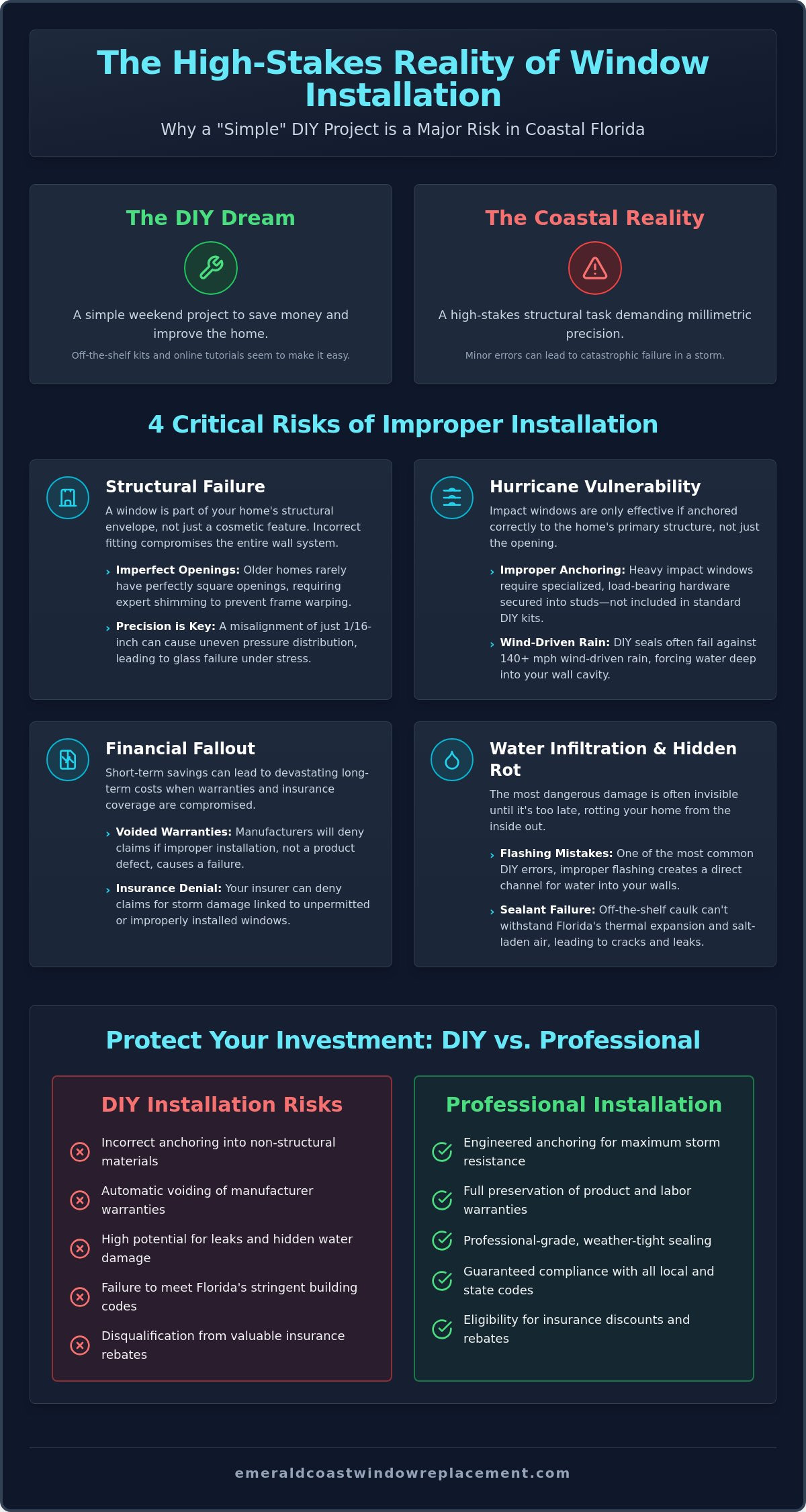
Many homeowners view a window replacement as a simple weekend project, much like swapping out a front door or painting a bedroom. In reality, the risks of diy window installation go far beyond a crooked frame; it is a high-stakes structural task that demands millimetric precision. While Modern window technology has made products more efficient, the actual integration into your home's framing remains complex. In coastal communities like Pensacola and Gulf Breeze, 'good enough' is a dangerous standard. A window that looks perfectly fine on a sunny afternoon can become a primary point of failure when the first tropical depression of the season rolls in.
The risks of diy window installation are often masked by the deceptive simplicity of modern retail kits. These off-the-shelf products are designed for perfect, square openings that rarely exist in older Florida homes. Real-world structural variations, such as settled headers or slightly bowed studs, require professional shimming and sealing techniques that a basic tutorial can't teach. We call this the 'coastal liability' because even a hairline gap can allow pressurized air and water to bypass your home's envelope, leading to catastrophic internal damage during a storm.
The Reality of the Florida Panhandle Climate
Our local environment is notoriously harsh on building materials. Intense humidity and salt-laden air act as constant catalysts for decay, especially in poorly sealed window frames. Standard DIY caulking and off-the-shelf sealants often lack the elasticity needed to handle the significant thermal expansion and contraction we see during our hot summers. Most importantly, typical DIY methods aren't engineered to withstand the 140+ mph wind-driven rain common in Escambia County. Without a professional-grade moisture barrier, that water is forced into your wall cavity, rotting your home from the inside out.
Deceptive Cost Savings vs. Long-Term Value
It is easy to get lured in by the lower price tag of retail-grade windows. However, these products often fail to meet the rigorous demands of coastal living, leading to premature replacement. When calculating your budget, you must consider the Total Cost of Ownership, which is the sum of the initial purchase price plus the ongoing costs of maintenance, energy loss, and potential repair of installation errors. Choosing a high-performance solution through the Emerald Coast Window Authority ensures your investment is protected by expert vetting. This approach provides a long-term return on investment that a DIY project simply cannot match.
Compromised Protection: The Dangers of Improper Hurricane-Impact Window Fitting
Hurricane-impact windows are engineered marvels, but their performance depends entirely on how they are anchored to your home's structure. Unlike standard windows, impact-resistant models are significantly heavier due to the multi-layered laminated glass and reinforced frames. This extra weight requires specialized anchoring systems that go beyond the basic fasteners found in a standard DIY kit. One of the most overlooked risks of diy window installation is failing to secure these heavy units into the structural studs with the correct load-bearing hardware. If the anchoring is insufficient, the entire window unit could be displaced during a severe weather event.
Precision is not a luxury in coastal Florida; it's a structural requirement. Even a 1/16-inch misalignment can cause the glass to fail during a pressure event because the frame cannot distribute the wind load evenly. Most homeowners don't have the high-precision levels or heavy-duty tools required to ensure a perfect fit in a opening that might be slightly out of square. Improper shimming is another common failure point. If shims aren't placed at the exact pressure points specified by the manufacturer, the frame can warp under hurricane-force winds, breaking the critical seal. Understanding how DIY work can affect your warranty is vital, as manufacturers will often deny claims if they determine that frame warping was caused by poor installation rather than a product defect.
The Science of Pressure and Impact
Coastal storms create intense cycles of positive and negative wind pressure. A window must resist being pushed in by the wind and being sucked out by the vacuum created as air moves around the building. In an impact-rated system, the 'seal' is just as important as the 'glass' itself. If the frame isn't perfectly plumb, the structural integrity is compromised. This increases the risk of projectile penetration, as the glass may pop out of its track rather than absorbing the hit from flying debris. For a secure fit that meets local standards, it's often best to consult with a specialist through the Emerald Coast Window Authority.
Safety Risks During Installation
Handling high-performance, double-pane impact glass isn't a one-person job. These units are cumbersome and can be dangerous if they slip. Common DIY injuries include back strain from heavy lifting, ladder falls, and severe cuts from accidental glass breakage. Professional crews always use multi-person teams and specialized suction equipment for coastal window projects to ensure safety and precision. The physical risks of diy window installation often outweigh the potential labor savings when you factor in the weight of these specialized products.
Financial Fallout: How DIY Installation Voids Warranties and Insurance
Saving money on labor costs is the primary driver for most home improvement projects. However, the financial risks of diy window installation often outweigh the initial savings by a significant margin. In the Florida Panhandle, where insurance premiums and building standards are among the highest in the country, cutting corners can lead to a cascade of long-term expenses. It's not just about the cost of the window; it's about the financial ecosystem that protects your home's value and your family's security.
Florida's 'My Safe Florida Home' grant program provides essential financial relief for residents looking to upgrade their storm protection. A critical requirement for these grants and most state-level rebates is that the work must be completed by a licensed, approved professional. Attempting a DIY installation immediately disqualifies you from these funds. Similarly, when you decide to sell your home, unpermitted or non-professional window work becomes a major red flag during the inspection process. Buyers in Escambia and Santa Rosa counties are savvy about storm resilience. If they see windows installed without a permit or professional certification, they'll likely demand a price reduction to cover the cost of a professional re-installation.
The Manufacturer Warranty Trap
Most high-performance window manufacturers include fine print that many homeowners overlook. Their 'lifetime' or extended warranties are almost always contingent on professional installation. If a seal fails or a frame warps due to improper anchoring, the manufacturer won't honor the claim. They'll argue that the product didn't fail; the installation did. Choosing a vetted contractor ensures that your product guarantee remains legally binding. This protection is vital when you're investing in premium impact-resistant technology designed to last for decades.
Insurance Premiums and Hurricane Credits
To qualify for hurricane mitigation credits on your homeowners insurance, you must pass a Wind Mitigation Inspection. Inspectors look for specific anchoring patterns and documented proof that the windows meet the 2026 Florida Building Code. Most inspectors won't sign off on DIY work because they can't verify the structural integrity of the hidden fasteners. Without that signature, you lose out on substantial premium discounts year after year. When you calculate those lost savings over a 10 or 20 year period, the risks of diy window installation become a permanent tax on your home's operating costs.
Water Infiltration and Structural Decay: The Invisible Risks
In the Florida Panhandle, water is the ultimate invader. One of the most significant risks of diy window installation is the failure to properly manage moisture at the rough opening. While a window might look sealed from the outside, the critical work happens behind the siding. Professional installers use a precise layering technique called flashing to direct water away from the structural framing. Most DIYers either skip the sill pan or install flashing in the wrong sequence, which creates a funnel effect. This traps water behind your walls where it has no way to evaporate in our high-humidity environment.
The damage caused by these errors is often invisible for the first few seasons. By the time you notice a soft spot in the drywall or a musty odor near the baseboards, the internal structure of your home may already be compromised. Research indicates that the cost to repair a single leaking window due to improper installation can range from $1,500 to $4,000, quickly erasing any initial labor savings. To avoid these hidden expenses, it's safer to work with a vetted local professional who understands the specific drainage requirements of coastal construction.
The Progression of Water Damage
Stage 1: Minor leaks and drywall staining. You might see faint yellow rings or bubbling paint around the window casing after a heavy summer thunderstorm.
Stage 2: Structural wood rot and compromised wall studs. Constant moisture softens the wood framing, which can eventually lead to sagging headers and windows that no longer open or close correctly.
Stage 3: Termite attraction and massive repair bills. Damp, decaying wood is a primary attractant for Formosan subterranean termites, common in Pensacola, which can cause thousands of dollars in additional structural damage.
Energy Efficiency Losses
Even the most expensive energy-efficient windows won't perform if air can bypass the frame. Small gaps in the shim space or improper foam insulation lead to significant air infiltration, which we call the 'Florida Heat Tax.' This forces your air conditioner to work overtime to combat the humid air leaking into your living space. Low-E glass technology is designed to reflect thermal energy, but it requires a perfectly airtight seal around the entire perimeter of the unit to achieve its rated performance. Without that precision, you're essentially paying for high-tech glass while leaving the proverbial back door wide open to the Pensacola heat.
Securing Your Investment: Why Professional Vetting Outperforms DIY
Choosing to upgrade your home’s exterior shouldn’t feel like a gamble. While we’ve explored the physical and financial risks of diy window installation, the most effective way to mitigate these dangers is through expert vetting. Using a neutral advisory service like Emerald Coast Window Authority changes the dynamic from a stressful sales pitch to a consultative partnership. We don't just point you toward a product; we connect you with licensed specialists who have already been screened for their craftsmanship and reliability in the Florida Panhandle. This approach ensures your project is handled by someone who understands our specific coastal demands.
The true cost of a DIY mistake often dwarfs the price of a professional quote. When you factor in the potential for $4,000 in repairs for a single leaking window, the initial labor savings disappear instantly. A professional labor guarantee provides the ultimate peace of mind, ensuring that the risks of diy window installation, such as seal failure or structural rot, are never your financial burden to carry. Your home is your most valuable asset; protecting it with professional expertise is the only way to ensure its long-term resilience and aesthetic beauty.
Navigating Local Building Codes
Florida's building regulations are evolving rapidly to meet increasing storm threats. With the 9th Edition of the Florida Building Code scheduled to take effect on December 31, 2026, homeowners must ensure their permit applications are filed correctly to meet current standards. In Pensacola, starting window work without a permit carries a penalty of double the permit fee or a minimum of $200. Professional contractors in Escambia and Santa Rosa counties handle the entire permit application and final inspection process. This ensures your installation is legally documented, which is a non-negotiable requirement for maintaining your home's insurance eligibility and resale value.
Finding the Right Partner
You can skip the high-pressure sales tactics and confusing jargon by utilizing a service that prioritizes transparency and education. Understanding the local market before you commit is vital, so reviewing a comprehensive price guide helps you set realistic expectations for your project. We take the guesswork out of the process by matching you with specialists who focus on high-performance hurricane-impact solutions. Request your free window estimate from a vetted local pro today.
Protecting Your Coastal Sanctuary
The decision to upgrade your home’s windows is an investment in both your property’s value and your family’s safety. As we’ve explored, the risks of diy window installation in a high-velocity hurricane zone are simply too high to ignore. From the danger of structural wood rot to the loss of vital insurance credits, a small mistake today can lead to thousands in avoidable expenses tomorrow. Precision anchoring and airtight seals aren’t just technical details; they’re your home’s first line of defense against the unique climate challenges of the Florida Panhandle.
You don't have to navigate these complex building codes or heavy lifting alone. By choosing a neutral advisory approach, you gain access to licensed Florida contractors who specialize in hurricane-impact solutions without enduring high-pressure sales tactics. We’re here to ensure your home improvement journey is low-stress and built to last. Connect with a vetted Pensacola window expert today to secure your home’s future. Taking the right steps now ensures your coastal residence remains beautiful and resilient for years to come.
Frequently Asked Questions
Does DIY window installation void my manufacturer warranty?
Yes, most manufacturers require professional installation by a certified contractor to keep the product warranty intact. If a seal fails or a frame warps, the company will likely attribute the problem to installation errors rather than a product defect. This leaves you responsible for the full cost of any replacement parts or repairs.
Do I need a building permit to replace windows in Pensacola, FL?
Yes, a building permit is required for window replacement in Pensacola as of 2026. While a new state law (HB 803) exempts some minor residential work under $7,500, this rarely applies to window projects in coastal wind-borne debris regions. Commencing work without a permit can result in a penalty of double the permit fee or a minimum of $200.
Can I get hurricane insurance discounts if I install my own windows?
No, you typically cannot qualify for hurricane mitigation credits with a DIY installation. Insurance carriers require a Wind Mitigation Inspection performed by a licensed professional to verify the anchoring patterns and structural integrity. Inspectors often refuse to sign off on DIY work because they cannot confirm the hidden fasteners meet the 2026 Florida Building Code.
What is the biggest mistake people make during DIY window installation?
The most common failure is the improper installation of the sill pan and flashing. These components are critical for directing water away from your home's structural framing. One of the primary risks of diy window installation is creating a "water funnel" that allows moisture to trap inside your walls, leading to invisible rot and mold growth over several years.
How much money do you actually save by installing windows yourself?
While you might save $100 to $300 per window in labor costs, these savings are often lost to future repairs. The cost to fix a single leaking window can range from $1,500 to $4,000. When you factor in the loss of insurance discounts and the potential for voided warranties, professional installation is almost always the more cost-effective choice for Pensacola homeowners.
Is it harder to install hurricane-impact windows than regular windows?
Yes, hurricane-impact windows are significantly more difficult to handle because of their reinforced frames and heavy laminated glass. They require specific, high-load anchoring patterns that go beyond standard window fasteners. If the unit isn't perfectly plumb and square, the structural risks of diy window installation increase, as the glass may fail to stay in the track during a high-pressure storm event.
Will DIY windows pass a Florida home inspection during a sale?
DIY windows are a major red flag during the home sale process in Florida. If an inspector finds no record of a permit or professional certification, it can jeopardize the buyer’s ability to get insurance or a mortgage. This often results in the seller having to offer a significant price credit to cover the cost of professional re-installation and permitting.
How do I find a licensed window contractor in the Florida Panhandle?
You can find a reliable local partner by using a neutral advisory service like Emerald Coast Window Authority. We connect you directly with vetted, licensed specialists who have expertise in hurricane-impact solutions. This approach allows you to skip high-pressure sales and ensures your project meets the rigorous structural demands of our coastal environment.


Comments