Understanding Window U-Factor and SHGC in Florida: A 2026 Homeowner’s Guide
- ECWA

- Jun 6
- 12 min read
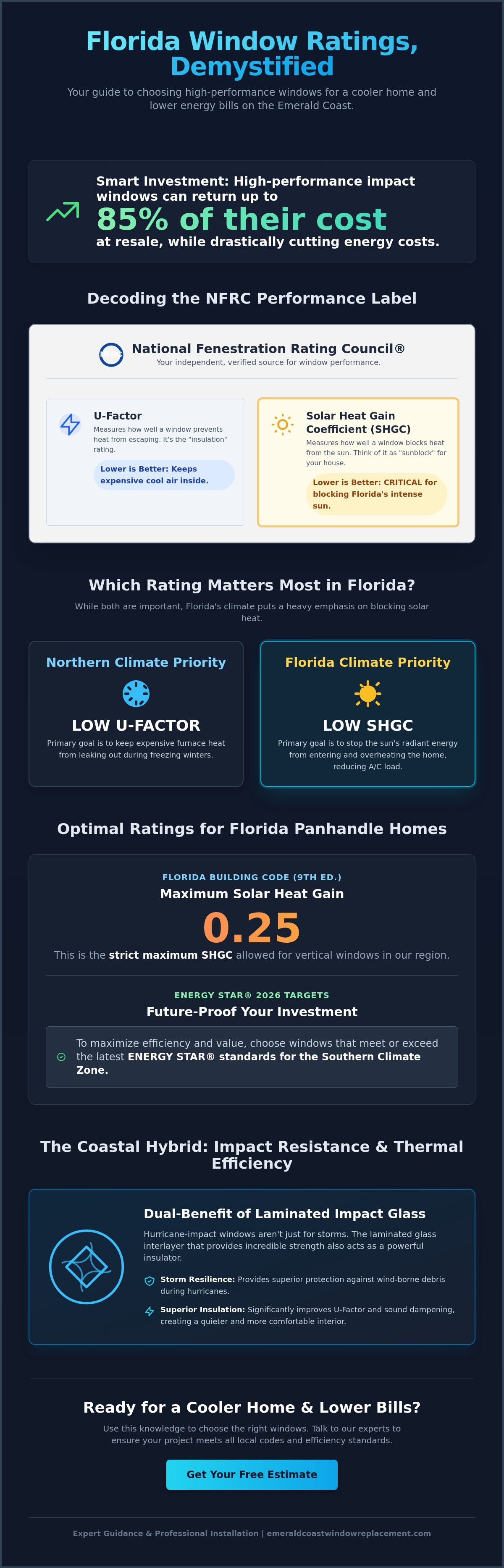
Did you know that high-performance impact windows can return up to 85% of their cost at resale while significantly slashing your monthly energy spend? If you've spent a summer in the Florida Panhandle, you know that the heat doesn't just sit outside; it tries to force its way into your living room through every pane of glass. Understanding window U-factor and SHGC in Florida is no longer just for engineers; it's a necessity for every homeowner, especially with the 9th Edition Florida Building Code setting a strict maximum Solar Heat Gain Coefficient (SHGC) of 0.25 for vertical glazing in our region.
It's frustrating to look at an NFRC label and see a wall of technical jargon that doesn't explain why your home still feels like an oven. You want lower utility bills and a home that remains a sanctuary during a July heatwave, but you need to know which numbers actually matter for our coastal climate. This guide will help you master these ratings so you can talk to contractors with total confidence. We'll explore how the right U-factor keeps your expensive cool air inside and why SHGC is your primary defense against the relentless Southern sun.
Key Takeaways
Learn how to decode the NFRC label to verify the performance and energy efficiency of any window before you buy.
Master the difference between heat retention and solar blockage by understanding window U-factor and SHGC in Florida.
Identify the 2026 ENERGY STAR targets for the Southern Climate Zone to ensure your investment meets the latest efficiency standards.
Discover how laminated glass in hurricane-impact windows provides a dual benefit of storm resilience and superior thermal insulation.
Understand why local Panhandle building codes and professional energy assessments are critical for choosing the right high-performance windows.
Table of Contents
The NFRC Label: Decoding Your Window’s Performance Passport
The sticker on your new window isn't just a piece of paper to be scraped off after installation. It's a performance passport. When you're investing in energy-efficient windows for a home in Pensacola, that National Fenestration Rating Council (NFRC) label is the only thing standing between you and a contractor's empty promises. It provides a standardized way of comparing products so you aren't comparing apples to oranges. Most importantly, it measures the performance of the entire unit, including the frame and spacers, not just the center of the glass.
There is a massive psychological relief that comes with seeing that NFRC logo. It means the numbers you're looking at have been independently verified through rigorous testing. You don't have to take a salesperson's word for it. By understanding window U-factor and SHGC in Florida, you can look at any window on a showroom floor and know exactly how it will behave when the August sun is beating down on your siding. Reading the label like a pro allows you to spot high-performance windows that actually meet the 2026 building standards before you ever sign a contract.
What is the NFRC and why should you trust it?
The NFRC is a non-profit organization that provides the only uniform rating system for the energy performance of windows, doors, and skylights. They don't sell windows; they provide the data you need to buy them wisely. As of the 9th Edition Florida Building Code (2026), manufacturers must be authorized by an NFRC-licensed agency to certify these ratings. This ensures that the Thermal transmittance, or U-factor, is calculated using the same scientific baseline across the board. Without this label, a window's efficiency claims are essentially invisible.
Florida vs. The North: Why our labels look different
If you're moving from a colder climate, you might be used to looking for a high R-value or a specific U-factor to keep the heat inside during a blizzard. In the Florida Panhandle, our priorities flip. Heat gain is the primary enemy here. While a homeowner in Maine cares about preventing heat from escaping, we care about stopping the sun's radiant energy from entering in the first place. This is why the Southern Climate Zone requirements place such a heavy emphasis on the Solar Heat Gain Coefficient. Choosing windows based on Northern standards can lead to a home that feels like a greenhouse. Localized expertise ensures your investment is tailored to our specific humidity and solar exposure.
U-Factor: Look for lower numbers to keep your air conditioning from leaking out.
SHGC: This is the "sunblock" for your home; lower is better for Florida.
Visible Transmittance: This tells you how much natural light will actually enter the room.
U-Factor vs. SHGC: Which Rating Matters Most in Florida?
Choosing the right windows for a home in Escambia or Santa Rosa County requires a strategic look at two primary numbers. While they might look like simple decimals on a sticker, they represent the front line of your home’s defense against the Gulf Coast climate. Understanding window U-factor and SHGC in Florida helps you see past the marketing brochures and focus on how a window actually handles the intense heat and humidity we face every day. These two metrics work together to create a thermal barrier, ensuring your home stays comfortable without your air conditioner running 24/7.
While Northern homeowners obsess over keeping heat inside, our focus is almost entirely on the opposite. In the Florida Panhandle, SHGC is often considered the "heavy lifter" because radiant solar energy is the biggest contributor to rising indoor temperatures. However, U-factor shouldn't be ignored. It serves as the secondary defense that keeps your expensive, cooled air from bleeding through the glass and frame. Balancing these two ratings is the secret to a high-performance home that remains affordable to cool in July.
U-Factor: Your A/C’s Best Friend
U-factor measures how well a window prevents heat from moving through it. U-factor is the rate at which a window, door, or skylight conducts non-solar heat flow. On a typical 95-degree afternoon in Pensacola, the air outside is significantly hotter than the air inside your home. A low U-factor ensures that this heat doesn't migrate inward. It also helps prevent the "convection" effect, that uncomfortable drafty feeling you get when standing near a window on a humid day. For our region, the Florida Building Code sets specific standards to ensure windows provide adequate insulation against this non-solar heat transfer.
SHGC: The Sun Shield
The Solar Heat Gain Coefficient (SHGC) is a scale from 0 to 1 that tells you how much solar radiation passes through the glass. A rating of 0.25 means only 25% of the sun's heat enters your home. This is non-negotiable for west-facing windows that take the full brunt of the afternoon sun. High SHGC ratings lead to "hot spots" in your living room and force your A/C to work much harder than necessary. By lowering this number, you directly lower your monthly cooling bill. If you aren't sure which ratings are best for your home's specific orientation, a quick look at high-performance windows can help you visualize the difference these coatings make.
The Optimal Ratings for Florida Panhandle Homes
Knowing the definitions of these technical terms is only half the battle. To truly protect your investment, you need a "cheat sheet" of specific targets that work for our unique coastal environment. In the Florida Panhandle, meeting the bare minimum of the building code might pass an inspection, but it won't necessarily stop your power meter from spinning like a top in August. Understanding window U-factor and SHGC in Florida means recognizing that "good enough" often fails when exposed to the relentless salt air and direct Southern sun that define life in Pensacola and Gulf Breeze.
For homeowners who want the best balance of performance and longevity, aiming for the highest efficiency tiers is a smart move. High-performance windows designed for our region don't just block heat; they preserve your interior finishes from UV damage and keep your home's microclimate stable. When you're reviewing options with a contractor, keep these 2026 targets at the forefront of your decision-making process.
ENERGY STAR 2026 Standards for the South
The ENERGY STAR version 7.0 requirements for the Southern Climate Zone are the gold standard for efficiency. To earn this certification in 2026, windows must achieve a U-factor of 0.32 or lower and an SHGC of 0.23 or lower. These targets are significantly stricter than in previous years, reflecting a national shift toward higher energy conservation. Utilizing vinyl windows is often the most effective way to meet these thermal goals because vinyl frames provide excellent natural insulation compared to older aluminum designs. These ratings are verified by the National Fenestration Rating Council, ensuring the window performs exactly as promised once it's installed in your wall.
Visible Transmittance: Don't live in a cave
While chasing the lowest possible SHGC is great for your utility bill, it can sometimes have an unintended side effect on your home's aesthetic. Visible Transmittance (VT) measures how much natural light comes through the glass on a scale of 0 to 1. If the SHGC is pushed extremely low through heavy tinting, the VT often drops as well, which can make your living room feel dark even at noon. The "sweet spot" for most Panhandle homes is finding a window that utilizes advanced Low-E coatings to reject heat while maintaining a high VT. This allows you to enjoy those beautiful Gulf views and plenty of natural light without the associated solar heat gain that makes your A/C struggle.
Target SHGC: 0.23 or lower for maximum cooling savings.
Target U-Factor: 0.32 or lower to keep your cooled air inside.
Target VT: 0.50 or higher to ensure your home stays bright and inviting.
Impact Resistance and Thermal Efficiency: The Coastal Hybrid
Many homeowners believe they have to choose between storm safety and energy savings. They assume that heavy-duty glass is built for strength alone, while efficiency is reserved for standard double-pane units. In reality, modern hurricane windows are often the most thermally efficient products available. The same technology that prevents a 2x4 from piercing your living room during a tropical storm also acts as a sophisticated thermal break. This creates a high-performance hybrid that protects your family from both the elements and rising utility costs.
There's a common myth that simply having "thick glass" is enough to save money on cooling. This isn't true. Thick glass on its own still conducts heat quite effectively. The real magic happens within the layers and the specialized coatings applied to the glass surfaces. When you invest in impact-rated products, you're getting a multi-layered defense system that outperforms traditional windows in almost every thermal category.
The Layered Advantage of Impact Glass
The secret to the efficiency of impact windows lies in the interlayer, typically made of Polyvinyl Butyral (PVB) or SentryGlas Plus (SGP). This transparent membrane is sandwiched between two layers of glass. While its primary job is to hold the glass together upon impact, it also serves as a powerful insulator. Understanding window U-factor and SHGC in Florida requires looking at how these materials disrupt heat flow. The interlayer adds mass and creates a non-conductive barrier that standard windows lack. As a bonus, this dense construction provides incredible sound-dampening, keeping the noise of coastal winds and traffic outside where it belongs.
Low-E Coatings: The Invisible Filter
Low-Emissivity (Low-E) coatings are microscopic layers of silver or other low-gain materials applied to the glass. They act like an invisible filter, reflecting infrared light (heat) while allowing visible light to pass through. In our region, Low-E 366 has become the gold standard, often required to meet the 2026 ENERGY STAR targets. These coatings are the most cost-effective upgrade you can make because they directly lower the Solar Heat Gain Coefficient. By blocking up to 95% of the sun's heat, they ensure your interior stays cool even when the mercury rises. If you want to see how these coatings perform in a real-world setting, you can explore our full range of high-performance windows to find the perfect fit for your home.
PVB Interlayer: Provides structural integrity and a thermal break.
Low-E 366: Reflects the highest amount of solar heat without darkening your view.
Argon Gas: Often used between panes to further reduce the U-factor.
Choosing the Right Windows for Your Pensacola Project
Now that you've mastered the technical side of energy ratings, it's time to apply that knowledge to your specific Pensacola property. Selecting a window based solely on its catalog rating isn't enough; you must ensure it meets the rigid legal requirements of the Florida Panhandle. Understanding window U-factor and SHGC in Florida serves as your ultimate vetting tool when interviewing contractors. If a salesperson can't explain how a specific model interacts with the 2026 building code or why certain west-facing rooms need a lower SHGC than others, they aren't the right partner for your home protection project.
A professional approach involves more than just swapping out glass. It requires a steady, dependable partner who understands that a home in Escambia County faces different pressures than one in the middle of the state. Use your knowledge to ask about whole-unit ratings rather than just center-of-glass data. This transparency ensures that the high-performance windows you pay for actually deliver the comfort and savings promised on the NFRC label.
Navigating Local Building Codes
The 9th Edition Florida Building Code (2026) is particularly strict for coastal areas like Escambia and Santa Rosa counties. These regions are designated as wind-borne debris regions, meaning your windows must provide both structural resilience and thermal efficiency. Buying a "bargain" window from an out-of-state retailer often leads to a failed inspection in Milton or Gulf Breeze because those products aren't engineered for our specific 160 mph wind speed mandates. Working with window option specialists who understand these local zones ensures your project stays on track and remains fully compliant with the law.
Getting Your Personalized Efficiency Plan
Every home is a unique ecosystem. A house with heavy oak shading on the south side requires a different SHGC balance than a beachfront property with zero protection from the morning sun. A professional energy assessment helps you map out these needs before you spend a single dollar on materials. Emerald Coast Window Authority focuses on connecting you with vetted local experts who prioritize long-term resilience over quick sales. They can help you determine if you need the ultra-low 0.23 SHGC for your entire home or if you can balance visible light in certain rooms.
Prioritizing these high-performance ratings is an investment in the beauty and safety of your coastal residence. By combining your new understanding of U-factor and SHGC with local expertise, you can secure a home that remains cool, quiet, and protected for decades. Take the next step by requesting a site-specific assessment to see how these 2026 standards will transform your monthly utility bills and daily comfort.
Secure Your Coastal Sanctuary for 2026 and Beyond
Mastering the nuances of understanding window U-factor and SHGC in Florida is the first step toward a more comfortable, resilient home. You now know that a low SHGC acts as your home's primary sunblock, while a superior U-factor ensures your expensive air conditioning stays exactly where it belongs. By choosing windows that meet or exceed the 2026 ENERGY STAR targets, you aren't just following a code; you're making a long-term investment in your property's value and your family's daily comfort.
Navigating these technical ratings doesn't have to be a solo journey. Our team provides expert guidance on Florida Building Codes and connects you with a vetted network of licensed Panhandle contractors focused on high-performance hurricane resilience. We take the stress out of the selection process so you can focus on the beauty of your coastal residence. When you're ready to see the difference that professional-grade efficiency makes, Get Your Free, No-Pressure Window Estimate from Local Pensacola Experts Today. Your home deserves a protector that understands the unique demands of the Gulf Coast.
Common Questions About Florida Window Ratings
What is a good SHGC rating for windows in Florida?
A good SHGC rating for Florida homes is 0.25 or lower to comply with the 2026 Florida Building Code. For those seeking the highest efficiency, aiming for 0.23 or lower aligns with the latest ENERGY STAR targets for the Southern Climate Zone. These numbers ensure that the vast majority of the sun's radiant heat is blocked before it ever enters your living space.
Does a lower U-factor always mean a better window for Pensacola?
A lower U-factor is always beneficial, but it isn't the only metric you should prioritize in the Panhandle. While U-factor prevents non-solar heat transfer, SHGC handles the sun's direct rays. Understanding window U-factor and SHGC in Florida means finding a balance where both numbers are low enough to create a complete thermal barrier for your specific home orientation.
Are impact-resistant windows also energy efficient?
Impact-resistant windows are exceptionally energy efficient due to their multi-layered construction. The laminated interlayer required for storm protection acts as a natural insulator, and these units almost always come with advanced Low-E coatings. This combination makes them some of the highest-performing windows on the market for both safety and long-term utility savings.
Can I get a tax credit for high-efficiency windows in 2026?
You can typically claim the federal Energy Efficient Home Improvement Credit for windows that meet ENERGY STAR Most Efficient requirements in 2026. This incentive encourages homeowners to invest in high-performance upgrades that reduce national energy demand. It's best to consult with a tax professional to confirm the current annual caps and specific product eligibility for your Pensacola renovation project.
What is the difference between U-factor and R-value?
U-factor and R-value are mathematical inverses that measure the same thing from different angles. U-factor measures the rate of heat transfer, where a lower number means better insulation. R-value measures the resistance to heat flow, where a higher number is better. In the window industry, U-factor is the standardized metric used on all NFRC labels to ensure clear comparisons.
Do Low-E coatings make my windows look dark or tinted?
Modern Low-E coatings are engineered to be nearly invisible to the naked eye. While older technologies sometimes had a noticeable green or grey tint, 2026-spec coatings maintain high visible transmittance. You can enjoy clear views of the Gulf while still reflecting the vast majority of infrared and ultraviolet light away from your interior furniture and flooring.
How much can I actually save on my A/C bill with new windows?
Replacing inefficient, single-pane windows with high-performance units can lead to a noticeable reduction in your monthly cooling costs. While exact savings depend on your home's size and A/C efficiency, blocking solar heat gain is the most effective way to lower your energy consumption. Many homeowners find that their HVAC systems run significantly less often during the peak of a Panhandle summer.
What happens if I install windows that don't meet Florida energy codes?
Installing windows that don't meet the 2026 Florida Building Code can lead to a failed municipal inspection and complications during a future home sale. Beyond the legal risks, you'll likely struggle with uncomfortable hot spots and higher utility bills. Local building departments in Escambia and Santa Rosa counties strictly enforce these energy and impact standards to ensure long-term regional resilience.


Comments