7 Critical Signs You Need Window Replacement in Pensacola (2026 Guide)
- ECWA

- 4 days ago
- 13 min read
What if the draft you feel near your glass is actually the sound of your hard-earned money escaping into the Florida humidity? Most local homeowners realize that skyrocketing Gulf Power bills and windows that are stuck shut are more than just minor annoyances. These are the primary signs you need window replacement Pensacola residents should never ignore. Your windows serve as the critical barrier between your family and the Gulf's unpredictable elements. When that barrier weakens, your home's structural resilience and your daily comfort are both at risk.
We understand that deciding between a quick fix and a full upgrade feels overwhelming, especially with the 9th Edition of the Florida Building Code taking effect on December 31, 2026. This guide will clarify exactly when it's time to transition to high-performance vinyl or hurricane-impact windows to protect your investment. You'll learn how to identify failing seals, why the My Safe Florida Home grant is a game-changer for your budget, and how the right upgrade can lead to insurance discounts of up to 45 percent. It's time to stop worrying about the next tropical storm and start enjoying a more secure, energy-efficient coastal lifestyle.
Key Takeaways
Understand how the unique "Salt Air Effect" along the Panhandle accelerates seal failure and frame corrosion compared to inland homes.
Identify the performance-based signs you need window replacement Pensacola residents should watch for, including rising cooling costs and air infiltration.
Learn the "screwdriver test" to distinguish between cosmetic surface wear and critical structural rot in your home’s window frames.
Explore how impact-resistant upgrades help you meet the 2026 Florida Building Code and qualify for substantial wind mitigation insurance credits.
Discover a practical prioritization strategy for replacing windows to improve home security and storm resilience.
Table of Contents
Why Pensacola Windows Fail: The Coastal Climate Reality
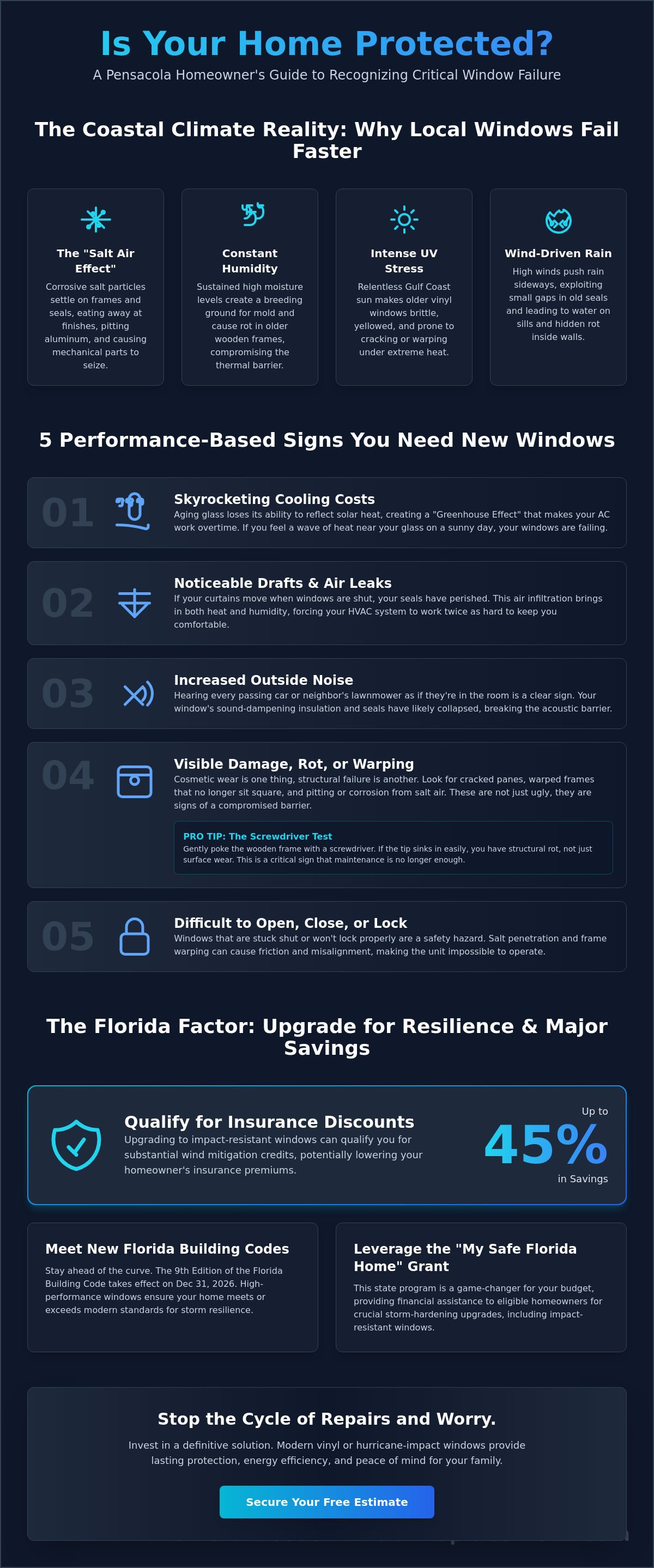
Living in the Florida Panhandle offers incredible views, but the environment is aggressive toward building materials. The "Salt Air Effect" is a constant factor for homes near Pensacola Beach and along the bay. Salt particles are corrosive; they settle on window frames and slowly eat away at protective finishes. Over time, this leads to pitted aluminum or degraded seals that allow conditioned air to leak out. This degradation is one of the most common signs you need window replacement Pensacola homeowners encounter during routine cleaning. When salt penetrates the mechanical parts of a window, it creates friction that eventually makes the unit impossible to operate.
Humidity is the next silent enemy. In our region, moisture levels stay consistently high, which creates a breeding ground for mold and rot within older wooden frames. When moisture penetrates the perimeter, it compromises the window's ability to act as a thermal barrier. Additionally, the intense Gulf Coast sun provides relentless UV stress. Many vinyl windows installed in the early 2000s weren't engineered for today's extreme heat. They often become brittle and yellowed, losing the flexibility needed to expand and contract without cracking or warping.
True window failure occurs when the unit no longer protects your interior from the exterior environment. It's more than a cosmetic issue or a cracked pane; it's a loss of structural integrity. Adhering to Hurricane-proof building standards is essential in our area because a failing window is a primary weak point during a storm. If the seal or frame is compromised, the window cannot withstand the pressure differentials common in coastal weather. A window that fails to seal is no longer a window. It's just a hole in your wall that costs you money every month.
The Role of Wind-Driven Rain in Escambia County
Heavy tropical downpours in Escambia County don't just fall; they're pushed sideways by high winds. This wind-driven rain exploits even the smallest gaps in aging seals. If you see water pooling on your sill after a storm, you likely have a failing perimeter. This often leads to hidden wall rot where moisture seeps into the framing behind the drywall. Standard windows from decades ago rarely meet the specific design pressure needs required for our modern coastal climate. High-performance windows are engineered to manage these pressures, ensuring that water stays outside where it belongs.
When Maintenance is No Longer Enough
Many people believe their 15-year-old windows are maintenance-free, but that's often a myth in a high-salt environment. Recaulking a window that has structurally warped is just a temporary band-aid. It doesn't fix the underlying issue of a frame that no longer sits square within the opening. Transitioning from constant fixing to actively protecting your home investment is a smarter long-term move. Choosing high-performance vinyl or hurricane-impact windows offers a definitive solution that stops the cycle of temporary repairs and provides lasting peace of mind for your family.
5 Critical Performance Signs You Need Window Replacement
Your windows are more than just a view; they're a complex system of seals, glass, and hardware designed to keep the Florida heat out and your comfort in. When this system fails, the performance drop is often dramatic. One of the most obvious signs you need window replacement Pensacola families notice first is a sudden spike in Gulf Power bills. This happens due to the "Pensacola Greenhouse Effect," where aging glass loses its ability to reflect solar heat. Your air conditioner ends up fighting a losing battle against the radiant energy pouring into your living room.
Drafts are another undeniable red flag. You can perform the "curtain flutter" test during a stiff Gulf breeze. If your blinds move or your curtains sway while the window is shut, your seals have likely perished. This air infiltration doesn't just bring in heat; it brings in humidity that forces your HVAC system to work twice as hard. If you find yourself hearing every car passing on Cervantes Street or the neighbor's lawnmower as if they were in the room with you, your window's sound-dampening insulation has likely collapsed.
Analyzing Your Energy Efficiency Gaps
You can test your windows today using the "back of the hand" test. On a sunny afternoon, place your hand near the glass without touching it. If you feel a wave of heat radiating off the surface, your windows are failing to provide a thermal break. It's also vital to distinguish between surface condensation, which wipes away, and internal "foggy glass." Moisture trapped between the panes indicates a permanent seal failure, meaning the insulating argon gas has escaped. Upgrading to energy-efficient windows is the only effective cure for these rising utility costs. You might start your journey by browsing high-performance window options that are specifically engineered for the Southern Climate Zone.
Safety and Accessibility Concerns
Beyond comfort, functionality is a major safety issue. Windows that are stuck, swollen, or painted shut represent a significant fire safety risk. If you can't easily open a window to escape during an emergency, the unit is a hazard. Difficult operation is rarely just about a dirty track; it's often a sign of a warped frame caused by years of moisture exposure and shifting foundations. These structural issues also compromise your home security, as warped frames often prevent locks from engaging properly. Adhering to the latest Florida Building Code requirements ensures that your new windows provide both the required emergency egress and the structural resilience needed to deter intruders. Identifying these signs you need window replacement Pensacola early allows you to address vulnerabilities before they become emergencies.
Visible Damage: Rot, Warp, and Salt-Air Corrosion
While performance issues like high utility bills are frustrating, physical decay is one of the most urgent signs you need window replacement Pensacola residents should look for. In communities like Milton and Pace, many older homes still feature original wooden frames that are susceptible to the region's intense moisture. You can perform a simple "screwdriver test" to check your home's structural integrity. If you press a flathead screwdriver against the wood and it sinks in easily, you have active rot. This isn't just a cosmetic flaw. It's a clear signal that the window can no longer support its own weight or withstand wind pressure during a tropical event.
Salt-air corrosion is another major factor that many general contractors overlook. If your home has aluminum frames, look for white, chalky pitting on the surface. This is a chemical reaction to the salt in our coastal air. It doesn't just ruin the aesthetic; it eats into the metal and weakens the entire unit. You might also notice rusted hinges, locks, or shoes. These are the internal mechanisms that help the window slide. When these components corrode, the window becomes heavy and dangerous to operate. It’s no longer a functioning safety feature; it’s a liability for your family.
Visible cues of a failing moisture barrier often include:
Peeling paint or bubbling finishes on the interior trim.
Yellow or brown water stains on the drywall surrounding the frame.
A sash that no longer sits flush with the frame, leaving visible gaps.
Cracked or brittle caulking that has pulled away from the masonry.
The Problem with Older Aluminum and Wood Frames
Aluminum frames from the 1990s act as thermal bridges. They conduct heat directly into your home, essentially acting like a radiator in the summer. In the Florida Panhandle, where humidity often exceeds 80 percent, wood frames decay at an accelerated rate. Once rot starts, it spreads into the wall studs. This leads to much more expensive repairs than a simple window upgrade. High-performance vinyl options have become the standard because they don't rot, pit, or conduct heat like these older materials.
The Repair vs. Replace Decision Matrix
Homeowners often ask if they can just replace a single cracked pane. While an Insulated Glass Unit (IGU) swap is possible, it's often a temporary fix. If the frame is warped or the hardware is corroded, new glass won't solve the underlying failure. Replacing just the glass ignores the fact that the frame itself is no longer square or airtight. Consulting with window option specialists allows you to get a professional assessment of whether your frames can still provide the protection your home needs. In most cases, a full-frame installation is the only way to ensure long-term resilience against Gulf storms.
The 'Florida Factor': Insurance, Codes, and Hurricanes
In our region, the decision to upgrade isn't always driven by a broken pane or a drafty room. Often, the most pressing signs you need window replacement Pensacola homeowners face come from their insurance carriers. The Florida insurance market has shifted dramatically. Many providers now view windows older than 20 years as a significant liability. If your home lacks modern "Opening Protection," you're likely missing out on substantial "Wind Mitigation" credits that could lower your annual premiums. Insurance companies are increasingly requiring homeowners to harden their residences against the Gulf's unpredictable storm seasons as a condition for policy renewal.
Hurricane readiness is a year-round priority for families in Escambia County. If you're still relying on heavy plywood or outdated shutters, your home remains vulnerable to rapid pressure changes during a storm. Modern hurricane windows provide a permanent, passive defense system that doesn't require manual installation when a storm enters the Gulf. This transition from temporary fixes to structural resilience is a hallmark of high-end home protection. It's about ensuring that your home's envelope remains sealed even when debris becomes airborne.
Wind Mitigation and Your Wallet
When an inspector performs a wind mitigation survey, they look for specific markings that certify your windows can withstand high-velocity pressure. Impact-rated windows can lead to insurance discounts of up to 45 percent, making them one of the few home improvements that pay for themselves through recurring savings. Carriers are moving away from "standard" windows in coastal zones. They prefer the predictable durability of high-performance vinyl and impact-resistant glass. If your current windows aren't documented as impact-rated, you're essentially paying a "risk tax" on every insurance bill.
Meeting Modern Impact Standards
It's vital to understand the technical difference between "Hurricane Rated" and true "Impact Resistant" glass. Impact-resistant windows are engineered to pass the "Large Missile" test, where a nine-pound 2x4 is fired at the glass at high speeds. Older windows often fail these modern tests because their frames aren't reinforced to handle the transfer of energy. With the 9th Edition of the Florida Building Code taking effect on December 31, 2026, the standards for structural openings are becoming even more stringent. Preparing your home now, well before the June 1st hurricane season rush, ensures you have the best selection of products and a clear path to compliance. If you're ready to secure your home's future, you can request a professional assessment of your current window protection to see how you measure up against 2026 standards.
Taking the Next Step: Your Pensacola Replacement Strategy
Recognizing the primary signs you need window replacement Pensacola is the first step toward a safer, more efficient home. Once you've identified drafts, rot, or rising costs, the next phase is strategic planning. If you're working within a specific budget, you don't necessarily have to replace every opening at once. We recommend prioritizing windows that face the afternoon sun to maximize energy savings; alternatively, you might focus on master bedrooms to ensure you meet modern emergency egress standards immediately. This phased approach allows you to address the most critical vulnerabilities while managing your investment over time.
Choosing a partner who truly understands the Florida Panhandle is essential. A professional assessment in areas like Gulf Breeze involves more than just taking measurements. It's a detailed look at your home's structural openings to ensure they meet the specific design pressure requirements of our wind-borne debris region. Emerald Coast Window Authority acts as your neutral guide in this process. We specialize in connecting homeowners with vetted local professionals who are experts in the 2026 building codes and Escambia County permitting processes. This ensures your project is handled with the precision that coastal residences require.
Finding Vetted Pensacola Professionals
The aftermath of a storm often brings "storm chaser" contractors who lack local roots and may not understand our specific building requirements. It's vital to choose established specialists who are familiar with the 4 to 12-week timeline typical for custom manufacturing and permitting in our area. Ask potential partners about their experience with Escambia County inspections and how they handle the Notice of Commencement process. In the City of Pensacola, this legal filing is required for any work exceeding $2,500. We make this easier by linking you with the best glass and windows experts in the region. These professionals take pride in their craftsmanship and value the long-term safety of the community over a quick transaction.
The Path to a Safer, More Efficient Home
Investing in high-performance windows offers one of the highest returns on investment for Florida homeowners. Beyond the immediate drop in cooling costs, you're enhancing your home's resale value and structural resilience. The transition to hurricane-impact or energy-efficient vinyl is a low-stress way to secure your family's comfort for the next two decades. You can start this journey today without the pressure of aggressive sales tactics. By requesting a free, professional estimate, you'll receive a clear roadmap for your home's protection. Let us help you find the right partner to ensure your Pensacola residence remains a beautiful, secure sanctuary for years to come.
Securing Your Home’s Future Against the Gulf Elements
Your windows are the frontline defense for your coastal residence. Identifying the physical and performance-based signs you need window replacement Pensacola homeowners often overlook is the first step toward long-term peace of mind. Whether you're battling skyrocketing summer utility bills or preparing for the next tropical storm, upgrading to hurricane-impact or energy-efficient vinyl windows is an investment in your family's safety and your home's value. Don't wait for a storm to expose a structural vulnerability that you can address today through proactive home hardening.
We're here to help you navigate this process with ease. As a neutral advisory service, we specialize in the unique coastal requirements of the Florida Panhandle. Our team focuses on connecting you with licensed hurricane-impact experts who prioritize quality craftsmanship over high-pressure sales tactics. Get a Free, No-Pressure Window Estimate from a Vetted Pensacola Pro and take the stress out of home maintenance. You deserve a home that's as resilient as it is beautiful.
Frequently Asked Questions
How do I know if my window drafts are fixable or require replacement?
Drafts are fixable if they stem from worn weatherstripping, but they require replacement if the frame itself is warped or the seal has failed. If recaulking doesn't stop the air infiltration, the structural integrity of the unit is likely compromised. This is a common indicator among the signs you need window replacement Pensacola homeowners should watch for. When the sash no longer sits square in the frame, no amount of temporary sealant will restore the thermal barrier.
Will new windows really lower my Pensacola energy bills in 2026?
Yes, upgrading to ENERGY STAR certified windows can significantly reduce your cooling costs by reflecting solar heat and maintaining a consistent internal temperature. In the Florida Panhandle, high-performance glass prevents the "greenhouse effect" that forces your AC to run constantly. By meeting the 0.32 U-factor standard, these windows provide a definitive solution to skyrocketing utility bills. You'll notice the difference immediately during our humid summer months.
What is the average lifespan of windows in the Florida Panhandle?
Windows in our coastal environment typically last between 15 and 20 years before the salt air and high humidity begin to degrade the seals and hardware. Proximity to Pensacola Beach can accelerate this timeline due to the corrosive nature of salt spray. While some materials like high-performance vinyl are more resilient, older aluminum or wood frames often show critical signs of failure much sooner than they would in an inland climate.
Can I replace my windows during hurricane season?
You can certainly replace your windows during hurricane season, though it's important to monitor the weather forecast for active tropical systems. Local specialists are accustomed to working around summer rain patterns and will ensure your home is never left vulnerable to the elements overnight. Starting the process during the season is often necessary to ensure your home is fully protected before the peak activity months of August and September.
Do I have to replace all my windows at once, or can I do them in phases?
Homeowners often choose to replace windows in phases to manage their budget while still addressing the most critical needs first. You might prioritize the south-facing side of your home to maximize energy efficiency or focus on master bedrooms to ensure safety egress. A phased approach is a practical strategy as long as you maintain a consistent plan for your home's total structural resilience and aesthetic value.
How do I know if I have impact-resistant glass already?
You can verify if you have impact-resistant glass by looking for a permanent etch, or "bug," in the corner of the pane. This mark will list the manufacturer, the safety standards it meets, and the date of production. If you don't see this etching, your windows likely aren't rated for large missile impact. Checking for these marks is a vital step when evaluating the signs you need window replacement Pensacola for insurance credits.
Why is there condensation on the outside of my windows in the morning?
Exterior condensation occurs when the glass temperature drops below the dew point, which is actually a sign that your windows are insulating well. It indicates that the heat from inside your home isn't escaping through the glass to warm the exterior pane. This is a common sight in the Florida Panhandle during humid mornings. Unlike internal fogging, which signals a failed seal, this surface moisture is harmless and will evaporate as the sun rises.
Does insurance ever cover the cost of window replacement in Florida?
Homeowners insurance typically only covers window replacement if the damage was caused by a covered peril, such as a fire or a major storm event. Insurance will not pay for replacements due to age, wear, or general seal failure. However, installing impact-rated windows often qualifies you for wind mitigation credits. These credits can lead to significant annual premium discounts, helping the investment pay for itself over time.


Comments