Best Windows for Salt Spray Resistance in Florida: The 2026 Coastal Homeowner Guide
- ECWA

- 3 days ago
- 12 min read
What if the hurricane windows you installed to protect your family are slowly being compromised by the very air you breathe? For many coastal residents, that white, chalky oxidation on metal frames is a sign that salt air is eating away at your home's structural integrity. Finding the best windows for salt spray resistance Florida provides is the only way to ensure your home's first line of defense doesn't fail when you need it most.
We all love the Florida coast, but we also know the frustration of hardware that seizes up or frames that look decades old after just a few seasons. You shouldn't have to struggle with a window that won't open or worry about weakened frames during a storm. You can protect your investment and potentially lower your wind insurance premiums by 25 to 45 percent by choosing materials specifically designed for the marine environment.
This 2026 guide details the exact vinyl and hardware configurations that withstand corrosive environments while meeting the rigorous standards of the upcoming 9th Edition Florida Building Code. You'll learn how to select high-performance windows that stay functional and look brand new for 20 years or more.
Key Takeaways
Identify the specific frame materials that resist thermal expansion and chloride corrosion in the unique Panhandle climate.
Discover why marine-grade 316 stainless steel is the essential hardware standard for the best windows for salt spray resistance Florida homes require to prevent seized locks.
Learn how the 50-mile rule affects properties in Gulf Breeze and Milton, proving that salt air damage isn't just a beachfront issue.
Navigate the latest 2026 building code updates, including Wind-Borne Debris Zone requirements and Sea Turtle Glass regulations for coastal properties.
Gain the knowledge needed to choose impact-rated configurations that provide Category 5 protection without sacrificing aesthetic value.
Table of Contents
Understanding Salt Spray Resistance for Florida Panhandle Homes
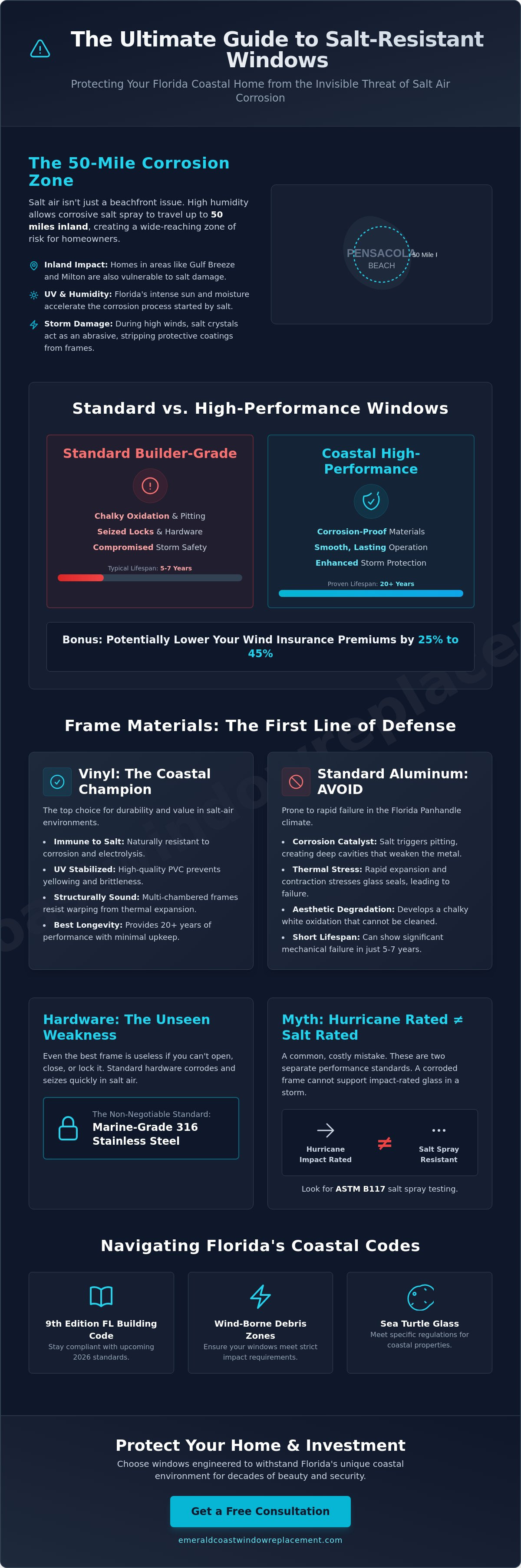
Living along the Gulf Coast means accepting that the air itself is chemically active. Salt spray resistance refers to a window's ability to withstand chloride-induced corrosion, a process where salt ions from the Gulf of Mexico eat away at metal components and finishes. In our region, this isn't just a concern for beachfront properties. The best windows for salt spray resistance Florida homeowners can invest in must account for the 50-mile rule. Industry data shows that salt air travels significantly inland, meaning homes in Gulf Breeze and even Milton face many of the same corrosive threats as those on Pensacola Beach. Salt air doesn't stop at the shoreline; it hitches a ride on our high humidity and settles deep into window tracks and frames miles away from the surf.
During high-wind events, salt crystals act as a microscopic abrasive. These crystals are hurled against your home at high velocities, effectively sandblasting the protective coatings off your window frames. Once the coating is compromised, the combination of intense Florida UV rays and nearly constant humidity accelerates the degradation of the underlying material. This creates a cycle of damage that can leave standard windows looking pitted and worn long before their time. Choosing High-Performance Windows specifically engineered for this environment is the only way to break that cycle.
The Chemistry of Coastal Corrosion
Sodium chloride is a relentless catalyst for oxidation. When salt settles on standard aluminum frames, it triggers a chemical reaction that leads to pitting. These are small, deep cavities that compromise the structural integrity of the metal. While a window might look fine from a distance, these microscopic pits act as stress concentrators. Standard builder-grade windows in areas like Pensacola Beach often show significant mechanical failure within five to seven years. The hardware becomes impossible to turn, and the frames develop a white, chalky oxidation that no amount of cleaning can remove.
Salt Spray vs. Hurricane Impact Ratings
It is a common misconception that a hurricane-rated window is automatically salt-spray resistant. These are two different performance standards. A window can be designed to stop a flying projectile but still utilize hardware that will seize up after twenty-four months of salt exposure. If a frame is weakened by corrosion, it may fail to hold the glass in place during a 140mph wind event, regardless of how strong the glass is. This is why we look for components that have undergone rigorous salt spray testing, such as the ASTM B117 standard. This testing ensures that the best windows for salt spray resistance Florida residents choose will maintain their structural strength and ease of use for decades, not just a few seasons. Investing in High-Performance Windows means ensuring the entire system, from the locks to the frame, is ready for the next big storm.
The Best Window Frame Materials for Salt Air Environments
Choosing the right frame is about more than just curb appeal. It's about how the material reacts to the chemical soup of salt and humidity that defines our region. The best windows for salt spray resistance Florida homeowners can buy usually fall into three categories: Vinyl, Fiberglass, or Coastal-Grade Aluminum. Each material handles the intense Panhandle sun differently. Thermal expansion is a major factor here. In our climate, materials like standard aluminum expand and contract rapidly. This constant movement can stress the glass seals and lead to premature failure. Multi-chambered frame designs are the solution. These internal pockets create air barriers that improve insulation and add structural rigidity. This design ensures your Energy-Efficient Windows don't warp or lose their seal under the 100-degree heat.
Vinyl Windows: The Coastal Durability King
Vinyl windows are the top choice for many Gulf Breeze and Milton homeowners because they're naturally immune to salt corrosion. Unlike metal, vinyl doesn't suffer from electrolysis. This is the process where different metals corrode when they touch in a salty environment. High-quality PVC stabilizers are essential for our high UV index. They prevent the frames from becoming brittle or yellowing over time. When you look at the cost-to-longevity ratio, vinyl often provides the best value. It stays functional for 20 years or more with minimal maintenance. It's a durable solution for those who want their home to look new without the need for constant scrubbing or repainting.
Aluminum and Fiberglass: Performance Alternatives
While standard aluminum fails quickly, coastal-grade aluminum features specialized marine-grade powder coatings. These finishes are significantly thicker than standard paint. They act as a shield against the abrasive salt crystals that can sandblast a home during a storm. Fiberglass is another high-end option. It offers the lowest thermal expansion rate of any material. This means it stays stable even during the most extreme temperature swings. However, fiberglass usually comes at a higher price point. If you prefer the slim-profile aesthetics of modern design, these configurations are often cited as the best windows for salt spray resistance Florida contractors recommend for contemporary builds. They provide a sleek look without the risk of the white crust oxidation found on cheaper products. Before you finalize your choice, you should explore Hurricane-Impact Windows that combine these durable materials with reinforced glass for total protection.
The Invisible Enemy: Hardware and Glass Specifications
While the frame material provides the structural foundation, the hardware is often the first part of a window to fail in a coastal environment. Salt air is a relentless invisible enemy that targets moving parts, hinges, and locking mechanisms. When searching for the best windows for salt spray resistance Florida homeowners must look beyond the frame to the internal mechanics. Corroded hardware doesn't just make a window difficult to open; it can prevent the window from locking securely, which compromises your home's safety during a hurricane. Many premium manufacturers now offer specific Coastal Package upgrades that replace standard components with materials engineered to survive the high-chloride atmosphere of the Panhandle.
Seal failure is another common issue driven by salt buildup. Standard spacer systems can allow salt crystals to accumulate at the edge of the glass, eventually leading to a breach in the insulating gas seal. High-performance windows utilize Warm Edge spacer systems. these non-metallic spacers reduce thermal transfer and provide a more resilient barrier against salt-induced seal degradation. By choosing a window designed as a complete system, you ensure that every component, from the smallest screw to the glass itself, is ready for the environment.
Marine-Grade Stainless Steel Hardware
The difference between a window that lasts five years and one that lasts twenty often comes down to the grade of stainless steel used in the hardware. Standard 304-grade stainless steel is common in many impact products, but it's susceptible to "tea staining" and pitting when exposed to salt spray. For homes near the Gulf, marine-grade 316 stainless steel is the only acceptable standard. This alloy contains molybdenum, which specifically resists the corrosive effects of chlorides. If you are installing Casement Windows, ensure the crank mechanisms and hinges are 316-grade. Standard zinc-plated or low-grade steel hardware will seize up quickly, leaving you with a window that's permanently stuck in place.
Laminated Glass and Low-E Coatings
The glass itself plays a dual role in coastal protection. The laminated glass used in hurricane windows provides a robust defense against flying debris and prevents salt-water intrusion even if the outer pane is cracked. Beyond safety, these units function as energy-efficient windows that significantly reduce cooling costs by reflecting the intense Florida sun. However, you must be careful with the type of Low-E coating you choose. We advise against "Surface 4" coatings, which place the reflective layer on the interior room-side glass. Because salt crystals are highly abrasive, the frequent cleaning required in coastal homes can easily scratch these exposed coatings, permanently damaging the window's clarity and performance.
Navigating Florida Building Codes and Coastal Zones
The Florida Panhandle operates under different regulatory standards than South Florida. While Miami-Dade follows HVHZ rules, Escambia and Santa Rosa Counties are primarily governed by Wind-Borne Debris Zone (WBDZ) requirements. The best windows for salt spray resistance Florida residents install must satisfy these structural mandates while resisting corrosion. If you live directly on the water, you'll also need to account for "Sea Turtle Glass" regulations. These require a visible light transmittance of 0.45 or less on the beach side to prevent hatchlings from being disoriented by home lighting. These rules protect our local ecosystem while ensuring your home remains a fortress.
Upgrading to impact-rated units isn't just about safety; it's a strategic financial move. Florida homeowners with documented impact protection can often secure insurance premium reductions of 25-45% on the wind portion of their policy. To ensure you qualify, always verify the Florida Product Approval (FPA) numbers. You can check these on the state's official database to confirm the window's design pressure and impact rating match your specific coastal zone. This documentation is your proof that the windows can handle the unique pressures of the Gulf Coast.
Local Code Compliance in Pensacola and Gulf Breeze
Waterfront homes require higher Design Pressure (DP) ratings than those located just a few blocks inland. The DP rating measures a window's ability to withstand outward and inward wind force. With the 9th Edition of the Florida Building Code taking effect on December 31, 2026, wind load calculations will become even more rigorous. When interviewing window option specialists, ask if their products meet the upcoming ASCE 7-22 standards. You should also confirm if they provide the necessary documentation for the My Safe Florida Home grant, which offers up to $10,000 for hurricane-hardening improvements for eligible homeowners.
Maintenance: Extending the Life of Coastal Windows
Even the highest quality frames require a "Freshwater Flush" protocol. We recommend rinsing your window exteriors with a low-pressure garden hose at least once a month to remove salt crust. When it comes to moving parts, avoid oil-based lubricants that attract sand and salt. Use a dry silicone spray on tracks and hinges to keep them gliding smoothly. Professional installation is the final piece of the puzzle. Most manufacturers require proof of proper installation and regular maintenance to honor salt-spray warranties. To get started on a project that meets all local codes, you can explore our range of Hurricane-Impact Windows designed for the Gulf Coast.
Finding the Right Coastal Window Expert in the Panhandle
Selecting the right product is only half the battle. The expertise of the person specifying your project determines whether your investment actually survives the Gulf Coast environment. General contractors are skilled at many things, but they often treat windows as a commodity. They might overlook the critical hardware nuances we discussed earlier, such as the difference between 304 and 316 stainless steel. Without that specific coastal knowledge, you could end up with a high-end frame and low-end locks that seize within twenty-four months. Selecting the best windows for salt spray resistance Florida homes need requires a partner who understands these regional micro-climates.
Emerald Coast Window Authority serves as a neutral advisory service to bridge this gap. We help you navigate the complex technical specifications of High-Performance Windows and refer you to vetted local contractors who specialize in coastal applications. When you evaluate the window replacement cost in Gulf Breeze, it's vital to compare quotes based on material grades rather than just the bottom line. A lower price often indicates standard hardware or non-marine-grade coatings that won't hold up against our salt air. Our network ensures you get the best windows for salt spray resistance Florida can offer without the stress of trial and error.
Vetting Your Window Installer
Don't assume every local contractor is an expert in coastal codes. You should verify that your installer holds active licensing and insurance specifically for Escambia or Santa Rosa County. Ask for references of homes they worked on at least five years ago. This allows you to see how their choice of hardware and frames has actually performed against the salt spray over time. A reliable expert will also provide a clear, written warranty that explicitly covers performance in high-salt environments. If the warranty has a "coastal exclusion" clause, that's a major red flag for any Panhandle property owner.
Your Next Steps for Home Protection
Protecting your coastal residence requires a systemic approach. The ideal configuration for our region includes High-Performance Vinyl Windows or marine-grade treated aluminum, paired with 316 stainless steel hardware and laminated impact glass. This combination provides Category 5 hurricane protection while maintaining its aesthetic value for decades. We invite you to start with a no-pressure consultation to understand the specific requirements of your property, whether you're beachfront or a few miles inland. Taking the right steps now prevents the frustration of corroded hardware and rising insurance costs later. Get your free coastal window estimate today and ensure your home is ready for whatever the Gulf throws its way.
Securing Your Coastal Legacy for 2026 and Beyond
Your home is likely your most significant investment; don't let the salt air quietly erode its value. Choosing the best windows for salt spray resistance Florida requires looking past the glass to the marine-grade hardware and non-corrosive frames that survive our unique climate. We've explored how the upcoming 2026 building code updates will demand even higher standards for wind loads and structural resilience in Escambia and Santa Rosa Counties. By prioritizing 316 stainless steel and high-performance vinyl, you ensure your home remains a safe, beautiful sanctuary for decades.
Finding the right path doesn't have to be overwhelming. As a neutral advisory service, we specialize in Florida WBDZ building codes and connect you with vetted local Panhandle contractors who understand the nuances of coastal protection. You deserve a partner who takes pride in craftsmanship and values your long-term security over a quick transaction. Connect with a Vetted Coastal Window Expert Today to start your journey toward a more resilient home. It's time to enjoy the Gulf views without the worry of corrosion.
Frequently Asked Questions
How long do windows typically last in Florida coastal areas?
Standard builder-grade units often show structural failure in five to seven years when exposed to the Gulf air. In contrast, high-performance impact windows designed for coastal use can last 20 years or more. This extended lifespan is only possible if you choose materials that don't oxidize and commit to a basic maintenance routine. Longevity is a direct result of how well the window system handles the Panhandle's humidity and salt.
Do I need different windows if I live on the sound vs. the Gulf?
You need high-performance windows for both, but the Gulf side faces more intense conditions. Homes on the Gulf deal with higher wind speeds and salt crystals that act as an abrasive during storms. Sound-side properties still face significant chloride exposure and high humidity. Both locations require marine-grade hardware and salt-resistant frames to prevent the hardware from seizing or the finishes from bubbling over time.
What is the best window frame material for salt air resistance?
High-quality vinyl and fiberglass are the most resilient materials for the Panhandle. Unlike standard metals, these materials are naturally immune to the chemical process of electrolysis and pitting. Vinyl is frequently cited as one of the best windows for salt spray resistance Florida homeowners can buy because it offers a perfect balance of durability and energy efficiency. It won't peel or require the constant repainting that metal frames often demand.
Does salt spray affect the warranty on my new windows?
Yes, salt spray is a major factor in window warranties. Many standard warranties actually exclude damage caused by salt air unless you live a certain distance from the coast. To protect your investment, you must ensure your product has a specific coastal warranty. You'll also need to keep records of your maintenance, as manufacturers often require proof of regular cleaning to honor claims in high-chloride areas.
Can I use aluminum windows if I live right on the beach?
You can, but only if they feature a specialized marine-grade powder coating. Standard aluminum windows will develop a white, chalky oxidation within a few seasons. Coastal-grade aluminum is treated with much thicker, more resilient finishes that shield the metal from salt ions. This allows you to enjoy the sleek, slim profiles of aluminum without the high risk of pitting and structural failure common in cheaper products.
What is marine-grade hardware and why is it necessary?
Marine-grade hardware is typically made from 316-grade stainless steel. This material is essential because it contains molybdenum, an element that specifically resists corrosion from salt. Standard 304 stainless or zinc-plated steel will eventually rust or tea stain in our environment. Using 316-grade components ensures that your casement cranks and locks remain functional and smooth for the life of the window.
How often should I clean my windows to prevent salt damage?
We recommend a freshwater rinse at least once a month. This freshwater flush removes salt crystals before they can bond to the frames or eat into the hardware. If you live directly on the beachfront, you might need to do this every two weeks. It's a simple step that involves a low-pressure garden hose and a soft cloth, but it's the best way to prevent long-term salt damage.
Will impact windows protect my home from salt-water flooding?
No, impact windows are engineered to stop flying debris and withstand extreme wind pressures. They aren't designed to hold back rising storm surges or hydrostatic pressure from flooding. While they're excellent at preventing wind-driven rain from entering your home, they don't replace the need for proper flood mitigation strategies. Their primary job is to keep the building envelope intact during a hurricane's high-wind cycles.


Comments