Hurricane Window Film vs. Impact Glass: The 2026 Homeowner’s Guide
- ECWA

- May 21
- 13 min read
Applying a thin layer of plastic to your windows might seem like a cost-effective shield against a Category 4 storm, but the reality is much more dangerous. When comparing hurricane window film vs impact glass, many Florida Panhandle homeowners feel caught between the high cost of full replacement and the lure of "hurricane-proof" marketing claims. You want to protect your family without overspending; it's frustrating to sift through conflicting information while another storm season approaches. We understand that your home is your greatest investment, and keeping it standing is our top priority.
You'll discover the critical differences between these two options to ensure your coastal residence is truly protected. This guide clarifies what actually meets the Florida Building Code, helping you avoid the "band-aid" trap of retrofit films that don't qualify for wind mitigation credits. We will show you how choosing engineered impact-resistant glass can lower your insurance premiums by 25 to 45 percent and reduce cooling costs by up to 25 percent. By the end, you'll have a clear path toward total peace of mind and structural resilience that lasts for decades.
Key Takeaways
Learn why only impact-rated windows meet the Florida Building Code for hurricane protection, while window film remains a non-compliant retrofit.
Understand the long-term financial benefits of upgrading, including how impact windows can lower your wind insurance premiums by up to 45 percent.
Compare the structural engineering of hurricane window film vs impact glass to see how "shatter-retention" differs from true storm-rated protection.
Discover why the age and condition of your window frames are the deciding factors in whether a retrofit solution will fail during a storm.
Gain a clear decision-making framework to protect your Florida Panhandle home while maximizing your property's resale value and energy efficiency.
Table of Contents
Protecting Your Emerald Coast Home: The Film vs. Impact Glass Debate
Living on the Emerald Coast means accepting that hurricane season is a definitive part of the yearly calendar. For residents in Pensacola and Gulf Breeze, the question isn't if a storm will test their home's resilience, but when. This reality often leads to a high-stakes debate regarding hurricane window film vs impact glass. While one option is a budget-friendly retrofit, the other is a structural upgrade designed for extreme survival. Many homeowners fall into a "false security" trap, believing that simply preventing glass from shattering is the same as protecting the home from a hurricane. It isn't. The ultimate goal during a major weather event is to keep your home's envelope sealed against massive atmospheric pressure changes.
What is Hurricane Window Film?
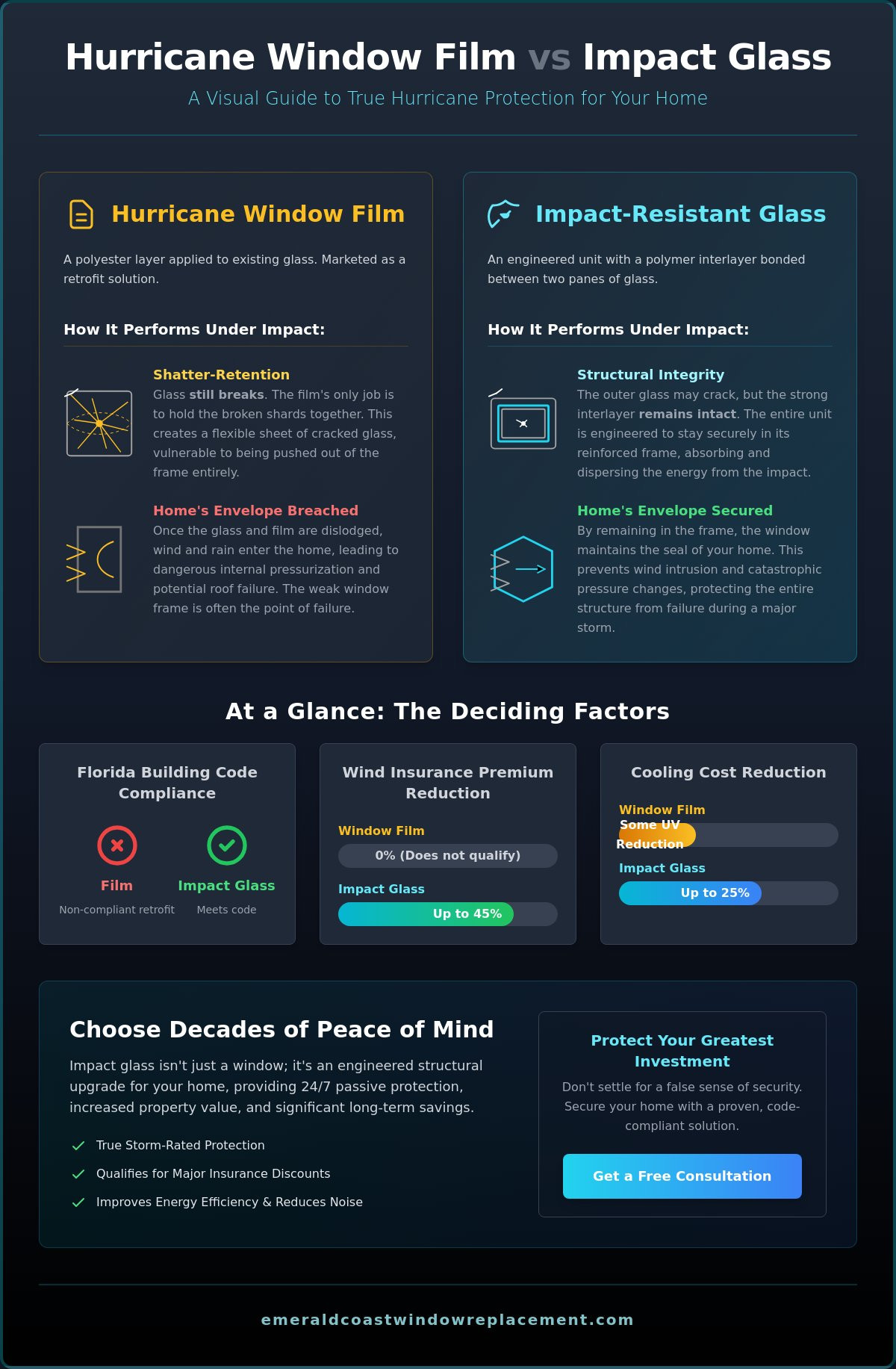
This product consists of heavy-duty polyester layers applied directly to the interior surface of your existing windows. It is often categorized as Safety and Security Window Film because its primary job is "shatter-retention." When an object strikes the glass, the film holds the broken shards together in a single sheet. While this prevents dangerous glass from spraying into your living room, it does not magically make the glass unbreakable. It also offers secondary benefits like UV protection and solar heat reduction, which are helpful for our Florida summers, but it does not change the structural limits of your existing window frames.
What is Impact-Resistant Glass?
Unlike a film that you stick on, a hurricane window is a factory-engineered unit built for durability. These windows feature a laminated "sandwich" design where a tough polymer interlayer is bonded between two panes of high-strength glass. This is a passive protection system that stays ready 24/7 without any effort from the homeowner. The outer pane is designed to be sacrificial; it may crack under extreme pressure, but the inner interlayer remains intact. This ensures the window stays in its frame and keeps the wind and rain outside where they belong.
The distinction between these two choices matters because of how coastal weather behaves. High winds don't just bring rain; they bring flying debris. If a window fails and the seal of your home is broken, internal pressure can build up with terrifying speed. This internal pressure is often what leads to catastrophic structural failure, such as the roof lifting off the walls. When we weigh hurricane window film vs impact glass, we are looking at the difference between managing a messy cleanup and preventing a total loss of the structure. Keeping that envelope sealed is the only way to ensure your home remains a safe haven when the wind starts howling across the bay.
Understanding Hurricane Window Film: Retrofit Protection or Marketing Myth?
When evaluating hurricane window film vs impact glass, it's vital to look past the marketing brochures and understand the physics of a storm. Window film is often sold as a way to make your existing glass "unbreakable." This is a significant misconception. In reality, film is a shatter-retention product. If a piece of debris hits a filmed window, the glass will still crack and break. The film's only job is to hold those broken shards together using a strong adhesive. While this prevents a "shrapnel" effect inside your home, it does little to address the immense wind pressure that follows an impact.
The danger during a hurricane isn't just the flying debris; it's the high-velocity wind pressure that tries to force its way into your home. A window covered in film becomes a flexible sheet of cracked glass. Under the sustained pressure of a Category 3 or 4 storm, that flexible sheet can bow and pull away from the edges of the window frame. Once the seal is broken, the wind enters the house, which can lead to the internal pressurization issues we discussed earlier. Without the structural reinforcement found in high-performance windows, your home's envelope remains vulnerable despite the added layer of polyester.
The 'Wet-Glaze' Attachment Problem
For a safety film to provide even a baseline level of protection, it must be anchored to the frame using a "wet-glaze" system. This involves applying a thick bead of structural silicone sealant around the perimeter of the glass. However, this bond is only as strong as the frame it is attached to. Most older window frames in Pensacola weren't designed to handle the load of a shattered pane being pushed by 130 mph winds. If the frame flexes or the adhesive fails, the entire filmed pane can pop out of the opening like a sail, leaving your interior completely exposed to the elements.
Why Film Fails Florida Building Code Standards
The Florida Building Code sets rigorous standards for impact protection, specifically through Testing Application Standards (TAS) 201, 202, and 203. These tests measure a window's ability to withstand large missile impacts and subsequent cyclic wind pressure. Because window film is an after-market addition to non-rated glass, it almost never carries these specific certifications. In the eyes of local building officials and insurance companies, film is not a substitute for impact-rated glass or approved shutters. It does not qualify as a "shutter equivalent," meaning you won't see the wind mitigation credits on your policy that come with a true structural upgrade.
Choosing between hurricane window film vs impact glass often comes down to the difference between a temporary safety measure and a permanent structural solution. While film might offer peace of mind against a stray golf ball or a minor accident, it lacks the engineering required to stand up to the unique demands of the Gulf Coast's most severe weather events.
The Engineering of Impact-Resistant Glass: Why Structural Integrity Matters
When you weigh the benefits of hurricane window film vs impact glass, the engineering of the glass itself reveals why one is a temporary fix and the other is a permanent shield. A true hurricane window isn't just a thicker piece of glass; it's a factory-assembled system designed to withstand extreme forces. This system utilizes a "sacrificial" outer pane and a resilient inner interlayer. If an object strikes the window, the outer glass may crack, but the inner polymer layer remains bonded to the shards, keeping the window intact and the home's envelope sealed against the storm.
The structural integrity of these units is verified through the "Large Missile Impact" test, formally known as ASTM E1996. During this rigorous process, a nine-pound 2x4 timber is fired from a laboratory cannon at 50 feet per second. To pass, the window must survive the strike and then endure thousands of cycles of positive and negative wind pressure without the glass pulling away from the frame. This level of testing ensures that your home stays pressurized even when the wind speeds reach triple digits. This is a level of performance that after-market film simply cannot replicate because film lacks the reinforced frame and factory-bonded seal required to pass such tests.
The Role of the Interlayer: PVB vs. SGP
The secret to impact glass lies in the interlayer material. Most residential applications use Polyvinyl Butyral (PVB). It's a tough, flexible plastic that provides excellent clarity and impact resistance. For homeowners seeking even higher levels of protection, SentryGlas Plus (SGP) is available. SGP is five times stronger and up to 100 times stiffer than standard PVB. While PVB is the gold standard for Pensacola homes, SGP is often used in commercial buildings or coastal properties with massive picture windows where the highest degree of structural rigidity is required to prevent the glass from "flopping" under heavy wind loads.
Passive Protection: Set It and Forget It
One of the most significant lifestyle benefits of impact glass is that it provides passive protection. Unlike shutters that require you to be home to deploy them, impact windows are always on duty. This offers 24/7 security against both hurricanes and potential intruders. Modern frames, specifically those made from high-quality vinyl or reinforced aluminum, are built for coastal durability. They won't rot, pit, or corrode in our salt-laden air, ensuring that the entire window system remains functional for 20 to 30 years. You get peace of mind without the stress of "boarding up" every time a tropical depression enters the Gulf.
Comparing Performance: Building Codes, Insurance, and Long-Term Value
When you look at the financial side of hurricane window film vs impact glass, the difference in return on investment is striking. While window film is a lower upfront expense, it's a sunk cost that adds no measurable value to your property. In contrast, impact windows typically increase a home's value by 3 to 5 percent. Most Florida homeowners recover their initial investment within five to eight years through a combination of reduced energy bills, insurance savings, and increased equity. If you are researching the window replacement cost Gulf Breeze homeowners are seeing in 2026, it's helpful to view these windows as a long-term asset rather than a simple repair.
The "Home Envelope" theory is the most compelling reason to choose structural glass over film. During a hurricane, your home acts like a pressurized vessel. If a window fails, wind rushes in and creates massive upward pressure on your roof. This internal pressure, combined with the external lift of the storm, is exactly what causes roofs to lift off their walls. Impact glass is engineered to keep that envelope sealed even after a direct hit. By maintaining this seal, you aren't just saving a window; you're likely saving the entire structure of your home from catastrophic failure.
Florida Building Code and Local Compliance
Building departments in Pensacola and Milton have strict requirements for hurricane protection. In our high-velocity hurricane zones, "impact-rated" is the only designation that guarantees your windows meet the Florida Building Code. Window film does not meet these standards for impact protection and is not a legal substitute for impact windows or approved shutters. Relying on film can lead to significant legal and insurance pitfalls. For instance, if you sustain damage and your protection didn't meet code, your carrier might dispute the claim. True impact windows qualify you for insurance premium discounts of 25 to 45 percent on the wind portion of your policy, a benefit film cannot provide.
Energy Efficiency and Sound Dampening
Beyond storm safety, the lifestyle upgrades are immediate. While film offers some heat reduction, it can't compete with the thermal performance of modern energy-efficient windows. These units can lower your annual cooling costs by 15 to 25 percent. Additionally, the same laminated interlayer that stops a 2x4 also acts as a massive sound barrier. You'll notice a dramatic decrease in outside noise from traffic or neighbors. These windows also filter 99 percent of harmful UV rays, which prevents your furniture, rugs, and artwork from fading in the harsh Florida sun.
Ready to secure your home with the highest level of protection? You can explore our selection of high-performance windows designed specifically for the Emerald Coast climate.
Making the Right Choice for Your Florida Panhandle Property
Choosing between hurricane window film vs impact glass often comes down to a simple question: are you looking for a temporary safety measure or a permanent structural shield? For homeowners in Pensacola, Gulf Breeze, and Navarre, the decision framework should prioritize the age of your property and your long-term goals for the home. If your current window frames are more than 15 years old, applying hurricane film is likely a wasted investment. Brittle vinyl or pitted aluminum frames lack the structural strength to hold a filmed pane in place during a storm. Even if the glass stays together, the entire unit can fail at the frame level, leaving your interior vulnerable to wind and water damage.
Vetting the right partner for your window upgrade is just as important as the product you choose. High-performance windows require precision to ensure the seal and frame reinforcement perform as engineered. When you invest in structural glass, you aren't just buying a product; you're securing a commitment to your home's survival. This investment pays off every June through November, providing a level of peace of mind that shutters or films simply can't match. You won't have to spend your weekend on a ladder or wonder if an adhesive bond will hold when the wind starts to gust.
When is Window Film a Viable Option?
There are specific scenarios where window film makes sense, provided it isn't your primary storm defense. It's an excellent choice for UV protection, helping to keep your cooling costs down and preventing your flooring from fading. In non-impact zones, it can serve as a secondary safety layer for tempered glass in bathrooms or entryways to prevent injury from accidental breakage. However, it's vital to remember that film should never be the only line of defense in a High-Velocity Hurricane Zone (HVHZ). It lacks the large-missile impact ratings required to keep your home's envelope sealed against a major Atlantic hurricane.
The Verdict: Why Impact Glass Wins in 2026
As we move through 2026, the advantages of impact glass are clearer than ever. Between the significant insurance premium discounts, the 15 to 25 percent reduction in energy costs, and the permanent 24/7 protection, it remains the gold standard for coastal living. While the upfront cost is higher than a retrofit film, the return on investment through property value and structural safety is undeniable. You're making a choice that protects your family, your furniture, and the very roof over your head. If you're ready to move past the "band-aid" approach of films and shutters, it's time for a professional assessment of your home's needs.
Take the first step toward a more resilient home this season. Connect with a vetted window specialist in Pensacola to discover which high-performance windows are right for your property.
Securing Your Family's Future on the Emerald Coast
We have explored the fundamental differences in the hurricane window film vs impact glass debate. While film provides a basic level of shatter-retention, it lacks the structural engineering required to withstand the high-velocity wind pressures of a major storm. True protection comes from keeping your home's envelope sealed; a feat only achieved by factory-tested, impact-rated windows. Choosing a structural upgrade ensures your residence meets the Florida Building Code while providing immediate benefits like noise reduction and lower utility costs. This is an investment in your home's resilience and your family's long-term safety.
Don't wait for a tropical system to enter the Gulf before you evaluate your home's defenses. Our team of vetted local contractors brings deep expertise in the Florida Building Code and a no-pressure consultative approach to every project. We're here to help you navigate your options with transparency and care. You can Get a Free Estimate from a Licensed Impact Window Expert today to start your journey toward a more secure home. You deserve the peace of mind that comes with knowing your coastal property is ready for whatever the next season brings.
Frequently Asked Questions
Does hurricane window film actually meet Florida Building Code requirements?
No, hurricane window film does not meet the Florida Building Code for impact protection. While it helps with shatter-retention, it isn't an approved substitute for impact-rated windows or shutters in high-velocity hurricane zones. Local building departments require systems that pass specific missile impact and cyclic pressure tests to ensure the home's envelope remains sealed during a storm.
Can I install hurricane window film myself to save money?
You can find DIY kits, but we strongly advise against it for storm protection. Effective safety film requires a structural "wet-glaze" attachment to the frame using professional-grade silicone sealants. Without this anchoring, the entire filmed pane can simply blow out of the frame under wind pressure. Saving a few dollars on labor isn't worth risking your home's structural integrity when the wind picks up.
Will impact-resistant glass lower my homeowners insurance in Pensacola?
Yes, installing impact-rated windows can lead to significant savings on your homeowners insurance in Pensacola. Florida law requires insurers to offer discounts for approved wind mitigation features. When evaluating hurricane window film vs impact glass, it is important to note that film does not qualify for these mandatory credits, while impact glass can reduce the wind portion of your premium by 25 to 45 percent.
What happens if an object hits impact glass—does it still break?
Impact glass is designed to crack but stay together in the frame. It features a sacrificial outer pane that may shatter upon impact from flying debris, but the tough inner polymer interlayer remains intact. This prevents the wind and rain from entering your home. Your window might look like a spiderweb after a strike, but it will continue to protect your interior and maintain your home's pressure seal.
How long does hurricane window film last compared to impact glass?
Quality impact windows are built to last between 20 and 30 years, even in our salt-laden coastal environment. In contrast, hurricane window film has a much shorter functional lifespan. The adhesive can degrade and the polyester can scratch or peel over time, typically requiring replacement every 10 to 15 years. The long-term durability of factory-engineered windows makes them a more reliable investment for Florida Panhandle residents.
Is impact glass more energy-efficient than window film?
Impact glass is substantially more energy-efficient than standard windows treated with film. These high-performance units can lower your annual cooling costs by 15 to 25 percent by blocking solar heat gain more effectively than a simple retrofit. While film provides some UV protection, it cannot match the thermal performance of a factory-sealed, multi-pane window system during our humid summer months.
Can I use window film on top of my impact-resistant windows?
It is generally unnecessary and potentially harmful to apply window film on top of impact-resistant glass. Most impact windows already include high-performance coatings that manage UV rays and heat gain. Adding an aftermarket film can cause excessive heat absorption between the layers. This can lead to glass breakage or void the manufacturer's warranty on your windows, so it's best to leave them as they are.
Do I still need storm shutters if I have impact-resistant glass?
No, you do not need storm shutters if you have installed impact-resistant glass. These windows are a stand-alone, passive protection system that is ready 24/7 without any manual deployment. This eliminates the stress of hanging heavy panels or closing accordion shutters every time a tropical system enters the Gulf. It's the ultimate "set it and forget it" solution for busy homeowners who want constant protection.


Comments