Pensacola Hurricane Window Building Codes 2026: A Local Homeowner’s Guide
- ECWA

- May 14
- 13 min read
In 2026, a window that fails to meet the updated Florida Building Code isn't just a safety risk. It's a financial liability that could cost you your homeowners insurance coverage and disqualify you from thousands of dollars in state funded grants. You likely already feel the pressure of keeping up with shifting regulations while trying to manage rising premiums in Escambia County. It's frustrating to face the confusion of the 8th versus the 9th Edition standards when all you want is a home that's safe, beautiful, and fully compliant.
We're here to help you master the Pensacola hurricane window building codes 2026 so you can move forward with confidence. By understanding these updates, you'll ensure your property passes every inspection and remains eligible for the My Safe Florida Home program's $10,000 matching grant. This guide provides a clear roadmap through the new wind speed maps and the adoption of ASCE 7-22 standards. You'll learn how to select high-performance impact windows that satisfy local officials and provide the long-term resilience your coastal home deserves.
Key Takeaways
Learn how the shift to the 9th Edition Florida Building Code impacts your property and why meeting the December 2026 deadline is vital for maintaining your insurance eligibility.
Identify your home’s specific requirements under the updated Pensacola hurricane window building codes 2026 to ensure compliance with new 140 to 150 mph wind speed standards.
Compare passive versus active protection to see why high-performance impact glass is the preferred choice for modern code compliance and long-term home security.
Navigate the My Safe Florida Home grant process to unlock up to $10,000 in matching funds for your window upgrade project.
Understand why choosing a partner who recognizes Escambia County’s unique wind-load nuances is the only way to guarantee your project passes local inspections.
Table of Contents
Navigating the 9th Edition Florida Building Code in Pensacola
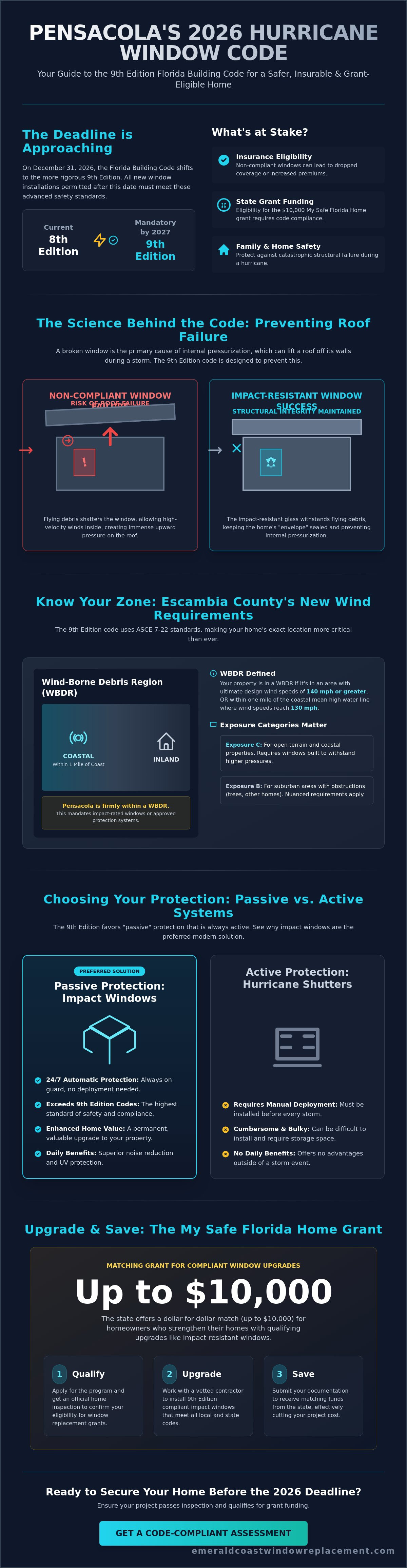
The Florida Building Code (FBC) serves as the primary shield for every coastal home in our state. It isn't just a set of bureaucratic rules; it's a life-saving standard designed to ensure your residence can withstand the extreme pressures of a Gulf storm. As we approach the end of 2026, we're seeing a major shift from the 8th Edition to the more rigorous 9th Edition. This update is specifically engineered to reduce catastrophic structural failure during hurricane landfalls. Because Pensacola is firmly within a Wind-Borne Debris Region (WBDR), these Pensacola hurricane window building codes 2026 mandates require windows that can handle the impact of flying objects and intense wind pressures without failing. When a window breaks during a storm, the resulting internal pressure can actually lift a roof off its walls. These codes exist to prevent that exact scenario.
The 2026 Regulatory Timeline for Homeowners
Timing is everything when planning home improvements in Escambia County. Permits pulled before December 31, 2026, generally follow the 8th Edition rules, but any application submitted after that date must strictly adhere to the 9th Edition. If you're starting a project in the middle of the year, it's wise to adopt a "code-forward" approach. Choosing high-performance windows that already meet the upcoming 9th Edition standards prevents your home from falling behind the curve. Always check the "Edition Year" on your contractor’s contract. This simple step ensures your investment is compliant with the latest safety benchmarks and won't face issues during future insurance renewals.
Why Pensacola Codes Differ from Inland Florida
Escambia County faces environmental challenges that inland counties like Leon or Alachua simply don't encounter. Our coastal geography triggers the "Mile Post" rule, where your proximity to the Gulf of Mexico directly dictates your window requirements. While an inland home might only need standard glass, our local Pensacola hurricane window building codes 2026 focus on the reality of 140 mph to 170 mph wind speeds. Local ordinances in Pensacola Beach or Perdido Key often exceed state minimums due to their exposed locations. We prioritize structural resilience because we understand that a "standard" window isn't enough when you're living on the front lines of hurricane alley. Investing in compliant vinyl or double-hung impact windows isn't just about following the law; it's about protecting your family's lifestyle and your home's long-term value.
Wind Speed Requirements and WBDR Zones in Escambia County
Understanding the geography of wind risk is the first step toward a safe home. In Escambia County, wind speed requirements are determined by your home’s exact location and its proximity to the coast. The Pensacola hurricane window building codes 2026 will utilize the ASCE 7-22 standard, which provides more precise, data-driven wind load calculations than previous editions. This means your home’s engineering requirements might change depending on whether you’re in a densely wooded neighborhood or an open coastal lot. By moving to this updated standard, the state ensures that every new window can withstand the specific pressures unique to its environment.
The Wind-Borne Debris Region (WBDR) is a critical designation. It triggers the legal requirement for impact-resistant windows or approved shutter systems. For most of our local area, this applies to any zone where ultimate design wind speeds reach 140 mph or greater. Additionally, homes within one mile of the coastal mean high water line where wind speeds hit 130 mph are also included. These rules ensure that during a major event, your home’s envelope stays sealed against flying debris. Maintaining this seal is the only way to prevent internal pressurization, which is the leading cause of roof failure in high-wind events.
Your home’s Exposure Category also plays a major role in the type of windows you need. Exposure B applies to suburban areas with plenty of obstructions like trees and other houses. Exposure C is for open terrain or coastal properties. If you live near the water, your windows must withstand higher pressures than a similar house located just a few miles inland. It’s a nuanced system, but getting it right ensures you remain eligible for the My Safe Florida Home grant program and avoid failing your final inspection.
Escambia vs. Santa Rosa: A Local Comparison
While much of Pensacola and Milton falls into the 140 mph zone, requirements escalate quickly as you move south. Residents in Gulf Breeze and Pensacola Beach often face requirements of 150 mph or even 170 mph. You shouldn't guess your zone; instead, use the Escambia County GIS maps to find your specific parcel’s wind speed. This data is the foundation of your project and dictates which high-performance vinyl or casement windows will meet the Pensacola hurricane window building codes 2026. If you're unsure how to interpret these maps, a quick consultation with a local specialist can clarify your home’s exact needs.
Understanding Design Pressure (DP) Ratings
A Design Pressure (DP) rating measures a window’s ability to withstand structural loads from both positive and negative wind pressure. In a 140 mph wind zone, most local codes require a minimum of DP50 for standard wall installations. However, physics dictates that corner windows face significantly higher pressures than those in the middle of a wall. Engineers often require higher DP ratings for these "zone 5" areas of your home to account for the increased turbulence and suction that occurs at the edges of a building during a hurricane.
Impact Ratings vs. Hurricane Shutters: What the 2026 Code Mandates
The choice between impact-rated glazing and traditional shutters is one of the most frequent questions we hear from local homeowners. Under the Pensacola hurricane window building codes 2026, both methods technically satisfy the requirement for opening protection in a Wind-Borne Debris Region. However, the practical and financial differences between these two paths are significant. Choosing impact windows represents "passive" protection. Your home stays shielded 24/7 without you needing to lift a finger. Shutters are "active" protection. They only work if you're home, have the physical strength to deploy them, and have enough warning to get them into place before the wind picks up.
Insurance carriers in Florida are increasingly favoring the passive approach. Many providers now offer deeper discounts or more favorable policy terms for homes equipped with impact-rated glass. In some high-risk areas of Escambia County, a carrier might even require impact glass as a condition for writing a new policy. This shift reflects the reality that shutters are often left in the garage during fast-moving storms, leaving the building envelope vulnerable to a breach. When you invest in a permanent solution, you're not just buying a window; you're securing your home's insurability for the next decade.
The Problem with "Standard" Glass and Shutters
Many residents believe their existing plywood or aging shutters will pass muster under the new regulations. This is rarely the case. For a shutter system to be code-compliant in 2026, it must have a valid Florida Product Approval number that matches the specific wind load requirements of your zone. Inspectors look for these labels during the final sign-off. If a shutter fails or isn't deployed correctly, the standard glass behind it will shatter instantly upon impact. This leads to internal pressurization, which can cause the roof to lift or walls to buckle. It's a risk that most modern homeowners simply aren't willing to take when safer alternatives are available.
Impact-Resistant Glass Standards (ASTM E1886/E1996)
To meet the "Large Missile Level D" standard required for Pensacola, a window must survive a rigorous laboratory test. This involves firing a nine-pound 2x4 stud at the glass at a speed of 50 feet per second. While the outer layer of glass may crack, the inner polymer interlayer must remain intact to keep the home sealed. High-performance vinyl windows provide an ideal frame for this heavy, laminated glass. They offer the structural rigidity needed to hold the unit in place while providing the energy efficiency our Gulf Coast climate demands. This combination of strength and thermal performance makes them a top choice for those navigating the Pensacola hurricane window building codes 2026. They provide a seamless look that preserves your home's curb appeal while offering the highest level of protection available.
Securing Permits and MSFH Grants for Your Window Project
Securing the funding and legal approval for your home's upgrade is just as important as choosing the high-performance glass itself. In 2026, the My Safe Florida Home (MSFH) program remains a vital resource for Panhandle residents, providing a 2:1 matching grant of up to $10,000 for hurricane mitigation. However, accessing these funds requires strict adherence to the Pensacola hurricane window building codes 2026. You can't simply choose any window; every unit must have a verified Florida Product Approval (FPA) number that matches the specific wind loads for your address. The local building departments in Escambia and Santa Rosa counties are more vigilant than ever, ensuring that every grant-funded project meets these life-saving standards before any funds are disbursed.
A "Wind Mitigation Inspection" is the mandatory first step for any homeowner seeking a grant or a building permit. This inspection provides a baseline of your home's current structural resilience and identifies the specific vulnerabilities that need to be addressed. Without this document, your permit application will likely be delayed, and you'll be ineligible for state funding. It's a detail-oriented process, but it ensures that your investment actually provides the protection you're paying for. This level of transparency protects you from substandard products that might fail when a storm enters the Gulf.
The 2026 MSFH Grant Application Process
The current grant cycle follows a specific three-step sequence designed for maximum accountability. First, you must apply through the official state portal for a free wind inspection. Second, you’ll receive a report that categorizes potential upgrades as "required" or "recommended." To qualify for the $10,000 match, you must prioritize the required improvements. Third, you'll need to gather quotes from contractors who can provide documentation proving their products meet the Pensacola hurricane window building codes 2026. Only after your application is approved can you move forward with the purchase of your new windows.
Permitting and Final Inspections in Pensacola
When it's time to install your hurricane windows, let your contractor handle the permitting. Homeowners should never pull their own permits for this type of structural work. If you pull the permit yourself, you assume all legal and financial liability for any installation errors or code violations. During the final inspection, a city or county official will verify critical details like fastener spacing, shim placement, and the presence of permanent FPA stickers on the window frames. Once the project passes, you'll receive a Certificate of Completion. This document is your golden ticket; send it to your insurance agent immediately to trigger the premium discounts you've earned. If you're ready to secure your home's future, we can help you evaluate your home's eligibility for current grants and ensure your project meets every local requirement.
Finding Vetted Contractors for Code-Compliant Installations
A window is only as strong as the anchors holding it to your home's frame. Even the most advanced impact-rated units will fail if the installation doesn't strictly adhere to the Pensacola hurricane window building codes 2026. We often see out-of-town contractors enter the Panhandle after a storm, but these crews frequently miss the specific wind-load nuances required for our coastal environment. They might use standard fasteners where Escambia County code requires heavy-duty stainless steel masonry anchors, or they may fail to account for the specific shim placement that prevents frame distortion under pressure. Choosing a local specialist ensures your project is handled by someone who understands the unique structural demands of our region.
Budgeting for these upgrades requires a clear understanding of the local market. It's vital to partner with a team that provides transparent data on window replacement costs in Gulf Breeze and Pensacola. This ensures you aren't overpaying for standard products or under-investing in the structural resilience your home needs to survive a Category 4 or 5 event. We act as your advisory bridge, connecting you with high-performance products and the licensed specialists who know exactly how to install them to meet the 9th Edition Florida Building Code standards.
The Value of a Local Referral Service
Our advisory model is built on a foundation of local protection and transparency. We vet every contractor in our network for active licensing, current insurance, and a deep, working knowledge of the Pensacola hurricane window building codes 2026. You won't face high-pressure sales tactics here. Instead, we provide a neutral, expert assessment of your home's specific vulnerabilities. We focus on matching your aesthetic preferences with the structural requirements of your wind zone. This low-stress approach allows you to make an informed decision about your home's safety without the anxiety of traditional construction transactions.
Next Steps: Secure Your Home Before Hurricane Season
The transition to the 9th Edition of the Florida Building Code on December 31, 2026, will likely trigger a rush for permits and materials. Starting your project now allows you to beat that surge and ensure your home is protected before the next major storm enters the Gulf. Investing in code-compliant, high-performance windows is more than a home improvement project; it's a commitment to the long-term resilience of the Pensacola community. We invite you to reach out for a free estimate from a code-compliant specialist today. Securing your property now protects your family, lowers your insurance premiums, and ensures your home remains a safe haven for decades to come.
Secure Your Pensacola Legacy with 2026 Code Compliance
Protecting your home against the Gulf's unpredictable climate is a journey that requires the right local partner. We've explored how the 9th Edition Florida Building Code raises the bar for structural resilience and why navigating the Pensacola hurricane window building codes 2026 is the only way to safeguard your insurance eligibility and home value. By utilizing the My Safe Florida Home grant program, you can offset the cost of high-performance impact windows while ensuring your property stands strong for years to come.
You don't have to navigate these technical requirements alone. We provide expert guidance on FBC 9th Edition compliance and connect you with licensed and insured Panhandle contractors who specialize in code-forward installations. If you're ready to move forward, we offer MSFH grant-ready estimates to help you maximize your state funding and pass your final inspections with ease. Find a Vetted Hurricane Window Expert in Pensacola Today. Your home is your most valuable asset. Investing in its protection today brings the peace of mind that comes from knowing you're prepared for whatever the next season brings.
Frequently Asked Questions
Do I need hurricane windows in Pensacola by law in 2026?
Yes, you are legally required to have opening protection if your home is located within a Wind-Borne Debris Region. In 2026, this applies to areas where design wind speeds reach 140 mph or higher. You must choose between installing impact-resistant windows or using code-approved shutters. Failing to meet these standards will prevent you from passing a building inspection and could lead to the cancellation of your homeowners insurance policy.
What is the minimum wind speed rating for windows in Escambia County?
The minimum ultimate design wind speed for windows in Escambia County ranges from 130 mph to 170 mph. Most residential areas in the city of Pensacola fall into the 140 to 150 mph category. Your exact requirement depends on your home's proximity to the coast and its specific exposure category. Always verify your property's zone using the official county GIS maps before purchasing any high-performance windows.
Can I use hurricane shutters instead of impact windows to meet the 2026 code?
Yes, the code allows you to use approved shutters over non-impact glass to satisfy safety requirements. However, these shutters must have a valid Florida Product Approval number and be installed according to the manufacturer's specific fastener schedule. While shutters are a legal alternative, many homeowners prefer impact-rated vinyl windows because they provide passive protection that doesn't require manual deployment before a storm enters the Gulf.
How much does the My Safe Florida Home grant provide for windows in 2026?
The My Safe Florida Home program offers up to $10,000 in matching grants for eligible homeowners. Under the current 2:1 match, the state provides two dollars for every one dollar you spend on qualifying improvements. Low-income residents may even qualify for the full $10,000 without a matching requirement. This funding is specifically designed to help you upgrade to windows that meet the Pensacola hurricane window building codes 2026.
What is the difference between the 8th and 9th Edition Florida Building Code?
The primary difference lies in the adoption of the ASCE 7-22 standard for wind load calculations. The 9th Edition, which becomes mandatory for permits pulled after December 31, 2026, uses more refined data to determine how wind interacts with your home's structure. This shift ensures that every window is rated for the specific pressures of its environment, offering a higher level of safety than the previous 8th Edition standards.
Will new hurricane windows lower my Pensacola home insurance premiums?
Yes, most Florida insurance carriers are required to offer discounts for homes with verified opening protection. Installing impact-rated windows often triggers significant premium credits once you provide your agent with a Certificate of Completion and a wind mitigation report. These savings help offset the initial investment while providing the long-term structural resilience that insurance companies look for when renewing policies in high-risk coastal zones.
How do I find the Florida Product Approval (FPA) number for my windows?
You can find the FPA number on a permanent sticker located inside the window frame or on the manufacturer's documentation. This number is essential for permit applications and serves as proof that the product meets the structural demands of the Pensacola hurricane window building codes 2026. If you can't find the sticker, your contractor can provide the official product approval specification sheet required by the building department.
Does the 2026 code require impact windows for second-story replacements?
Yes, the code applies to all exterior openings regardless of the floor level. If you're replacing windows on a second story within a Wind-Borne Debris Region, those units must meet the same impact or shutter requirements as the ground floor. Maintaining a sealed building envelope is critical for the entire structure. If a second-story window fails, the resulting internal pressure can cause the roof to lift, compromising the entire home.


Comments