Window Replacement for Condensation in Pensacola: The 2026 Homeowner’s Guide
- ECWA

- May 24
- 13 min read
What if that persistent fog between your window panes isn't just a side effect of a humid morning on the Gulf Coast, but a quiet alarm sounding for your home's structural integrity? Many homeowners in the Florida Panhandle assume a little mist is normal. However, when moisture stays trapped inside the glass, it's a definitive sign of seal failure. Seeking a window replacement for condensation Pensacola is no longer just about restoring your view; it's a necessary step to prevent mold growth and prepare for the 140 to 150 mph wind load standards required by the 9th Edition of the Florida Building Code.
It's exhausting to watch your cooling costs rise while you worry if your current glass will hold up during the next storm. We understand that your home is your sanctuary, and you need solutions that offer both aesthetic beauty and high-performance protection. This guide will help you diagnose your window issues accurately and explain why upgrades like hurricane-impact glass and Argon-filled panes are essential for our coastal climate.
We'll walk through the technical specs that stop condensation and discuss the latest regional safety requirements. You'll gain the confidence to choose energy-efficient windows that lower your utility bills and secure your property, helping you take the next step toward a resilient coastal residence.
Key Takeaways
Learn how to accurately diagnose surface moisture versus internal fogging to determine if your home's structural integrity is at risk.
Understand why a window replacement for condensation Pensacola is the only permanent fix for irreversible seal failure caused by our coastal humidity.
Discover how technical specs like Low-E glass and Argon gas fills create a thermal barrier that stops condensation and lowers cooling costs.
Identify the specific "Salt Air Factors" in the Florida Panhandle that accelerate window deterioration and how to choose high-performance replacements that last.
Gain a clear strategy for vetting local specialists who understand the 2026 Florida Building Code requirements for wind-borne debris regions.
Table of Contents
Understanding Window Condensation in Pensacola Homes
Condensation happens when warm, humid air meets a cool surface, like your window glass on a July afternoon. It's the same reason a glass of iced tea "sweats" on your porch. For homeowners in Escambia County, Understanding Window Condensation is the first step in protecting your property's value. While a bit of mist might seem harmless, it often signals that your home's thermal envelope is failing. When moisture becomes a permanent fixture on your glass, it's time to consider a window replacement for condensation Pensacola to prevent long-term damage to your walls and flooring.
The Science of the Dew Point in the Florida Panhandle
Pensacola often sees humidity levels exceeding 80 percent, which creates relentless vapor pressure against your home. Inside your house, you likely keep the thermostat around 72 degrees to stay comfortable. In this environment, the dew point is the specific temperature at which the air becomes saturated and can no longer hold its water vapor, forcing it to turn into liquid droplets. When that hot, heavy Florida air hits glass cooled by your air conditioner, moisture is the inevitable result. This temperature differential is a constant battle for local windows. Older single-pane units or windows with failing seals lack the insulation needed to keep the glass temperature above that critical dew point.
When Condensation is Normal vs. When It's a Warning
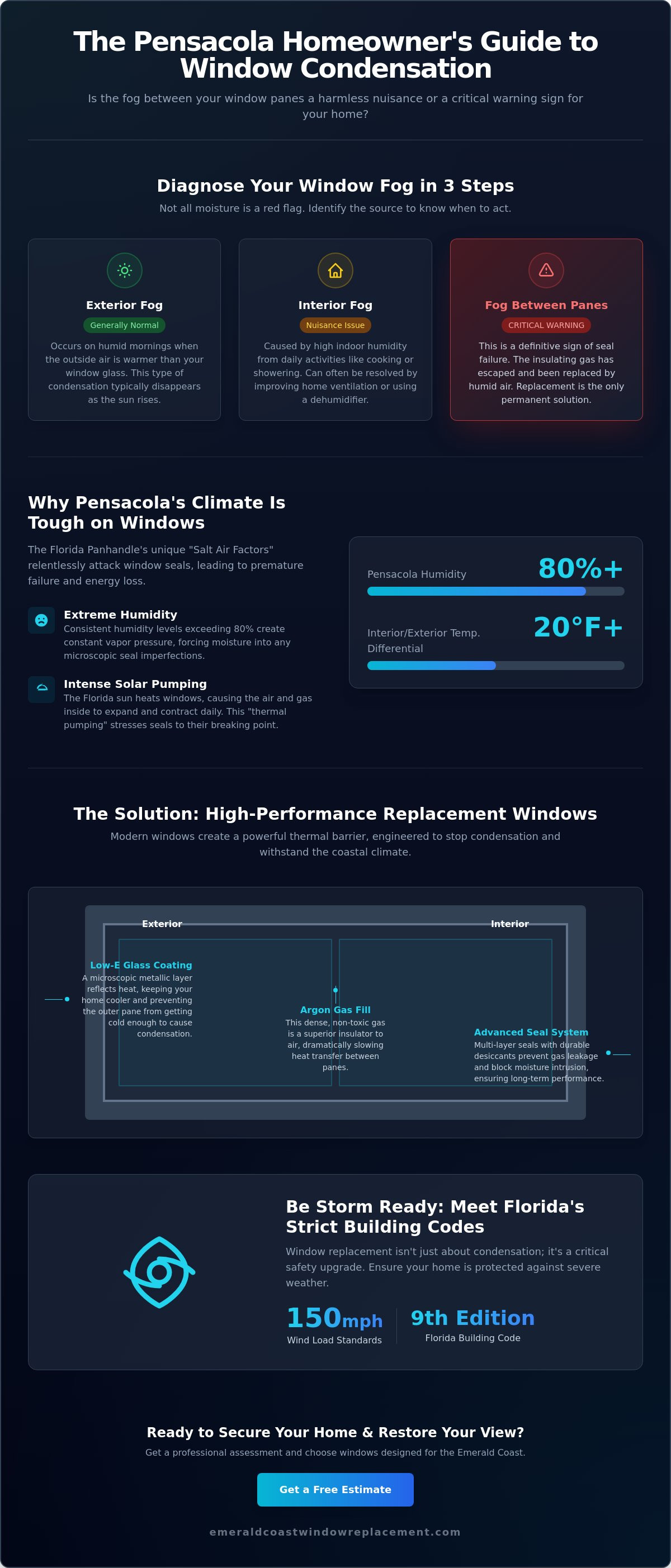
Not all moisture requires an immediate window replacement for condensation Pensacola, but you need to know how to spot the danger signs. Distinguishing between a temporary weather event and a chronic structural failure will save you a lot of stress. You can generally categorize what you see into three groups:
Exterior Fogging: This is usually normal. It happens on humid mornings when the glass is colder than the dew point outside. It typically disappears as the sun warms the air and the glass temperature rises.
Interior Fogging: This is often a "nuisance" issue caused by daily life. It occurs when you're cooking, showering, or even just breathing in a tightly sealed room. Improving your home's ventilation or using a dehumidifier usually solves this.
Between-Pane Moisture: This is a critical warning sign. If you see fog, streaks, or water droplets trapped between the layers of glass, your window's factory seal has perished.
Once those factory seals break, the insulating gas escapes and your window loses its ability to protect your home. This is why investing in energy-efficient windows is so vital for our region. Modern units are specifically engineered to withstand the intense thermal pumping caused by the Florida sun. These high-performance systems ensure your home stays dry, your view stays clear, and your cooling bills stay manageable. Don't ignore the fog; it's a clear indicator that your windows are no longer doing their job.
Inside vs. Outside vs. Between Panes: The Diagnostic Framework
Determining whether you need a window replacement for condensation Pensacola starts with a simple "swipe test." Reach out and run your finger across the foggy area. If the moisture smudges, the problem is either on the interior or exterior surface of the glass. However, if the fog remains unreachable behind the glass, your window has suffered a permanent seal failure. This diagnostic distinction is vital because while surface moisture often relates to humidity habits, internal fogging means your window's insulating properties have vanished. When the factory seal breaks, the inert Argon gas that blocks heat transfer leaks out, replaced by humid Florida air that eventually clouds your view.
Ignoring these signs often leads to more expensive structural repairs later. If you've noticed multiple windows failing, it's wise to begin budgeting by reviewing a window replacement cost Gulf Breeze guide to understand local pricing for high-performance units. Identifying the issue early allows you to plan for an upgrade before the damage spreads to your home's framing.
Identifying Blown Seals and Failed Desiccants
Modern windows rely on a spacer bar located between the panes. This bar contains desiccant beads designed to absorb tiny amounts of moisture that might enter the unit over time. In our intense coastal heat, the constant expansion and contraction of the glass eventually overwhelms these beads. Once they reach their saturation point, you'll see a permanent "silica haze." This is a white, cloudy residue left behind when moisture dries inside the unit. Attempting to "reseal" or "fix" a blown unit is rarely a long-term solution. For Pensacola homeowners, a full replacement is the only way to restore the thermal barrier and ensure your home remains protected against the elements.
The Hidden Danger of Pooling Water on Sills
The moisture you see on the glass is only part of the problem. Chronic condensation eventually drips down, pooling in the window tracks and seeping into the wall cavity. This creates a perfect breeding ground for the dangers of household mold, which can compromise your indoor air quality long before you smell it. In many of Pensacola's historic or established neighborhoods, wood-framed windows are particularly vulnerable to "hidden rot." This softened wood is a beacon for local pests, specifically Formosan termites, which thrive in moist environments. Replacing failing units with high-quality vinyl windows eliminates these moisture traps and removes the invitation for wood-destroying organisms. If you're concerned about the state of your current frames, you can request a professional assessment to see if your home's structural integrity is at risk.
Why Pensacola’s Coastal Climate Accelerates Window Failure
While we've discussed how to spot the signs of failure, it's essential to understand why our local environment is so aggressive toward your home's glass. Living on the Gulf Coast means your windows are under constant siege from factors that inland homeowners never face. A window replacement for condensation Pensacola often becomes necessary years earlier than the national average because our salt-laden air and intense solar radiation work together to dismantle even high-quality seals. It isn't just a matter of age; it's a matter of environmental stress.
In historic neighborhoods like North Hill or East Hill, many homes still feature original single-pane windows. These units offer almost zero thermal resistance, making them a magnet for condensation. As Cornell University explains, the thermal quality of your window is a primary factor in preventing moisture buildup. Upgrading to modern hurricane windows does more than protect against debris; it creates a pressurized, airtight seal that resists the extreme atmospheric changes common in Escambia County.
Thermal Pumping and Solar Heat Gain
The direct afternoon sun in Florida is a powerful force. When solar energy hits a double-pane window, the air or gas trapped between the glass expands rapidly. As temperatures drop at night, that air contracts. This daily cycle, known as thermal pumping, acts like a slow-motion bellows, eventually rupturing the primary seal and allowing humid air to seep in. A south-facing window in Pensacola may fail 5 years sooner than a north-facing one simply because of this relentless solar stress. Without high-performance spacers to absorb this movement, the glass will eventually lose its insulating power.
The Impact of Salt Spray on Seal Integrity
Salt crystals are abrasive and hygroscopic, meaning they attract even more moisture. When salt spray hits your windows, microscopic crystals can lodge in the tiny micro-cracks of a degrading seal, physically prying the material away from the glass. This is why we recommend vinyl windows for coastal durability. Unlike metal frames that corrode and expand, high-quality vinyl remains stable and resists the pitting caused by salt air. Pairing these frames with high-performance spacers ensures your window replacement for condensation Pensacola stands up to the corrosive environment of our coastal zone, keeping your home's structural integrity intact for the long term.
Choosing the Right Replacements to Eliminate Condensation
Selecting a window replacement for condensation Pensacola requires more than just picking a pretty frame; you need to specify a glass package designed for the Gulf Coast. High-performance windows rely on a combination of advanced coatings and insulating gases to keep the glass surface temperature stable. When the interior pane stays warm, moisture in your home's air cannot reach its dew point on the glass, effectively stopping fogging before it starts. This is why window option specialists emphasize U-factors and Solar Heat Gain Coefficients specifically tuned for Climate Zone 1.
The seal system is just as critical as the glass itself. Traditional metal spacers often create "cold spots" around the perimeter of the window, leading to a ring of condensation even on high-quality units. We recommend "Warm Edge" spacers made of non-metallic materials. These spacers expand and contract along with the glass, maintaining the integrity of the Argon or Krypton gas fills that provide your home's primary thermal defense. These dense gases are far more effective than plain air at blocking heat transfer, ensuring your air conditioner doesn't have to work overtime during a Florida heatwave.
The Role of Low-E Coatings in Surface Temperature
Low-Emissivity (Low-E) glass is a standard requirement for any modern Pensacola home. This microscopic, metallic coating acts as a thermal mirror, reflecting heat back to its source. In the summer, it keeps the sun's scorching energy outside. In the winter, it holds your expensive heated air indoors. By keeping the interior glass temperature closer to your room's ambient temperature, Low-E coatings prevent the "chilled surface" effect that triggers condensation. As a secondary benefit, these coatings block up to 95 percent of UV rays, protecting your furniture and flooring from the intense Florida sun.
Double vs. Triple Pane: What Does Pensacola Really Need?
For most Pensacola homeowners, double-pane high-performance windows offer the best return on investment. They provide excellent humidity control and energy savings of $180 to $260 per year when replacing single-pane units. However, triple-pane windows are becoming a popular choice for residents near NAS Pensacola or the downtown corridor. The extra layer of glass and second gas-filled chamber offer superior sound dampening against jet noise and traffic. If you choose triple-pane units, ensure your home's framing can support the additional weight, as these units are significantly heavier than standard replacements. To find the perfect balance of protection and value for your specific property, you can request a quote for high-performance windows today.
Finding Vetted Pensacola Contractors for Your Replacement
Selecting high-performance glass is only half the battle. The long-term success of your window replacement for condensation Pensacola depends entirely on the hands that install it. Our coastal environment is unforgiving; a minor error in sealing or leveling can lead to premature seal failure within just a few years. While "storm chasers" often flood Escambia County after a hurricane, these out-of-state crews rarely understand the nuances of the 9th Edition of the Florida Building Code or the specific wind load requirements for our tidal waters. Choosing a local specialist ensures your investment is protected by someone who understands our climate and stands by their work long after the project is complete.
Why Installation Quality Dictates Window Longevity
Even the most expensive hurricane-impact window will fail if the frame isn't leveled and shimmed with absolute precision. When a window sits unevenly, the weight of the glass puts constant, uneven pressure on the primary seal. Over time, this stress causes the seal to rupture, leading to the trapped moisture and "silica haze" we discussed earlier. A blown seal is often the result of poor initial installation rather than a defect in the window itself. Professional installers in our region must also use high-grade coastal caulking and flashing. These materials are specifically formulated to resist the intense UV radiation and salt spray that cause standard sealants to crack and peel, creating a secondary defense against moisture intrusion into your wall cavities.
The Stress-Free Way to Get Your Estimate
We know that the process of finding a reliable contractor can be overwhelming, especially when you're dealing with the urgency of failing windows. Emerald Coast Window Authority serves as a dedicated partner for homeowners, connecting you with vetted, licensed professionals who specialize in coastal installations. We prioritize transparency and craftsmanship over quick transactions, ensuring that every referral meets our high standards for reliability and technical expertise. You won't have to worry about high-pressure sales tactics or confusing jargon. Instead, you'll receive a clear, educational assessment of your home's needs.
Before you sign a contract, use this checklist to evaluate your local window estimates:
Verify Local Licensing: Ensure the contractor is licensed to work in Pensacola and understands the ASCE 7-22 wind load standards.
Check Glass Specifications: Confirm the quote includes Low-E coatings and Argon gas fills suited for Climate Zone 1.
Review the Warranty: Ask if the labor is covered separately from the manufacturer's glass seal warranty.
Inquire About Permits: A permit is required for most window replacements in Florida; your contractor should handle this process.
Protecting your home from the Panhandle's humidity shouldn't be a high-stakes gamble. Get your free, no-pressure window estimate in Pensacola today. By choosing a partner who values structural resilience and aesthetic beauty, you can ensure your home remains a safe, clear-view sanctuary for years to come.
Secure Your Home's View and Integrity Today
Foggy windows in the Florida Panhandle are more than a nuisance; they're a clear signal that your home's first line of defense has been compromised. We've explored how our unique salt air environment and intense solar heat accelerate seal failure, leading to trapped moisture and potential structural damage. Choosing a window replacement for condensation Pensacola allows you to upgrade to high-performance vinyl units that meet the 2026 wind load standards while eliminating the threat of mold and hidden rot. This isn't just a repair; it's a strategic investment in your property's resilience.
You don't have to navigate these technical requirements alone. Our vetted network of licensed Florida contractors provides expert guidance on hurricane-impact ratings and energy-efficient glass packages tailored for the Gulf Coast. We take a no-pressure, consultative approach to ensure your home remains safe, dry, and beautiful. Our goal is to connect you with professionals who value craftsmanship as much as you value your sanctuary.
Investing in quality craftsmanship today ensures your coastal residence stands strong against the elements for decades to come. Your home deserves the protection of a clear, high-performance view.
Frequently Asked Questions
Is condensation on the outside of my windows a bad sign?
Condensation on the exterior of your glass is actually a sign that your windows are performing correctly. It occurs when the glass surface is cooler than the outdoor dew point, which is common on humid Pensacola mornings. This indicates your home's interior cooling is staying inside rather than leaking through the pane. As the sun warms the glass, this moisture will naturally evaporate without damaging your home.
Can I fix the fog between my window panes without replacing the whole window?
No permanent fix exists for moisture trapped between the panes other than replacing the unit. Once the factory seal is breached, the insulating gas escapes and the internal desiccant beads become saturated. While some companies offer "defogging" services, these do not restore the window's original thermal performance or structural integrity. A window replacement for condensation Pensacola is the only way to ensure your home remains energy-efficient and protected.
How much does it cost to replace windows due to condensation in Pensacola?
The cost for window replacement depends on several factors, including the frame material, the number of panes, and specific hurricane-impact ratings required for your neighborhood. In Escambia County, homeowners should also consider the updated Florida Building Code requirements which may influence the type of glass needed. We recommend requesting a detailed estimate from a vetted local professional to get a clear picture of the investment required for your specific property.
Do energy-efficient windows really stop interior fogging?
Energy-efficient windows are highly effective at reducing interior fogging because they keep the inside glass temperature above the dew point. Features like Low-E coatings and Argon gas fills act as a thermal barrier, preventing your home's humid air from cooling down enough to turn into liquid on the glass. This technology significantly reduces the risk of moisture pooling on your sills and causing damage to your frames.
Does the Florida building code require impact windows for replacements?
In most parts of Pensacola, the Florida Building Code requires either impact-rated windows or an approved shutter system for all window replacements. The 9th Edition of the code specifically adopts ASCE 7-22 standards, requiring windows to withstand wind speeds of 140 to 150 mph. Because our region is a designated Wind-Borne Debris Region, installing hurricane-impact windows is often the most efficient way to meet these safety mandates and qualify for insurance discounts.
How long do window seals typically last in the Florida Panhandle?
Window seals in the Florida Panhandle often have a shorter lifespan than those in milder climates due to intense solar radiation and salt air corrosion. The constant expansion and contraction caused by the Florida sun, known as thermal pumping, puts immense stress on the sealant material. While high-quality vinyl windows with high-performance spacers are built for durability, you may notice seal failure in older or lower-grade units much sooner than the national average.
What happens if I ignore the condensation between my window panes?
Ignoring trapped moisture can lead to serious structural issues, including wood rot in your wall cavities and the growth of household mold. Over time, the clear view you enjoy will be replaced by a permanent white haze as minerals from the evaporated water etch into the glass. Additionally, your cooling system will work harder to compensate for the lost insulating gas, leading to a steady increase in your monthly utility costs.
Will new windows lower my Pensacola energy bills?
Upgrading to high-performance units can result in significant savings on your cooling costs during our long summers. Homeowners who switch to ENERGY STAR certified windows typically save between $180 and $260 annually on their energy bills. Beyond the monthly savings, you may also recoup 65 to 75 percent of the project's cost through increased home resale value, making it a sound long-term investment in your coastal property.


Comments